Well done Sir
Behold he comes riding on the clouds ☁️
The Three Sisters
The Three Sisters
Exuma Folklore
Researcher ✔️
Michael Elijah Muhammad Clare
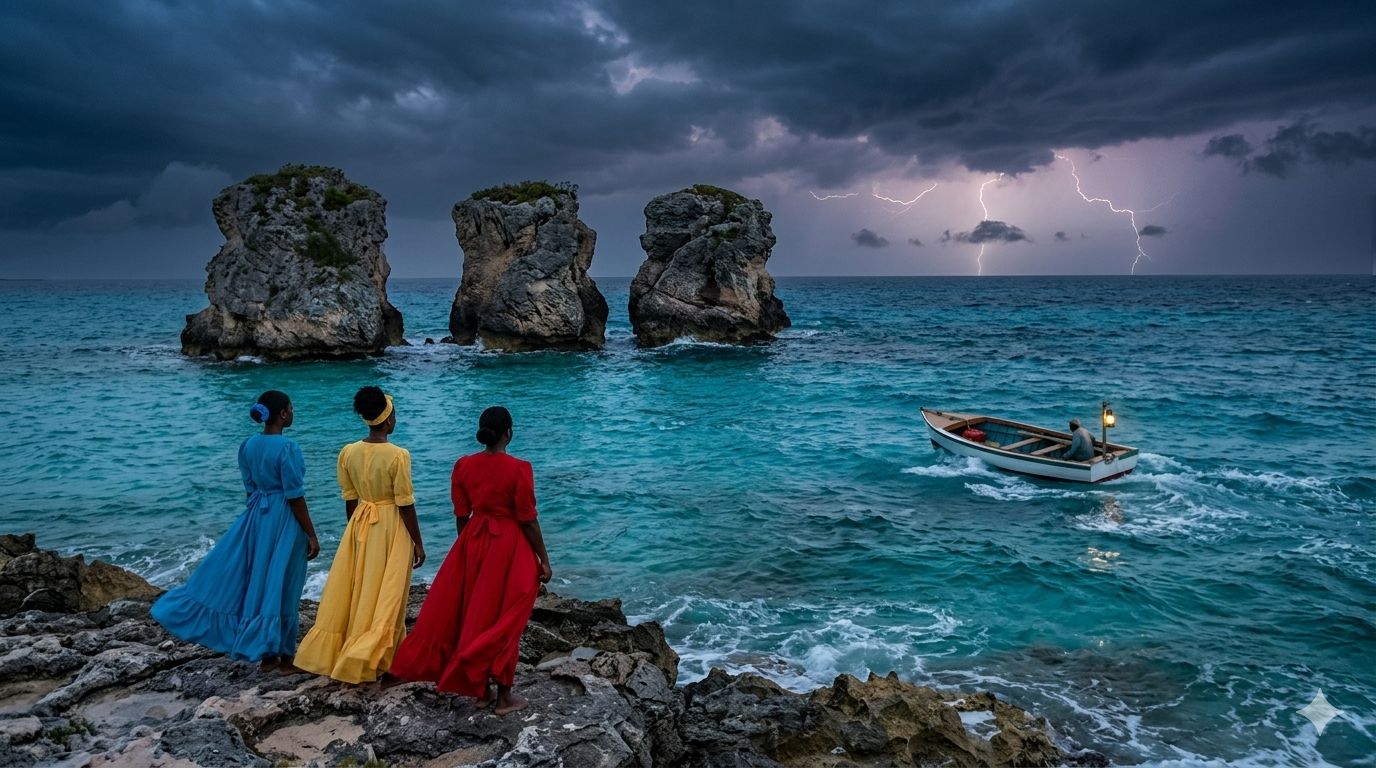
In the islands of Exuma, there is an old piece of Bahamian folklore told quietly among fishermen and elders about a strange rock formation known as the Three Sisters.
Just off the shoreline stand three tall limestone pillars rising from the water, side by side. From a distance they almost look like three women standing together, gazing out toward the open sea.
Island people say those stones were not always stones.
Long ago, they were three sisters.
Many generations ago, when the Exuma islands were far more isolated and life depended heavily on the sea, three sisters lived in a small settlement along the shoreline. The young women were known throughout the area for their beauty, but even more for the deep love they had for one another.
They did everything together.
They fished in the shallows, gathered fruit from the bush, walked the beaches at sunset, and each evening they would wait along the shore for the fishing boats to return home.
One day, a powerful storm began building far out across the ocean.
Dark clouds rolled in from the east. The wind began to howl through the palms and across the rocky coastline. The fishermen who had gone out earlier that morning had not returned, and the sea was beginning to turn wild.
As night fell, the three sisters climbed onto the rocky shoreline and stared out into the black water, searching the horizon for the lantern lights of the fishing boats.
The storm only grew worse.
Waves crashed violently against the rocks. Thunder shook the sky. Lightning flashed across the sea, turning night into daylight for brief moments before darkness swallowed everything again.
But the sisters refused to leave.
They stood on the rocks through the entire night, praying and calling into the wind for their loved ones to return safely from the raging sea.
According to the old story, the storm never answered them.
The wind roared so fiercely that by the time morning came, the sisters were still standing there in the exact same place, staring out across the ocean.
When the villagers finally came down to the shoreline after the storm had passed, the three women were nowhere to be found.
Instead, standing where they had been the night before, were three tall stone pillars rising from the water.
Three silent figures.
Facing the sea.
Many elders in the Exumas say the rocks are a reminder of loyalty, love, and the dangers of the ocean that has always shaped life in the islands.
Fishermen passing the formation sometimes nod toward the stones or quietly mention the story, especially when the weather begins to turn rough.
Some even say that during heavy storms, when the wind whistles around the rocks and the waves crash against them, it almost sounds like voices calling out across the water.
Whether people believe the legend or not, the Three Sisters still stand along the Exuma coastline today.
Watching the sea.
Just as the story says they always have.
Caribbean Firestorm
Caribbean Firestorm
By: Michael Elijah Muhammad Clare
The Day CARICOM Took On Washington
The Caribbean Sea had always looked peaceful from the outside.
Crystal water. Cruise ships drifting across the horizon. Tourists drinking rum beneath palm trees while steel drums echoed through the streets of Nassau.
But history has a way of hiding storms beneath calm water.
And in this moment of global chaos, the Caribbean was no longer just watching the world burn.
It was stepping into the fire.
The spark came during one of the most dangerous geopolitical moments of the century.
War had erupted in the Middle East. Iran was collapsing under relentless military pressure, its economy shattered and its military command structure weakening by the day. Oil markets were convulsing. Global shipping lanes were on edge.
And in the middle of it all, the United States under President Donald Trump had launched a series of aggressive moves across the world stage.
The capture of the Venezuelan president.
A tightening oil blockade on Cuba.
And military pressure stretching from the Persian Gulf to the Caribbean basin.
To many leaders in the Caribbean, it felt like the region was once again becoming a chessboard for global power.
That was when the Caribbean Community made its move.
Phase 1 — The Caribbean Rebellion
The first blow came from the conference halls of the Caribbean.
At an emergency summit, the leaders of CARICOM gathered in Nassau for what would become one of the most intense diplomatic meetings in the organization’s history.
Behind closed doors, the discussion was blunt.
The war with Iran was escalating.
The Venezuelan leadership had been captured.
Cuba was facing energy collapse due to the oil blockade.
And Caribbean governments were increasingly being pressured to fall in line with Washington.
When the summit ended, the Caribbean leaders walked out together and delivered a statement that stunned Washington.
They publicly condemned the Trump administration’s military escalation with Iran.
They condemned the seizure of the Venezuelan president.
They condemned the oil blockade on Cuba.
And they warned that the Caribbean would not support policies that destabilized the region.
For the first time in decades, the Caribbean bloc openly challenged Washington on the world stage.
But the most surprising voice came from Nassau.
Phase 2 — Nassau Speaks
Inside the capital of the Bahamas, political tensions were already rising.
For months, the Bahamian government had been openly rebuking Washington’s aggressive foreign policies. Officials in Nassau had repeatedly criticized the blockade of Cuba and the growing military presence across the Caribbean.
At the same time, the Bahamas had quietly been strengthening economic partnerships with China.
Chinese infrastructure investments had flowed into the country over the years. Ports, construction projects, tourism developments, and financing agreements had tied the Bahamian economy more closely with Beijing.
Now that relationship suddenly carried geopolitical weight.
When Bahamian officials joined CARICOM’s condemnation of the United States over the Iran war and Caribbean policy, it sent a message far beyond the islands.
Washington was no longer dealing with quiet diplomatic complaints.
The Caribbean was pushing back.
Phase 3 — The First Economic Shots
CARICOM governments began coordinating their response.
Step by step.
First came the ports.
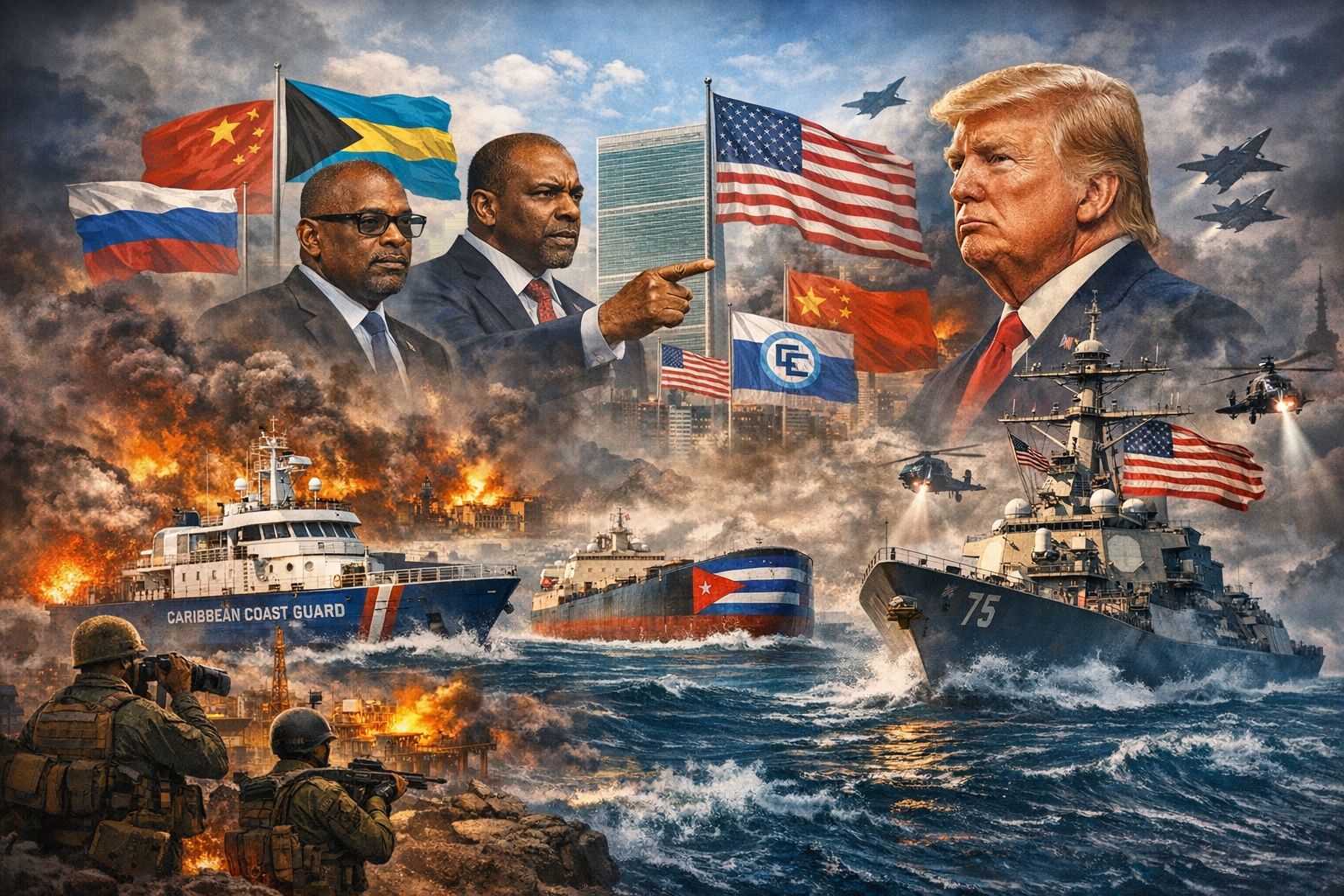
Several Caribbean nations announced restrictions on U.S. military docking privileges. American naval vessels that once moved easily through the region suddenly faced bureaucratic barriers and limited refueling access.
Then came the skies.
Caribbean governments began tightening rules on U.S. military overflights. Cargo aircraft supporting operations across Latin America and the Atlantic were forced to reroute around the island chain.
Next came the oil corridor.
Caribbean leaders announced humanitarian fuel convoys that would move through regional ports and continue toward Cuba despite the American blockade.
To Washington, it was sanctions evasion.
To the Caribbean, it was survival.
Phase 4 — Washington Responds
The response from the Trump administration came fast.
Trade pressure was the first weapon.
New tariffs targeted Caribbean exports heading into American markets. Rum, seafood, agricultural products, and financial services suddenly faced increased restrictions.
Tourism agreements came under review.
Airline partnerships were quietly threatened.
Then immigration pressure followed.
Thousands of Caribbean citizens working in the United States under temporary programs suddenly faced uncertainty as Washington hinted at new visa restrictions.
But the most visible response came from the sea.
American naval forces surged across the Caribbean basin.
Destroyers patrolled near the Windward Passage.
Surveillance aircraft circled above the shipping lanes between Cuba and Haiti.
Coast Guard vessels began inspecting cargo ships suspected of violating sanctions.
The Caribbean had challenged the United States.
Now the world was watching to see how far it would go.
Phase 5 — Global Powers Enter the Scene
As tensions escalated, the crisis expanded far beyond the Caribbean.
China publicly praised Caribbean leaders for defending regional sovereignty and announced expanded economic cooperation with several island nations.
Russian diplomats condemned the blockade on Cuba.
Middle Eastern nations distracted by the collapsing situation in Iran began watching the Western Hemisphere with renewed interest.
At the United Nations, Caribbean diplomats delivered speeches accusing Washington of turning the Caribbean basin into a militarized zone.
Suddenly the conflict was no longer about one region.
It was part of a global power struggle.
Phase 6 — The Caribbean Sea Crisis
The moment that nearly pushed the situation over the edge came late one night.
A tanker carrying humanitarian fuel was escorted by a Caribbean coast guard vessel through the Windward Passage on its way to Cuba.
An American destroyer intercepted it.
Floodlights lit up the dark water.
Helicopters lifted into the sky.
Radar systems locked onto both ships.
Across the Caribbean Sea, military analysts watched in silence as the standoff unfolded.
For thirty seconds, two vessels representing two sides of a growing geopolitical crisis faced each other in the open ocean.
Thirty seconds where a single mistake could have ignited a confrontation that would shake the entire Western Hemisphere.
The Caribbean escort ship slowly turned away.
The tanker followed.
War was avoided.
But the message had already been sent.
Phase 7 — A New Caribbean Reality
Behind the scenes, diplomats scrambled to defuse the situation.
The truth was obvious to everyone involved.
The Caribbean could never defeat the United States militarily.
But the islands had discovered something powerful.
Unity.
Diplomatic pressure.
And the ability to turn a regional conflict into a global one.
Negotiations eventually began.
But the Caribbean had already changed the balance of power in the region.
Small island nations had taken a stand during one of the most chaotic moments in modern history.
And the calm waters of the Caribbean would never again look quite as peaceful as they once did.
Page Reply:
This post is not a prediction. It is a thought experiment about the fragile reality of the world we are living in right now.
Across the planet, tensions are rising in ways we have not seen in generations. Nations are challenging each other, economies are being weaponized, alliances are shifting, and conflicts are spreading across regions that once seemed far removed from global confrontation.
When you step back and look at the bigger picture, it becomes clear how delicate the balance of our modern world truly is. The systems that keep civilization running trade, diplomacy, cooperation, and stability are far more fragile than many people realize.
One wrong decision by a government.
One miscalculation by a military commander.
One moment where pride replaces wisdom.
History has shown again and again that entire eras can change in a matter of days.
What makes this moment even more dangerous is that humanity now holds the power to destroy itself on a scale never before possible. The technology that powers our progress also carries the potential to wipe out generations and leave scars on the Earth that could last centuries.
That reality should force all of us, leaders and citizens alike, to stop and ask a very serious question.
What exactly are we doing?
Are we building a future for the next generations of human beings, or are we walking step by step toward a world where conflict becomes the default answer to every disagreement?
Every nation believes it is defending its interests. Every government believes its position is justified. But when every side believes it is right and refuses to step back, history has a way of pushing humanity toward outcomes that nobody truly wanted.
This is why moments like the one we are living through should not just be viewed as political stories or headlines.
They are warnings.
Warnings that remind us how quickly stability can disappear, how quickly alliances can fracture, and how quickly ordinary people around the world can find themselves living inside events they never imagined.
Human civilization has come incredibly far. We have built cities, crossed oceans, reached space, and unlocked technologies that previous generations would have considered miracles.
But progress does not protect us from our own decisions.
In the end, the future of this planet is not decided by weapons or governments alone. It is shaped by whether humanity learns to value survival, cooperation, and wisdom more than pride, power, and domination.
Because if we fail to learn that lesson, the consequences will not belong to one country or one region.
They will belong to all of us.
And by then, it may already be too late. I’m just saying we should all just stop and think about it…
Your time is now, stop waiting…
I’d trust God’s word over man’s word any day…
She Was Left to Drown in the Rising Tide Yamacraw
She Was Left to Drown in the Rising Tide Yamacraw
Researcher ✔️
Michael Elijah Muhammad Clare
During the middle of slavery in the Bahamas, particularly in Nassau, there was a female slave named Hannah. According to my great-grandmother’s tale, this woman was a seer a person who had the ability to see into the future and communicate with the ancient spirits of the ancestors.
This woman is said to be a part of my ancestry. My grandmother said that her own mother told her this story many years ago.
The story says that this young slave woman, nineteen years old, was named Hannah by her slave master. She was seen as unbreakable by the overseers in South Carolina before she was sold and shipped to the Bahamas with the Loyalists.
Other slaves who had been on plantations with Hannah told stories of her having the power to shape-shift, raise the dead, and speak to the ancestors, conjuring a blue fire in the night outside the knowledge of the overseers and masters. Yet she remained stubborn and unbreakable in spirit.
By the time she was sold to new masters, she had already created a reputation for herself among other slaves and southern plantation owners. Many people believed the rumors about her, and some said that nobody wanted to own her.
As for the shape-shifting abilities my grandmother spoke of, she said Hannah could turn into almost anything, even another person she knew.
I once asked my grandmother why Hannah did not simply turn into a lion and kill her oppressors. My grandmother replied that Hannah was bound by ancient laws. According to her, the ancestors who came from the skies had decided which days of the year based on the rotation of the Earth around the sun this gift would be available to their descendants on Earth.
My grandmother said Hannah remained within the trenches of slavery because she could not free her people. According to her, many of them had nowhere else to go and did not believe escape was possible.
By the time Hannah was shipped to the Bahamas on a ship with the Loyalists, she had endured so many beatings from her overseers that no human being was known to survive such punishment beatings severe enough to kill a horse.
But my grandmother said Hannah was special, and the lashes could never penetrate her soul.
In 1814, my grandmother said that Hannah’s owners finally heard the rumors about her. By that time she was thirty-six years old.
They confronted her with overwhelming brutality, trying to force a confession from her that she was a witch. A local priest was also in attendance.
That day, from morning until afternoon, the master’s overseer beat Hannah while she was strapped to a silk cotton tree in Fox Hill, near where the roundabout stands today in Nassau. The overseer expected her to die from the beating.
But Hannah did not die.
Her bloody body was left hanging on the whipping tree until the next morning.
The following week Hannah was still too weak to return to work. Her master, disgusted and convinced by the rumors that she was a witch, handed Hannah over to his cousins in the area.
They beat her again and treated her with cruelty.
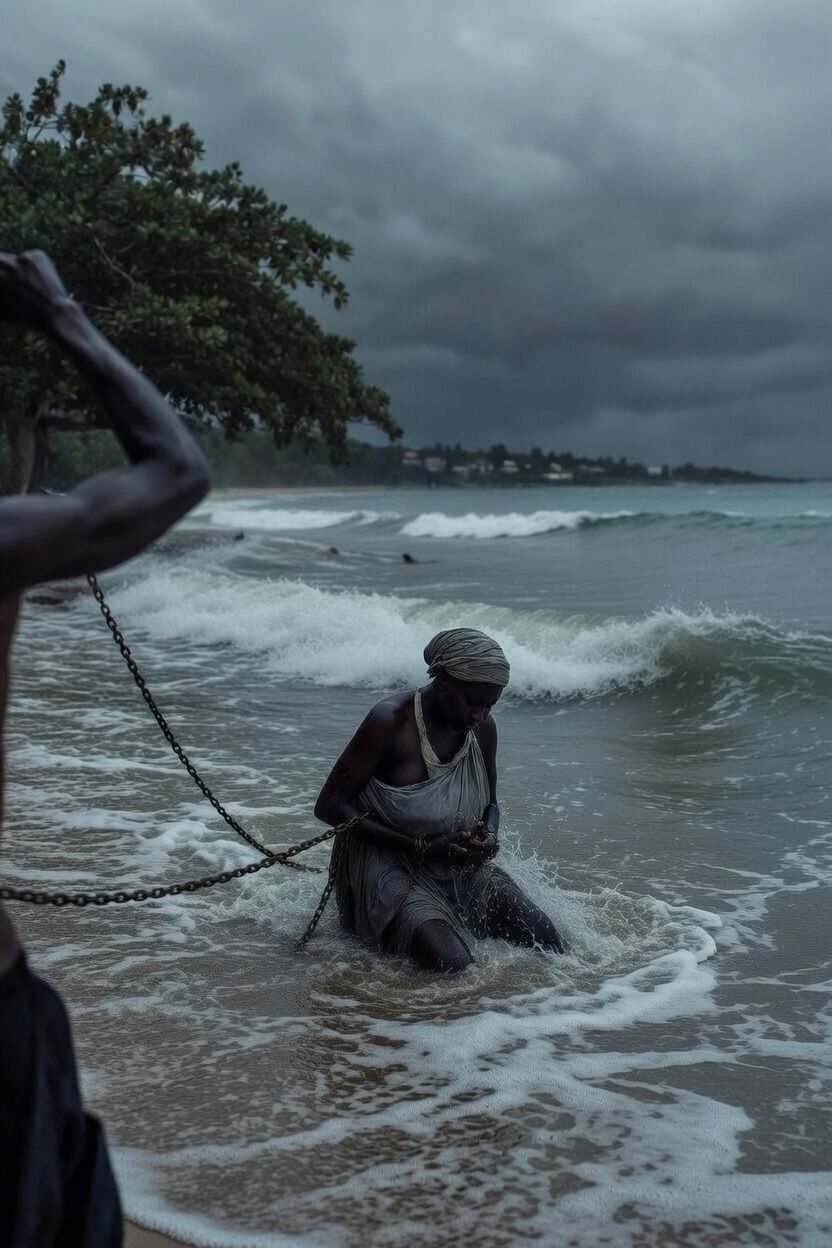
Finally, they chained Hannah’s dying body in the waters off Yamacraw Shores at low tide.
When the tide came in, Hannah drowned.
But her body was never found.
Many slaves believed Hannah turned into a fish and swam away into the deep sea.
No trace of her was ever seen again, except for the shattered gray dress Hannah had worn the day before.
No blood.
No body.
No clues to what truly happened to Hannah.
To this very day, Yamacraw Shores is still considered a spooky place by many people, especially during the month of May, though no one seems to know exactly why.
The elders today still say that a blue fire can sometimes be seen at night if you repeatedly say the name Hannah around this month.
Personally I’ve never tried it, nor will I ever because I don’t know if she’s mad for what happened to her in this world.
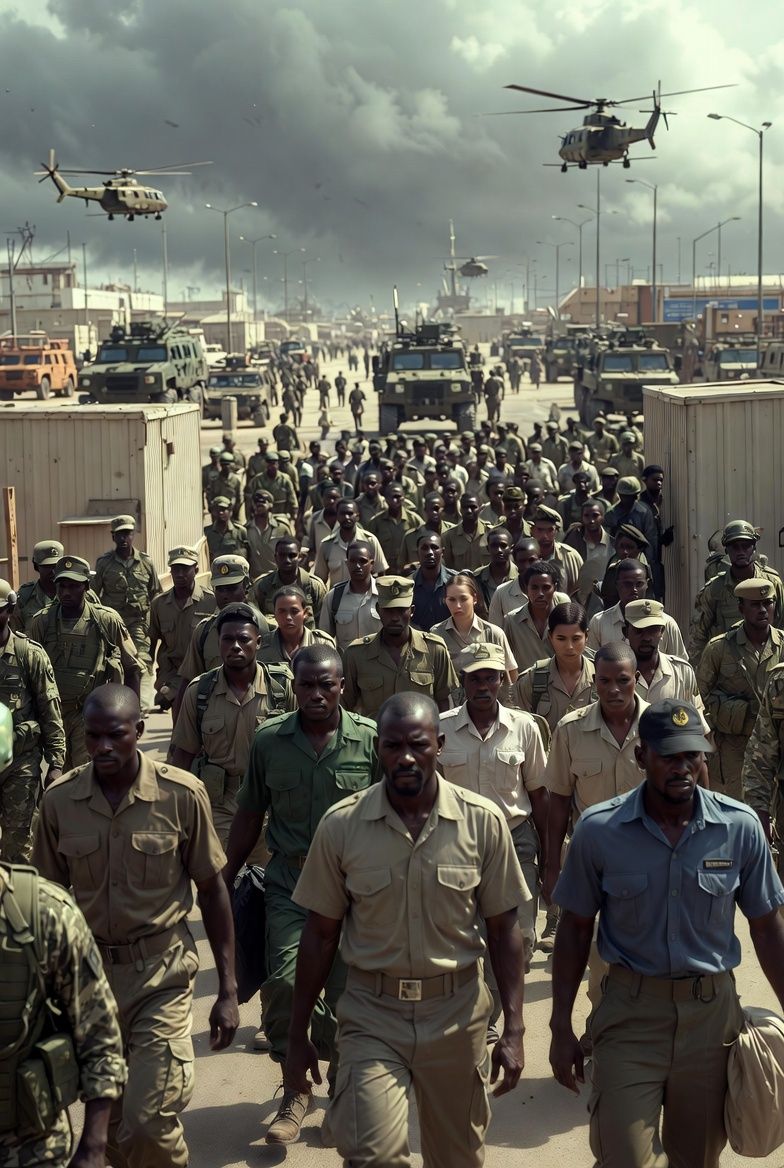
If the Iran war spills into world war III who would be drafted first
If the Iran war spills into world war III who would be drafted first
By: Michael Elijah Muhammad Clare
Title: What Could Happen in the Bahamas and the West if World War III Breaks Out
If the unthinkable happens and World War III ignites, life in the Bahamas and across Western nations could change overnight. While our islands are far from battlefields, global conflicts ripple everywhere, and the realities of modern war could touch us in ways few imagine.
Military Drafts: Who Could Be Called
In the United States, men between 18 and 25 are currently registered for potential conscription, though a wartime draft could expand to 18–45. Women may be included if emergency laws change. Meanwhile, in the Bahamas, there is no existing draft; our Royal Bahamas Defence Force is entirely volunteer-based. In a global conflict, the government could pass emergency laws to call men (and possibly women) aged 18–40 into service.
Across Europe, the picture varies. Countries like Finland, Greece, and Austria maintain active conscription with age ranges from 18–45, while most Western European nations like Germany, France, and the UK would likely reinstate drafts between 18–40, potentially extending to 50 in extreme circumstances. Some countries bordering conflict zones, such as Estonia, Latvia, and Lithuania, have already strengthened their conscription systems, calling men 18–27 into service.
Drafting People with Disabilities
In major conflicts, people with disabilities may also be considered for military service, depending on the type and severity of the disability. Individuals with physical limitations that prevent combat roles, such as severe mobility impairments, amputations without prosthetics, or chronic heart and lung conditions, would typically be exempt. Those with mild or manageable conditions, including partial hearing or vision loss, minor limb limitations, or certain chronic illnesses that do not prevent basic duties, could be drafted into support roles such as logistics, communications, medical assistance, or administrative work. Psychological evaluations would also determine eligibility, and individuals with severe mental health conditions would generally be exempt.
Daily Life Changes
For Bahamian’s, a global war would not just be about potential drafts. Expect:
* Increased military presence: More patrols and checkpoints to protect ports and key infrastructure.
* Supply chain disruptions: Imported goods could become scarce; food, fuel, and medical supplies could be rationed.
* Economic impact: Tourism may drop dramatically, affecting jobs and the price of living.
* Communication monitoring: Governments may regulate the internet and media to prevent misinformation and maintain security.
Global Reality Check
Even countries far from the front lines would feel the consequences. Energy prices, shipping routes, and financial markets would fluctuate wildly. NATO countries have plans to mobilize millions if necessary, and some nations have expanded draft ranges to include men up to 60, showing just how serious governments take total war scenarios.
What Bahamian’s Can Do
* Stay informed about government updates and emergency instructions.
* Keep essential supplies for at least 2 weeks.
* Understand that drafts or voluntary enlistment may affect men aged 18–40 first.
* People with manageable disabilities may be called for support roles, while severe disabilities would likely exempt them.
* Focus on community safety, support networks, and practical skills.
While we hope such a war never happens, history shows that preparation is better than panic. Bahamian’s must be aware of global tensions and ready to adapt if the world slips into a conflict that could touch every corner of life, even our peaceful cays.
Do y’all want me to tell y’all another scary Bahamian Folklore story…
Do y’all want me to tell y’all another scary Bahamian Folklore story tonight?
This is based on a true story as well. So it will be late at night when I post it. But I suggest you sleep with your Bible next to you after hearing this event.
If not enough people want it I won’t share it…