
Caribbean Firestorm
Caribbean Firestorm
By: Michael Elijah Muhammad Clare
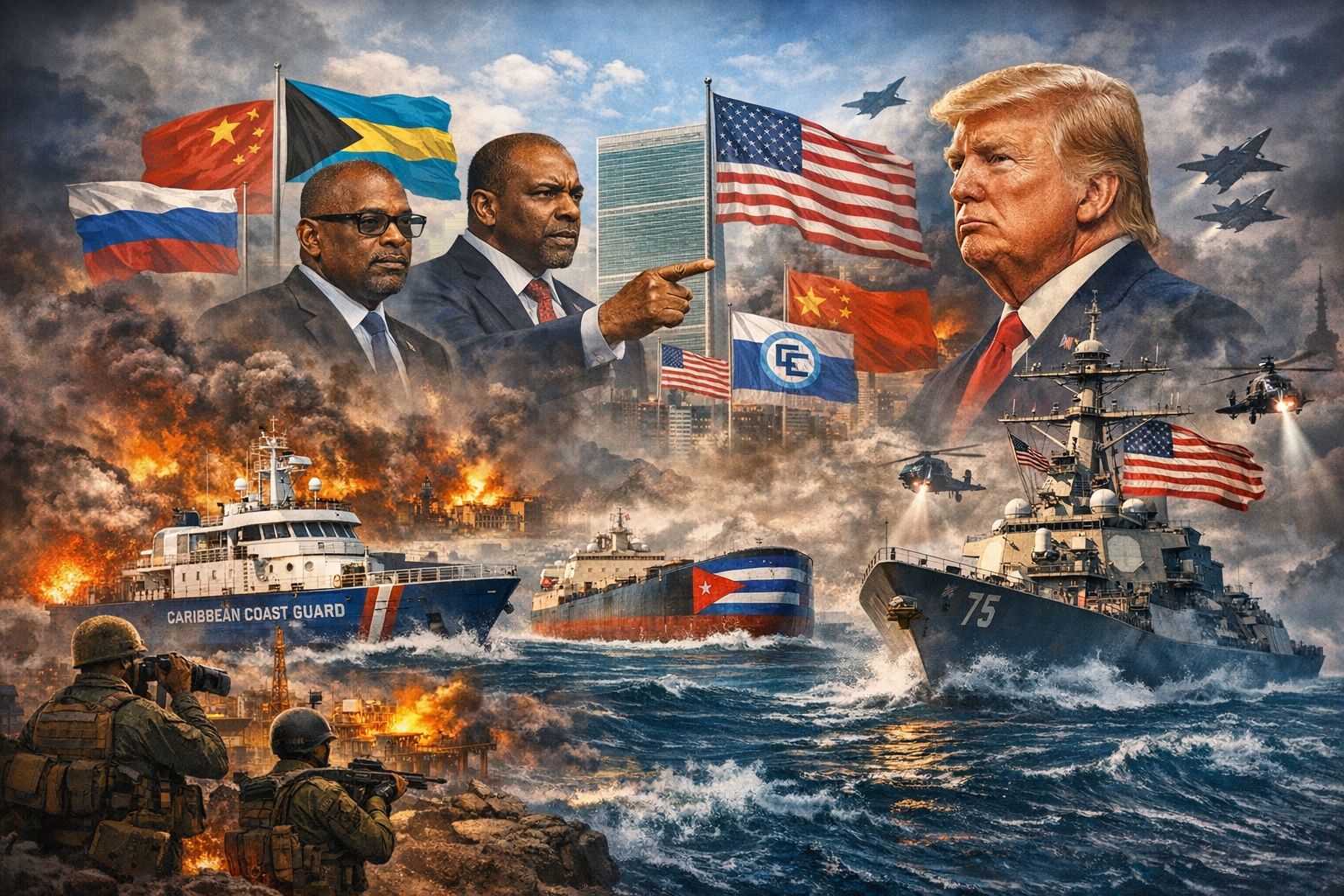
The Day CARICOM Took On Washington
The Caribbean Sea had always looked peaceful from the outside.
Crystal water. Cruise ships drifting across the horizon. Tourists drinking rum beneath palm trees while steel drums echoed through the streets of Nassau.
But history has a way of hiding storms beneath calm water.
And in this moment of global chaos, the Caribbean was no longer just watching the world burn.
It was stepping into the fire.
The spark came during one of the most dangerous geopolitical moments of the century.
War had erupted in the Middle East. Iran was collapsing under relentless military pressure, its economy shattered and its military command structure weakening by the day. Oil markets were convulsing. Global shipping lanes were on edge.
And in the middle of it all, the United States under President Donald Trump had launched a series of aggressive moves across the world stage.
The capture of the Venezuelan president.
A tightening oil blockade on Cuba.
And military pressure stretching from the Persian Gulf to the Caribbean basin.
To many leaders in the Caribbean, it felt like the region was once again becoming a chessboard for global power.
That was when the Caribbean Community made its move.
Phase 1 — The Caribbean Rebellion
The first blow came from the conference halls of the Caribbean.
At an emergency summit, the leaders of CARICOM gathered in Nassau for what would become one of the most intense diplomatic meetings in the organization’s history.
Behind closed doors, the discussion was blunt.
The war with Iran was escalating.
The Venezuelan leadership had been captured.
Cuba was facing energy collapse due to the oil blockade.
And Caribbean governments were increasingly being pressured to fall in line with Washington.
When the summit ended, the Caribbean leaders walked out together and delivered a statement that stunned Washington.
They publicly condemned the Trump administration’s military escalation with Iran.
They condemned the seizure of the Venezuelan president.
They condemned the oil blockade on Cuba.
And they warned that the Caribbean would not support policies that destabilized the region.
For the first time in decades, the Caribbean bloc openly challenged Washington on the world stage.
But the most surprising voice came from Nassau.
Phase 2 — Nassau Speaks
Inside the capital of the Bahamas, political tensions were already rising.
For months, the Bahamian government had been openly rebuking Washington’s aggressive foreign policies. Officials in Nassau had repeatedly criticized the blockade of Cuba and the growing military presence across the Caribbean.
At the same time, the Bahamas had quietly been strengthening economic partnerships with China.
Chinese infrastructure investments had flowed into the country over the years. Ports, construction projects, tourism developments, and financing agreements had tied the Bahamian economy more closely with Beijing.
Now that relationship suddenly carried geopolitical weight.
When Bahamian officials joined CARICOM’s condemnation of the United States over the Iran war and Caribbean policy, it sent a message far beyond the islands.
Washington was no longer dealing with quiet diplomatic complaints.
The Caribbean was pushing back.
Phase 3 — The First Economic Shots
CARICOM governments began coordinating their response.
Step by step.
First came the ports.
Several Caribbean nations announced restrictions on U.S. military docking privileges. American naval vessels that once moved easily through the region suddenly faced bureaucratic barriers and limited refueling access.
Then came the skies.
Caribbean governments began tightening rules on U.S. military overflights. Cargo aircraft supporting operations across Latin America and the Atlantic were forced to reroute around the island chain.
Next came the oil corridor.
Caribbean leaders announced humanitarian fuel convoys that would move through regional ports and continue toward Cuba despite the American blockade.
To Washington, it was sanctions evasion.
To the Caribbean, it was survival.
Phase 4 — Washington Responds
The response from the Trump administration came fast.
Trade pressure was the first weapon.
New tariffs targeted Caribbean exports heading into American markets. Rum, seafood, agricultural products, and financial services suddenly faced increased restrictions.
Tourism agreements came under review.
Airline partnerships were quietly threatened.
Then immigration pressure followed.
Thousands of Caribbean citizens working in the United States under temporary programs suddenly faced uncertainty as Washington hinted at new visa restrictions.
But the most visible response came from the sea.
American naval forces surged across the Caribbean basin.
Destroyers patrolled near the Windward Passage.
Surveillance aircraft circled above the shipping lanes between Cuba and Haiti.
Coast Guard vessels began inspecting cargo ships suspected of violating sanctions.
The Caribbean had challenged the United States.
Now the world was watching to see how far it would go.
Phase 5 — Global Powers Enter the Scene
As tensions escalated, the crisis expanded far beyond the Caribbean.
China publicly praised Caribbean leaders for defending regional sovereignty and announced expanded economic cooperation with several island nations.
Russian diplomats condemned the blockade on Cuba.
Middle Eastern nations distracted by the collapsing situation in Iran began watching the Western Hemisphere with renewed interest.
At the United Nations, Caribbean diplomats delivered speeches accusing Washington of turning the Caribbean basin into a militarized zone.
Suddenly the conflict was no longer about one region.
It was part of a global power struggle.
Phase 6 — The Caribbean Sea Crisis
The moment that nearly pushed the situation over the edge came late one night.
A tanker carrying humanitarian fuel was escorted by a Caribbean coast guard vessel through the Windward Passage on its way to Cuba.
An American destroyer intercepted it.
Floodlights lit up the dark water.
Helicopters lifted into the sky.
Radar systems locked onto both ships.
Across the Caribbean Sea, military analysts watched in silence as the standoff unfolded.
For thirty seconds, two vessels representing two sides of a growing geopolitical crisis faced each other in the open ocean.
Thirty seconds where a single mistake could have ignited a confrontation that would shake the entire Western Hemisphere.
The Caribbean escort ship slowly turned away.
The tanker followed.
War was avoided.
But the message had already been sent.
Phase 7 — A New Caribbean Reality
Behind the scenes, diplomats scrambled to defuse the situation.
The truth was obvious to everyone involved.
The Caribbean could never defeat the United States militarily.
But the islands had discovered something powerful.
Unity.
Diplomatic pressure.
And the ability to turn a regional conflict into a global one.
Negotiations eventually began.
But the Caribbean had already changed the balance of power in the region.
Small island nations had taken a stand during one of the most chaotic moments in modern history.
And the calm waters of the Caribbean would never again look quite as peaceful as they once did.
Page Reply:
This post is not a prediction. It is a thought experiment about the fragile reality of the world we are living in right now.
Across the planet, tensions are rising in ways we have not seen in generations. Nations are challenging each other, economies are being weaponized, alliances are shifting, and conflicts are spreading across regions that once seemed far removed from global confrontation.
When you step back and look at the bigger picture, it becomes clear how delicate the balance of our modern world truly is. The systems that keep civilization running trade, diplomacy, cooperation, and stability are far more fragile than many people realize.
One wrong decision by a government.
One miscalculation by a military commander.
One moment where pride replaces wisdom.
History has shown again and again that entire eras can change in a matter of days.
What makes this moment even more dangerous is that humanity now holds the power to destroy itself on a scale never before possible. The technology that powers our progress also carries the potential to wipe out generations and leave scars on the Earth that could last centuries.
That reality should force all of us, leaders and citizens alike, to stop and ask a very serious question.
What exactly are we doing?
Are we building a future for the next generations of human beings, or are we walking step by step toward a world where conflict becomes the default answer to every disagreement?
Every nation believes it is defending its interests. Every government believes its position is justified. But when every side believes it is right and refuses to step back, history has a way of pushing humanity toward outcomes that nobody truly wanted.
This is why moments like the one we are living through should not just be viewed as political stories or headlines.
They are warnings.
Warnings that remind us how quickly stability can disappear, how quickly alliances can fracture, and how quickly ordinary people around the world can find themselves living inside events they never imagined.
Human civilization has come incredibly far. We have built cities, crossed oceans, reached space, and unlocked technologies that previous generations would have considered miracles.
But progress does not protect us from our own decisions.
In the end, the future of this planet is not decided by weapons or governments alone. It is shaped by whether humanity learns to value survival, cooperation, and wisdom more than pride, power, and domination.
Because if we fail to learn that lesson, the consequences will not belong to one country or one region.
They will belong to all of us.
And by then, it may already be too late. I’m just saying we should all just stop and think about it…
Related stories

Biometric Voter Cards Go Local, PAC Digs Into $1.5m Vouchers, and Some PMH Wards Relocate
Late-afternoon Bahamas Islands Briefing for Wednesday, October 14, 2026: Exuma’s Business Outlook is tomorrow;…

PUBLIC MESSAGE TO ALL BAHAMA DRAMA FOLLOWERS
We are taking Bahama Drama to the next level, and we want you to…

Eleuthera Residents Threaten to Stop Paying BPL Bills, Treasure Cay’s $177m Sale Nears Closing, and a “Miracle Baby” Gets Her Wheels
Afternoon Bahamas Islands Briefing for Wednesday, October 14, 2026: Eleuthera residents threaten to withhold…
Join the conversation
No comments yet. Be the first.