


By Michael Elijah Muhammad Clare · Published: November 22, 2026, 4:45 PM EST
Last updated: November 22, 2026, 5:32 PM EST
A white paper · lol242 Science · A conceptual framework by an independent thinker

Abstract
Everything you have ever touched is a leftover. In the first fraction of a second, matter and antimatter were made in almost exactly equal amounts and almost all of it cancelled into light. For roughly every billion antiquarks there was a billion and one quarks, and that one-in-a-billion surplus is the stuff of every star, every reef, every child in Exuma. Physics calls this the baryon asymmetry problem, and it is still open.
This paper sets out a conceptual framework I call The Ridge. Its central claim is that the surplus was not a lucky accident. It was the crest of a differential: one side of the elementary particles compounding over the other, one over the other, over and over, until the imbalance had nowhere to go but up and out. The ridge is not a thing sitting in the way. It is the slope the imbalance builds as one side compounds over the other. Because it is emergent rather than imposed, any system carrying that kind of differential will crest on its own, with no outside trigger.
I connect this picture to real physics: spontaneous symmetry breaking, order parameters and instability growth, first-order and second-order phase transitions, electroweak baryogenesis, bubble nucleation and eternal inflation, the 2021 cavitation model of the Big Bang, and cosmological perturbation theory. I then follow the star-stuff through its recycling loop, separate quantum indistinguishability from entanglement, weigh Poincaré recurrence honestly, and close with what all this means for belief in a Most High who stands outside time. The Ridge is a framework, not a proof. It now has a mathematical skeleton, a toy field-theory model of how a differential crests, but it is not yet a derived theory and not yet tested, and I say plainly where it breaks.
Introduction: a leftover with a direction
I am not a trained physicist. I am a software developer, a writer and an activist from The Bahamas, and I have spent a lot of my life watching water. Anybody raised on these islands knows that the sea does not make a wave out of nothing, and it does not make one by accident either. A wave is the record of something that was already moving.
That is the instinct behind this paper. Modern cosmology has a superb account of what happened after the first tiny fraction of a second: the hot dense early universe, the forging of hydrogen and helium, the release of the oldest light, the slow gathering of galaxies. It has a powerful, if still debated, account of the stretch before that, called inflation. But at the root of it all sits a question that keeps serious physicists up at night: why is there something left over at all?
If the universe had made matter and antimatter in perfectly equal amounts, they would have destroyed each other, and the cosmos today would be a thin bath of light with nobody in it to notice. Instead a small surplus of matter survived. The standard answer is that some processes in nature are slightly lopsided, and under the right conditions that lopsidedness gets locked in. I agree with that answer. What I want to add is a way of seeing it: the lopsidedness was not a single coin flip that happened to land heads. It was a differential that compounded, built its own slope, and crested.
What follows is organized around six claims. For each one I state the idea in my own words, then put it next to what the physics actually says, so a reader can see exactly where I stand on solid ground and where I am reaching.
1. Quarks are the raw stock
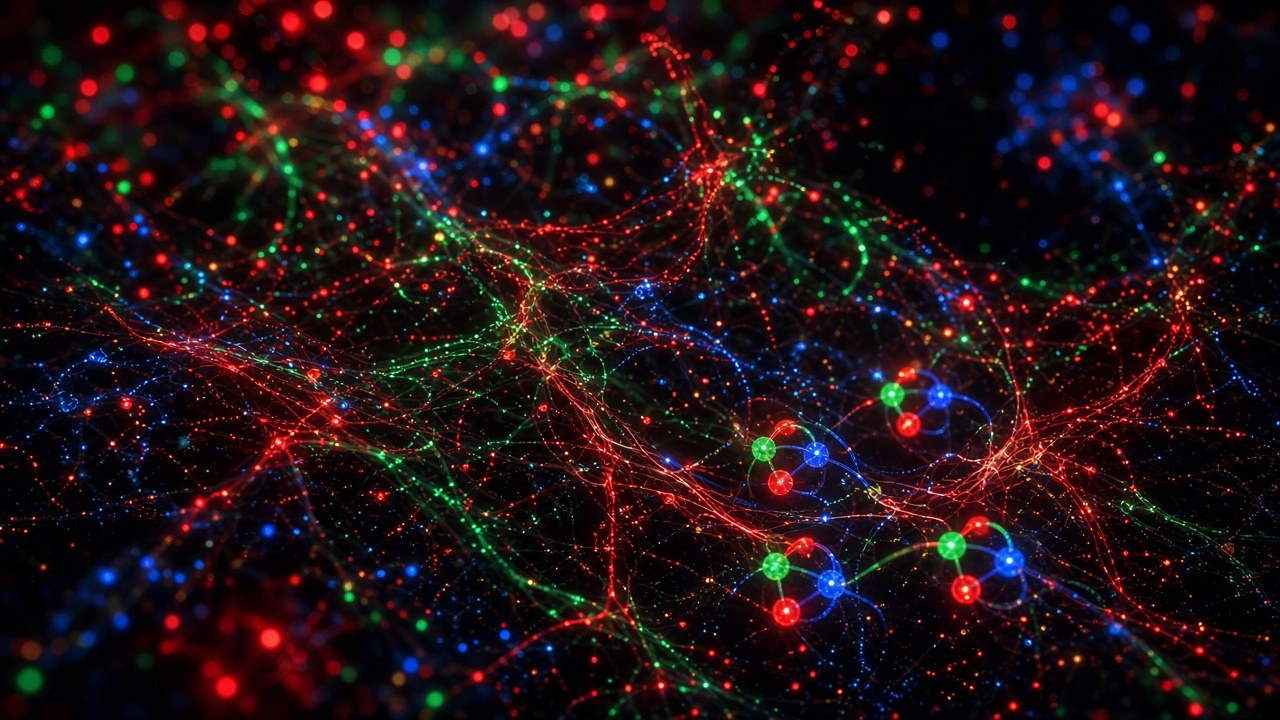
Start with the inventory. Everything solid in your life is made of atoms, atoms are made of electrons around a nucleus, and the nucleus is made of protons and neutrons. Go one level deeper and protons and neutrons are each made of three quarks held together by gluons, the carriers of the strong force. Quarks, together with leptons such as the electron, are the elementary particles of the Standard Model as far as anyone has been able to test.
In the first few millionths of a second after the hot Big Bang began, it was too hot for protons and neutrons to exist. The universe was a quark-gluon plasma, a seething soup of free quarks and gluons. As it expanded and cooled, at around ten microseconds, the quarks were confined into protons and neutrons. A few minutes later, those protons and neutrons fused into the first light nuclei [9].
So when I say quarks are the raw stock of the universe, I mean it literally. They are the lumber. Everything after is carpentry. But lumber alone does not explain why there is a house. For that we need the leftover.
2. Equal amounts, one survivor in a billion
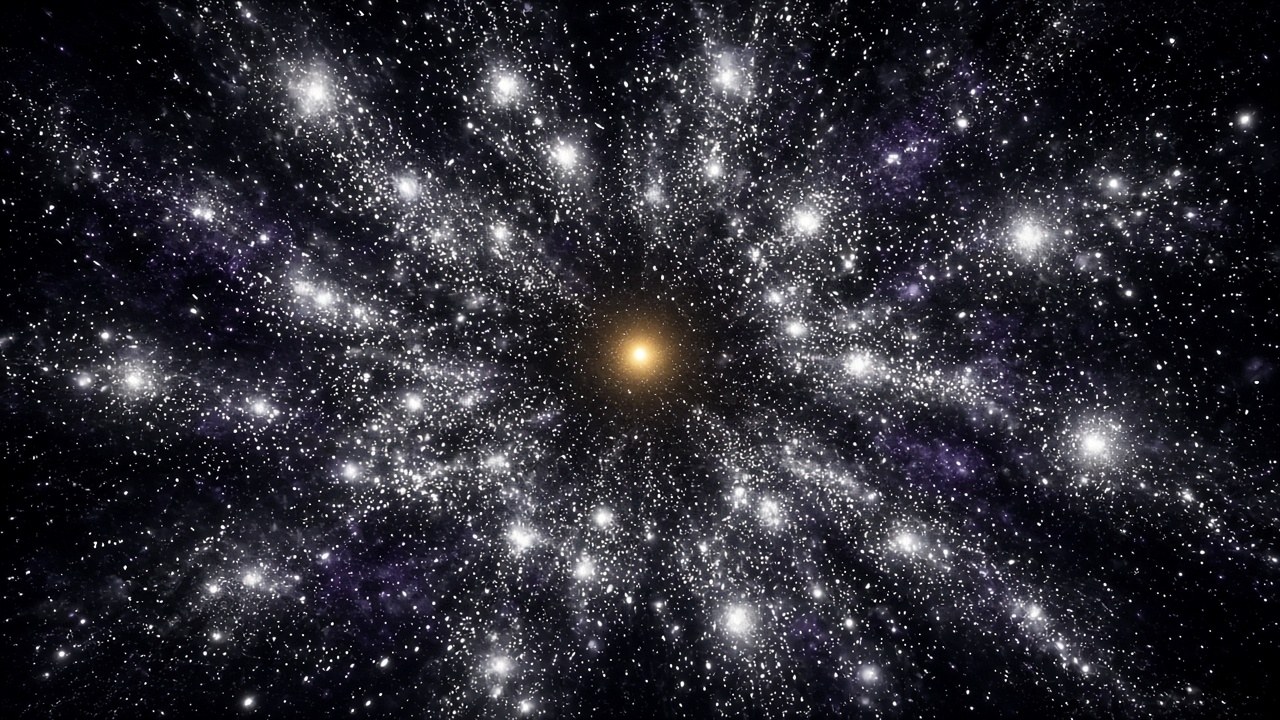
Every kind of matter particle has an antimatter twin with the same mass and opposite charge. When a particle meets its antiparticle, they annihilate into energy. The laws of physics as we know them treat matter and antimatter almost, but not quite, the same. So in the early universe, as energy turned into particles, it made quarks and antiquarks in nearly equal numbers.
Then the great cancelling happened. Nearly every quark found an antiquark and the pair vanished into light. That light is still around: it has cooled and stretched into the cosmic microwave background, about 400 photons in every cubic centimetre of space. The matter that remains is tiny by comparison. Physicists measure it as the baryon-to-photon ratio, written η, and two completely independent methods agree on it. The abundances of deuterium and helium forged in the first minutes give about 6.0 × 10⁻¹⁰, and the pattern of the cosmic microwave background measured by the Planck satellite gives about 6.1 × 10⁻¹⁰ [9][10]. In plain words: for every particle of matter in the universe there are well over a billion particles of light. That is the scar of the annihilation, and it tells us that the original surplus was on the order of one part in a billion.
That one part in a billion is everything. Your body, the Exuma Cays, the Sun, the Milky Way: all made from the survivors.
In 1967 the Russian physicist Andrei Sakharov set out what any theory must have to produce such a surplus from a balanced start [1]. There are three conditions:
- Baryon number violation. Some process must be able to change the net count of quarks minus antiquarks. If that count is locked, you can never end up with more of one than the other.
- C and CP violation. Nature must treat matter and antimatter differently, both under swapping particles for antiparticles (C) and under that swap combined with a mirror reflection (CP). Otherwise every process that makes extra matter is cancelled by a mirror process that makes the same amount of extra antimatter.
- Departure from thermal equilibrium. The universe must be out of balance while this happens. In perfect equilibrium, forward and backward processes run at the same rate and any surplus is washed out as fast as it forms.
Hold on to that third condition. It is the door The Ridge walks through. Sakharov is telling us that the surplus could only form while the universe was out of balance, while something was flowing.
3. Not an accident: the ridge is the difference itself

Here is the heart of it. The standard story is often told as if the surplus were a statistical fluke, a quantum coin that happened to land matter-side up. I do not believe it was random in that sense. I believe the surplus was the side with more momentum, the side that was already winning and kept on winning.
My first picture for this was a ridge on the ocean floor: water flowing along meets a rise, piles up, crests, and a surface wave rolls outward. That picture was a good start, but it puts the cause in the wrong place. It makes the ridge a rock, a fixed bump that was already sitting there waiting. I now want to state the idea more sharply, because the sharper version is the true one.
The ridge isn’t a thing sitting in the way — it’s the slope the imbalance builds as one side compounds over the other.
The ridge is the difference. Picture two populations of elementary particles, two sides of a balance. If one side gains even the smallest edge in rate, that edge does not stay small. Each round, the side that is ahead converts a little more of the shared stock its way, and the next round starts from a bigger lead. One over the other, over and over, and the difference compounds. The slope gets steeper because it is steep. Eventually the imbalance cannot hold its shape, and it crests.
The sea gives us a clean, real example of a crest that builds itself, with no reef required. In shallow water the speed of a wave depends on the depth of the water under it, roughly as the square root of gravity times depth. That means the taller part of a swell, standing in slightly deeper water, travels slightly faster than the trough in front of it. The back of the wave catches up to the front. The face steepens, the crest grows, and finally the wave breaks. Nothing on the floor did that. The wave built its own ridge out of the difference in its own speed. Anybody who has watched a swell stand up and pitch over on a flat sand bank has seen it.
This is what I mean by emergent, not imposed. The Ridge does not need an outside hand to set it off. A system carrying a differential, held out of equilibrium, will crest on its own. That is a stronger claim than the rock version, because it does not ask where the rock came from.
Where physics already speaks this language

When I took this framing to the physics, I found that it sits right next to some of the most important ideas in the field: spontaneous symmetry breaking and phase transitions.
Spontaneous symmetry breaking. Picture a marble balanced on top of a smooth hill in the middle of a round valley, like the crown of a sombrero. The situation is perfectly symmetric, but it is unstable. The smallest nudge in any direction sends the marble rolling down and it ends up at one particular spot in the valley. The laws were symmetric; the outcome is not. This is exactly how the Higgs field gives mass to the W and Z particles, worked out in 1964 by Englert and Brout, and by Higgs [12][13]. Nobody has to choose the direction. The instability does it.
Order parameters and instability growth. Physicists describe a phase transition with an order parameter, a number that is zero in the balanced, symmetric phase and grows once the symmetry breaks. Think of the net magnetism of a piece of iron as it cools below its Curie temperature: above, zero; below, one direction takes over and the alignment compounds as each tiny magnetic domain pulls its neighbours along. In an unstable state, a small deviation grows on its own, often exponentially at first, until something nonlinear caps it. That is the mathematical shape of “one side compounding over the other.” In the language of The Ridge, the order parameter is the size of the imbalance, and the crest is the point where it saturates.
First-order and second-order transitions. In a second-order, or continuous, transition the order parameter grows smoothly from zero, like iron gaining magnetism. In a first-order transition the system is stuck in an old state behind a barrier, and the new state appears suddenly in bubbles that nucleate here and there and spread, the way steam bubbles form in boiling water or ice crystals spread through supercooled water. Sidney Coleman worked out the theory of how such bubbles nucleate in a quantum field, in his classic paper on the “fate of the false vacuum” [7]. Bubble walls are, quite literally, ridges: moving boundaries where one phase is overtaking another.
Electroweak baryogenesis. This is the closest real-world cousin of The Ridge as applied to the leftover matter. In 1985 Kuzmin, Rubakov and Shaposhnikov showed that the Standard Model itself contains processes, now called sphalerons, that violate baryon number at the high temperatures of the early universe [8]. In the electroweak baryogenesis scenario, as the universe cooled to around 100 GeV in temperature, bubbles of the new Higgs phase nucleated in the hot plasma. Particles scattering off the moving bubble walls, through CP violation, built up an excess of one kind in front of the wall; that excess biased the sphalerons to make more baryons than antibaryons; and the expanding wall swept the new baryons inside, where they were safe from being washed out [11]. All three Sakharov conditions, delivered by a moving front where one side compounds over the other. That is about as close as mainstream physics gets to drawing my ridge.
I must be honest about the catch. Lattice studies showed that with a Higgs boson as heavy as the one discovered in 2012, the Standard Model’s electroweak transition is not first-order at all; it is a smooth crossover [16]. And the Standard Model’s CP violation is far too weak. So electroweak baryogenesis needs new physics, such as extra Higgs fields, and other routes, like leptogenesis, where the imbalance first forms among neutrinos and is later converted into baryons, are also seriously studied [17]. The Ridge does not pick a winner among these. What it says is that whichever mechanism nature used, the deep pattern is the same: an out-of-balance differential that grew, built its own slope, and crested.
4. The flow, the ripple, and space itself stretching
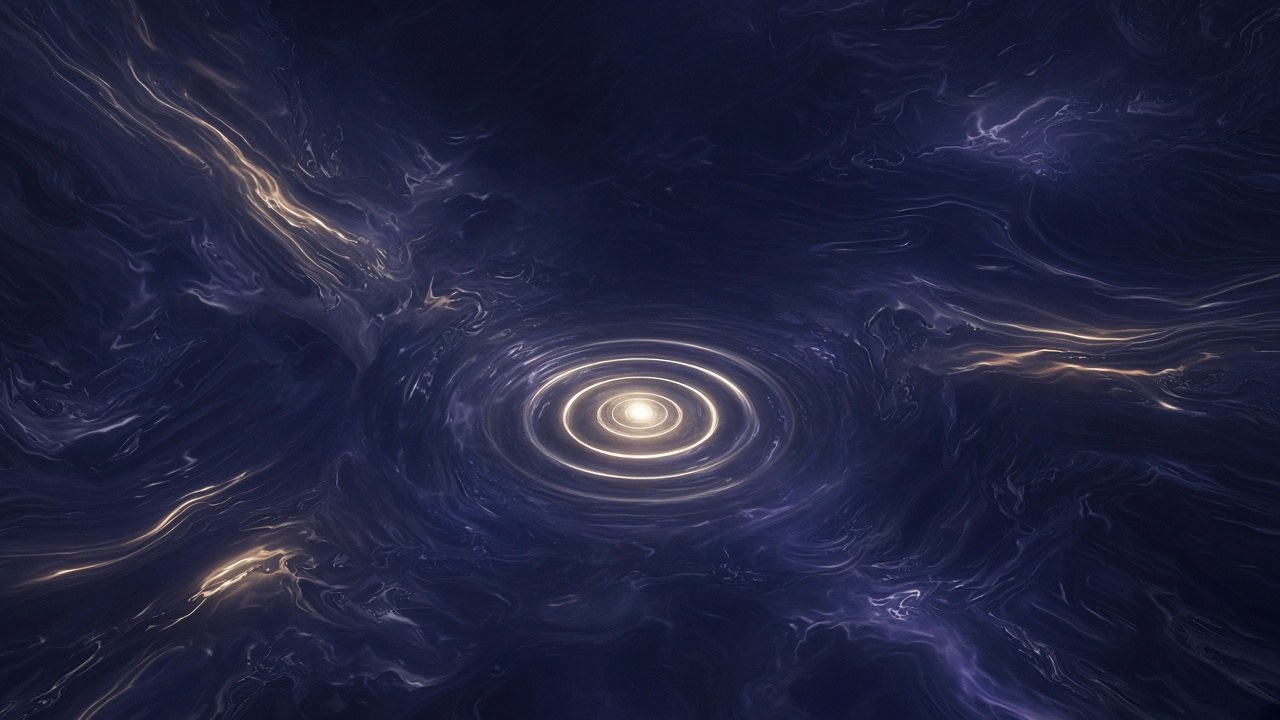
The second half of my picture is about motion. Before the crest, there was a prior energetic flow, already in motion. That flow met a difference, a flux in the elementary stock, and at that point a tiny ripple nucleated. It did not start out faster than light. It started small. It built momentum as it spread, reached other pockets, and became a force: expansion, space itself stretching.
The word “nucleated” is chosen with care. In real physics, a first-order transition does not happen everywhere at once. It starts at points, bubbles that form where conditions tip, and grows outward from there. With the emergent-ridge framing, the trigger is not an outside event striking a still pond. The trigger is the moment the compounding differential in one small region becomes large enough to stand up on its own. Where the slope is steepest, the crest forms first.
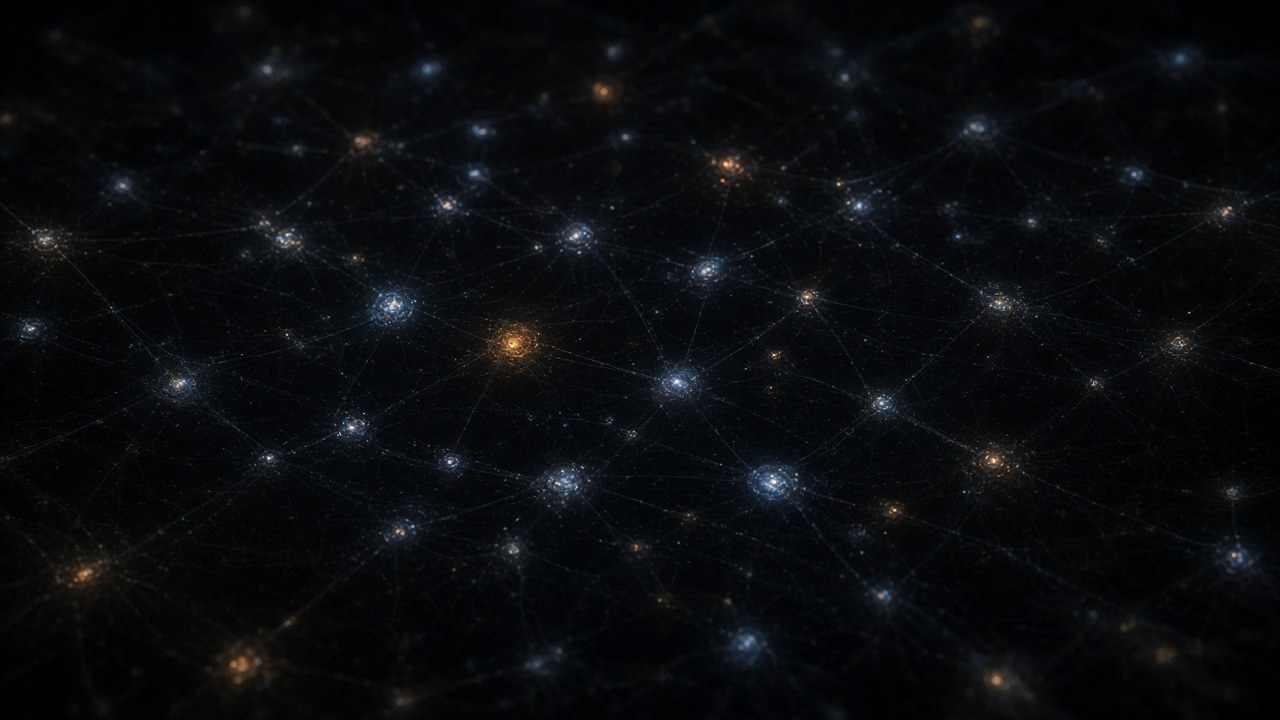
And here is a point I want every reader to take home, because so many pictures of the Big Bang get it wrong: there was no container. There was no wall for anything to bang against, and no centre that everything flew away from. The expansion of the universe is the stretching of space itself. Every distant galaxy is moving away from every other, like raisins in rising dough, and there is no outside to the dough. No container, no bang against a wall. Just imbalance cresting into motion.
A word on light speed, because my claim that the ripple did not start faster than light is easy to misread. Nothing can travel through space faster than light. But the stretching of space has no such limit, and galaxies far enough away from us are receding faster than light today without breaking any law. My point is about the origin: the crest did not need some impossible superluminal kick to begin. It began local, causal and small.
I also have to be straight about a difference between my picture and the standard model of cosmology. I say the ripple built momentum as it spread. In standard inflation, the expansion is fastest at the very start: an enormous, accelerating stretch in a tiny fraction of a second, followed by a long era of slowing expansion, and then, in the last several billion years, a renewed acceleration driven by dark energy. Reconciling the “building momentum” language of The Ridge with that measured history is real work that has not been done, and I list it among the limitations below.
Mathematical skeleton
Read this first. What follows is a toy model, a skeleton, not a derived theory. It shows how the picture of the ridge can be written in the standard language of field theory so that physicists can check it, attack it and improve it. The equations below are textbook-standard; what is mine is how they are put together and what they are asked to mean. Nothing here has been fitted to data, and the numbers that matter are not derived. A reader who skips the equations and reads only the plain-English lines around them will still follow the argument.
Step 1. The momentum differential is a slope in a field
Start with the leftover itself. Let the local excess of matter over antimatter be a single number at every point in space and every moment in time. Call it φ(x, t). Where matter and antimatter are perfectly balanced, φ = 0. Where matter is winning, φ is positive. This is the same kind of object physicists use for the inflaton, the field that drives inflation, and it has a real cousin in the Affleck–Dine mechanism of baryogenesis, where the baryon excess is carried by a scalar field [29]. In that mechanism the net baryon number is literally the rate at which a complex field turns in its internal space, a quantity that behaves like angular momentum. Real physics already ties the leftover to something momentum-like.
The momentum differential, the side-to-side difference that compounds, is then the slope of that field across space:
Where ∇φ is zero, nothing is leaning. Where it is large, one side is pulling hard over the other.
Step 2. The rules of the game: a Lagrangian and a lopsided potential
Every field theory starts from a Lagrangian density, which says how much it costs the field to change in time, to change across space, and to sit at a given value. For a single scalar field the standard choice is
The first piece is the energy of motion, the second is the cost of a slope (the momentum differential itself costs energy, which is why it cannot grow for free), and V(φ) is the potential: the landscape the field rolls on.
For The Ridge, the landscape must have two valleys. One valley sits at φ = 0, the balanced, symmetric state. Physicists call a valley like this a false vacuum: it is stable against small nudges but it is not the lowest ground. The other valley sits at a positive value φT, the matter-winning state, and it is deeper. That is the true vacuum. Between them stands a hill. A simple potential with exactly this shape, the same form used for first-order phase transitions in the early universe, is
with positive constants m, A and λ. Setting V′(φ) = 0 gives the balanced valley at φ = 0, the top of the hill at φb = [A − √(A² − 4λm²)] / (2λ), and the matter valley at φT = [A + √(A² − 4λm²)] / (2λ). The matter valley is the deeper one whenever A² > (9/2) λ m². The cubic term is the tilt: it is what makes the landscape lopsided. (An equivalent alternative is a tilted double well, V = (λ/4)(φ² − v²)² − εφ, where the small tilt ε plays the same role. The conclusions below do not depend on which form is used.)
This is the honest mathematical meaning of “the ridge is not a rock in the way.” Nothing is placed on the landscape from outside. The hill and the deeper valley are properties of the field’s own rules.
Step 3. The equation of motion
Applying the Euler–Lagrange equation, ∂μ[∂ℒ/∂(∂μφ)] − ∂ℒ/∂φ = 0, to equation (2) gives the field’s law of motion:
In an expanding universe with scale factor a(t) and Hubble rate H = ȧ/a, the same equation picks up a friction term from the stretching of space, the “Hubble friction”:
(From here on I absorb the factor c² in front of V′ into the constants, so that m, A and λ are measured in units of inverse time squared.)
Step 4. The ripple: a wave that compounds and then saturates
Now look at a small ripple riding on the balanced state. Write φ = 0 + δφ and expand V′ in powers of δφ around the false vacuum. A general Taylor expansion gives V′(δφ) = V″(0) δφ + ½ V‴(0) δφ² + (1/6) V⁗(0) δφ³ + …. Putting that into equation (4) gives
For the potential in equation (3), these are exactly α = A and β = λ. Each term has a plain meaning:
- c²∇²δφ is ordinary wave propagation: the ripple spreads.
- −m²δφ is the restoring pull of the balanced valley. Small ripples just wobble and fade back. This is why the symmetric state can wait for a very long time.
- +α(δφ)² is the compounding term. Once a ripple leans toward the matter side, this term pushes it further in the same direction, harder the bigger it gets. One side compounding over the other, written as algebra.
- −β(δφ)³ is saturation. It stops the growth from running off to infinity and lets the field settle into the matter valley. This is the crest flattening into the new sea level.
Here is the key point about speed. For a small ripple of wavenumber k, equation (6) gives the dispersion relation ω² = c²k² + m², so the speed at which a signal or wave packet travels is the group velocity vg = dω/dk = c²k/ω, which is always less than c. Now take a region that has been pushed up near the top of the hill, φ ≈ φb, where V″(φb) < 0. Long-wavelength ripples there obey ω² = c²k² − |V″(φb)|, which turns negative for k < √|V″(φb)| / c. Those ripples do not oscillate; they grow like eγt with growth rate γ = √(|V″(φb)| − c²k²). This is called a spinodal or tachyonic instability. What grows is the amplitude, the height of the crest. Nothing travels faster than light. That is precisely the claim that the ripple did not start faster than light but built momentum as it went.
And it goes one step further. Once a region has tipped over into the matter valley, it forms a bubble whose wall moves outward. Coleman showed that in empty space such a wall accelerates, its speed climbing toward, but never reaching, the speed of light [7]. In a hot plasma, friction gives the wall a terminal speed instead. Either way, the front that carries the new phase starts slow and gathers speed as it spreads. The mathematics says what the water said.
Step 5. The ridge as a threshold
Where exactly is the ridge? It is not an object. It is the set of points where the slope of the field has grown steep enough that the region can no longer stay balanced:
Below the threshold the region is symmetric territory, the false vacuum, still waiting. Above it, symmetry breaks and the region crests into the matter valley.
The threshold is tied to the height of the hill. To tip over, a region must lift its field from 0 past the hilltop φb, and it must do so over a patch large enough to survive: smaller patches are squeezed back by the cost of their own walls. In Coleman’s thin-wall picture that minimum size is the critical bubble radius Rc = 3σ/ΔV, where ΔV = V(0) − V(φT) is how much deeper the matter valley is and σ = ∫ √(2V) dφ, taken across the hill, is the tension of the wall [7]. An order-of-magnitude estimate of the critical slope is then
A higher hill means a larger σ, a larger patch and a gentler threshold slope spread over a bigger region; a deeper matter valley means a smaller patch and an easier crest. Equation (9) is a heuristic, not a theorem: it is my way of translating Coleman’s amplitude-and-size condition into the language of slopes. In the same thin-wall limit, the rate at which critical bubbles appear per unit volume per unit time is Γ ∝ e−B/ħ with B = 27π²σ⁴ / (2ΔV³) [7]. A steeper differential, piled up by the prior flow, is what pushes regions across that line.
Step 6. No container: boundary and initial conditions
No wall, no box. The domain is all of space, ℝ³, with open boundaries: far away, the field simply stays in the balanced state or stays bounded. For computer simulation the same physics can be put in a periodic box of side L, which has no edges at all. Either way, the “outside” of a crested region is not a container. It is just the regions where |∇φ| < |∇φ|c, still symmetric, still waiting.
The prior flow, the energy already in motion before the crest, enters as a transport law with a source. If the flow moves with velocity field v0(x) and the underlying particle processes produce a small, uneven asymmetry at rate S(x, t), then before the crest the field obeys
For a uniform flow this solves to φ(x, t) = φ(x − v0t, 0) + ∫0t S(x − v0(t − s), s) ds. In words: the flow carries the asymmetry along and keeps adding to it, and wherever the production rate differs from place to place, the slope ∇φ steepens. That is the banking-up. The initial state is the balanced field plus a small seed,
with φ0 = 0 for a perfectly balanced start and ε(x) a tiny seed, for example a quantum fluctuation. The seed is not a push from a boundary; it is a small wrinkle inside the field. Equation (10) is a phenomenological stand-in: a complete model would have to derive the flow and the source from the same Lagrangian as equation (2), and that work has not been done.
Step 7. From crest to leftover: the baryon asymmetry
The measured leftover is the baryon-to-photon ratio, η = nB/nγ ≈ 6.1 × 10⁻¹⁰ [9][10]. In this skeleton it is the integrated excess in every region that crossed the ridge, after annihilation and washout have taken their cut:
The assumptions, stated plainly:
- 𝒱 is a large comoving volume, t* is when the ridge forms, and tf is after the transition has finished. Θ is the step function: it counts only regions that crested.
- κ converts the field value into a net baryon number density. Setting it requires coupling φ to real baryon number, as Affleck–Dine and electroweak baryogenesis do in their own ways [29][11].
- w ≤ 1 is the survival fraction after annihilation and any washout by sphaleron processes [8].
- f is the fraction of the volume that crested. If the bubbles percolate and fill space, f → 1 and the integral reduces to the simple form on the right.
- nγ is evaluated at the same epoch, with later dilution, such as entropy released by annihilation, folded into w.
I will not pretend this predicts 6.1 × 10⁻¹⁰. With free choices of κ, w and φT, equation (12) can produce almost any number. Making The Ridge a theory means fixing those quantities from deeper physics and then seeing whether the right number comes out. That has not been done here.
Step 8. What we would see, and what would kill it
A skeleton earns respect only if it can be broken. Two kinds of observation could test a fleshed-out version.
The pattern in the oldest light. The primordial ripples measured in the cosmic microwave background follow a nearly scale-invariant power spectrum, P(k) = As (k/k*)ns−1, with spectral index ns = 0.9649 ± 0.0042 and amplitude As ≈ 2.1 × 10⁻⁹ from Planck 2018 [10]. If the seeds of structure were saturated ripples of the kind in equation (6), their spectrum would have to land on those numbers, and on the tight limits on non-Gaussianity [27] and primordial gravitational waves [28]. I note honestly that the toy model on its own does not produce scale invariance; in standard inflation that comes from a nearly constant expansion rate stretching quantum fluctuations, and a Ridge model would have to supply its own reason or borrow that one.
A hum of gravitational waves. If the crest was a first-order transition, bubbles nucleating, expanding and colliding would have shaken spacetime and left a stochastic gravitational-wave background. Its peak frequency today is set by the temperature T* of the transition and how quickly it completed (written β/H*), roughly
where f*/H* is the peak frequency at the time of the transition in units of the Hubble rate, typically tied to β/H*, and g* counts the particle species in the plasma [26]. A transition near the electroweak scale lands in the millihertz band of the planned LISA observatory [26]. A transition near the scale of quark confinement would land in the nanohertz band of pulsar timing arrays; NANOGrav reported evidence for a gravitational-wave background there in 2023, though its source is still debated and supermassive black hole binaries are a leading explanation [30]. The eternal-inflation literature has also looked for the imprint of bubble collisions directly in the CMB [21]. The 2021 cavitation model, for its part, points to a different fingerprint: the cellular, web-like layout of galaxy clusters [6].
What kills it. Once its parameters are fixed so that equation (12) gives the measured η, a Ridge model is dead if (a) it cannot produce a primordial spectrum compatible with Planck’s ns, non-Gaussianity and tensor limits, or (b) LISA or pulsar timing arrays find no gravitational-wave background at the frequency and strength it predicts. Those are the lines in the sand.
5. The recycling loop, and the twin of everything

The crest never really stops rolling. It just changes form.
In the first three minutes, the surviving protons and neutrons fused into hydrogen and helium, about three-quarters hydrogen and one-quarter helium by mass, with traces of lithium [9]. That was the whole periodic table for the first hundred million years or so. Then gravity gathered that gas into the first stars, and stars are furnaces. They fuse hydrogen into helium, helium into carbon and oxygen, and the most massive stars go on to build up to iron in their cores. When those massive stars collapse and explode as supernovae, they blast those elements out into space, and new elements are forged in the violence. The 1957 paper by Burbidge, Burbidge, Fowler and Hoyle laid out this stellar alchemy in detail [14].
That scattered star-stuff does not go to waste. It mixes into new clouds of gas, which collapse into new stars with planets around them. The calcium in your bones, the iron in your blood, the oxygen you just breathed: those atoms were cooked inside stars that died before the Sun was born. The same raw stock, cresting, scattering and reforming, over and over.

Everything has its twin
Follow that loop down far enough and something strange shows up. At the level of the building blocks, there are no originals. Every electron in the universe is exactly identical to every other electron. Not similar. Identical. Same mass, same charge, same spin, with no scratch or serial number to tell them apart. In quantum mechanics this is called indistinguishability, and it is not a philosophical nicety; it changes how nature counts. If you swap two electrons, the physical situation is literally the same situation. That simple fact gives us the Pauli exclusion principle, the structure of the periodic table, and the reason matter is solid and does not collapse [15].
Here I want to correct something I used to say myself. I once described this sameness as entanglement. It is not, and the difference matters.
- Indistinguishability is about identity. All electrons are the same kind of thing, everywhere, always. It holds whether or not two electrons have ever met.
- Entanglement is about correlation. Two particles that have interacted can share a single joint quantum state, so that measuring one tells you something about the other no matter how far apart they are [18]. Entanglement is a relationship between particular particles. It can be created and it can be destroyed.
So the building-block parallel I am pointing to is indistinguishability, not entanglement. Every electron already has its perfect twin, trillions upon trillions of them.
Now go up from electrons to whole arrangements. In 1890 Henri Poincaré proved that a closed system confined to a finite region of its possible states, left alone long enough, will return arbitrarily close to any state it has been in before [19]. This is the Poincaré recurrence theorem. If the universe were such a system, then on a long enough timeline, down to the atomic level, every arrangement would come round again. Everything would have its twin.
But I owe the reader the fine print. The recurrence times are absurd. For anything bigger than a handful of particles they dwarf the 13.8-billion-year age of the universe so badly that the number of digits in the waiting time is itself astronomically large. Physicists who have studied recurrence in a universe with a cosmological constant found timescales on the order of e raised to the power of 10120 years, and they treated recurrences as a problem for such models, not a prediction [20]. And our universe is expanding; it is not obviously a closed box with a finite set of states at all. So the recurrence half of “everything has its twin” is a possibility worth thinking about, not an established fact. The identity half, every electron the twin of every other, is rock solid.
6. A mind outside time
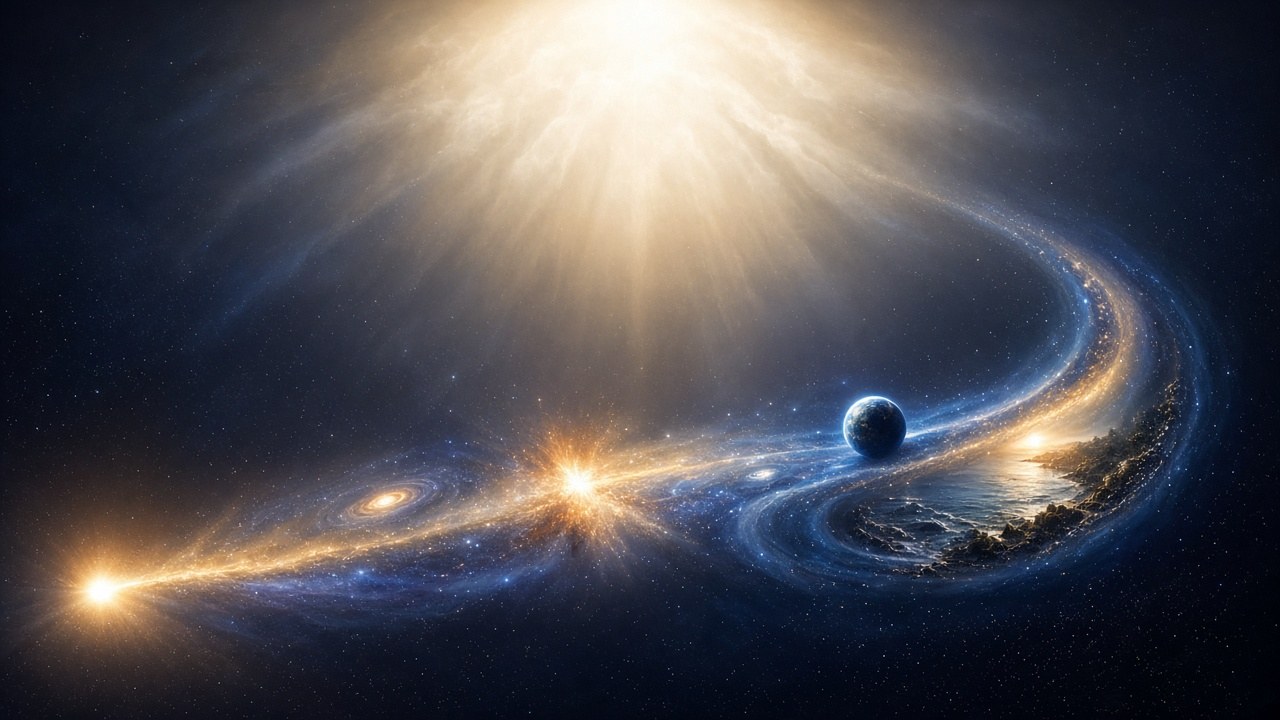
Now I come to the part that matters most to me.
Everything above is a sequence: a flow, a differential, a crest, a ripple, stars, supernovae, planets, people. We experience it as a process because we are inside time, moving through it one moment after another. But imagine a being that is not inside time at all. Such a mind would not watch the universe unfold. It would perceive the whole sequence, from the first ripple to the last fading star, as a single completed state, the way you can see a whole wave in one photograph even though the wave took seconds to form.
This is not a new idea. Augustine and Boethius both described God’s knowledge as an eternal present, holding all of time at once. What is new is how naturally it fits with physics. Einstein’s relativity showed that there is no single universal “now” that all observers agree on; different observers slice spacetime into moments differently. Many physicists and philosophers take that as a reason to think of spacetime as a whole, a completed four-dimensional structure. I do not claim relativity proves God. I claim that a mind outside time is not in conflict with what physics tells us about time.
And here is the argument that, for me, makes faith in Elohim, the Most High, coherent for a scientifically inclined mind. If the universe follows laws, then in principle its whole history could be mapped by computation. People have dreamed of that since Laplace. But in practice no computer inside the universe can do it: chaos, quantum uncertainty and the sheer size of the job make it impossible from in here. A mind outside time does not face that wall. It would not need to compute the universe step by step, any more than you need to compute a photograph to see it. It would simply know it, whole. The same lawfulness that makes the universe computable in principle makes a timeless knower intelligible in principle.
I am not asking anyone to accept that as science. It is philosophy, and faith. I am saying that a person can follow the physics all the way down to the quarks and the crest and still stand on the shore at Exuma, look at the horizon, and believe, with no contradiction at all.
Scientific parallels
The Ridge is my own framework, but it is not an orphan. Several established lines of research sit close to it, and readers who want to go deeper should start here.
Inflation and eternal inflation: Guth, Linde, Vilenkin
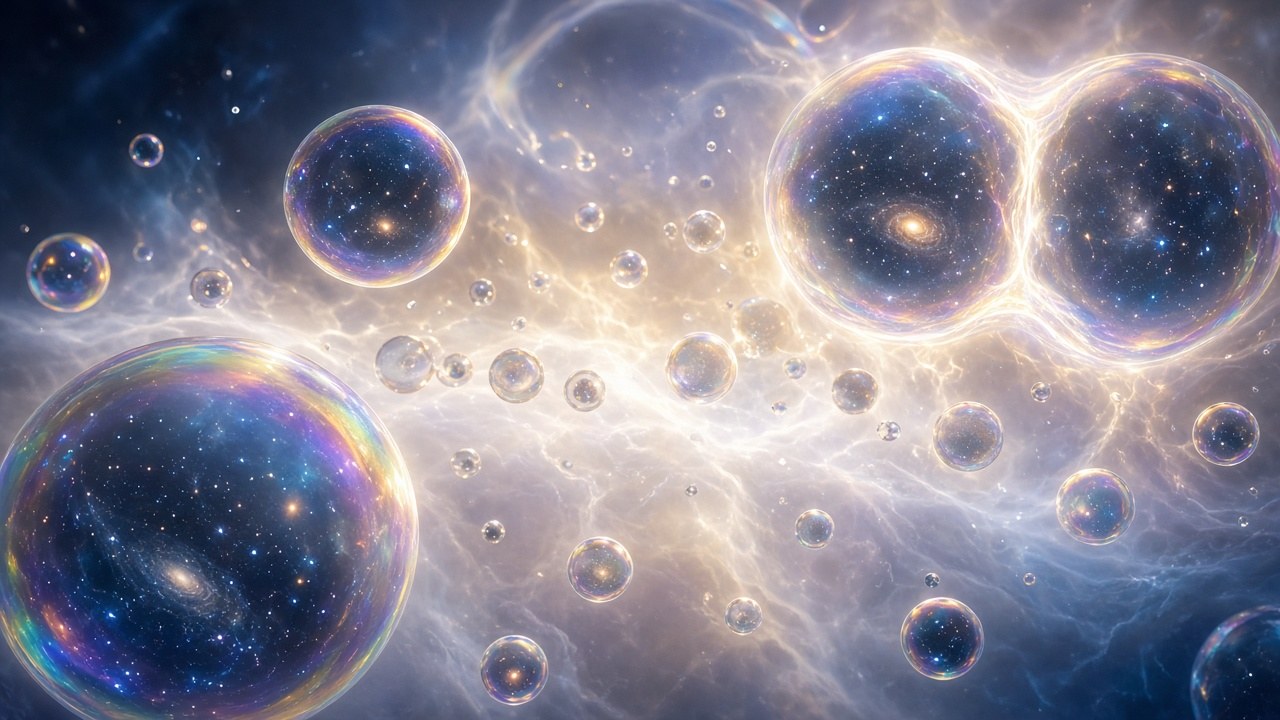
In 1981 Alan Guth proposed that the very early universe went through a brief period of extremely rapid, accelerating expansion, driven by a field stuck in a high-energy “false vacuum” [2]. Inflation explains why the universe looks so smooth and so flat on large scales. Andrei Linde’s “new inflation” of 1982 fixed problems in Guth’s original version [3], and in the 1980s Alexander Vilenkin and Linde showed that inflation, once started, tends never to stop everywhere at once [4][5]. In this picture of eternal inflation, the false vacuum keeps inflating forever, while here and there it decays, nucleating bubbles, or pocket universes, in which inflation ends and a hot Big Bang follows. Our observable universe would be one such pocket. Bubble nucleation, false vacuum decay and pockets that reach one another are the closest standard-cosmology language for my “ripple that reached other pockets.” Researchers have even searched the cosmic microwave background for the scars of collisions between our bubble and others; none have been confirmed [21].
The cavitation model of the Big Bang
The published idea nearest to my water picture is the cavitation model of Mikhail Shneider and Mikhail Pekker of Princeton, published in Physics of Fluids in 2021 [6]. In a liquid under strong negative pressure, the liquid tears and bubbles of vapour form, which is called cavitation. Shneider and Pekker propose that the inflationary stage of the universe behaved like a cavitating liquid: the cosmological term in Einstein’s equations plays the role of negative pressure, and at many points the false vacuum ruptures into bubbles of ordinary physical vacuum where matter is generated. They argue this could explain the large-scale smoothness of the universe without ultrafast inflation, and could seed the cellular, web-like pattern of galaxy clusters we see today. Their model is a proposal, not consensus, but it shows serious physicists reaching for fluid images of the beginning, as I am. Where they use a liquid tearing under tension, I use a liquid building its own crest. Both say the start was a fluid instability, not an explosion in a box.
Cosmological perturbation theory and the fossil ripples
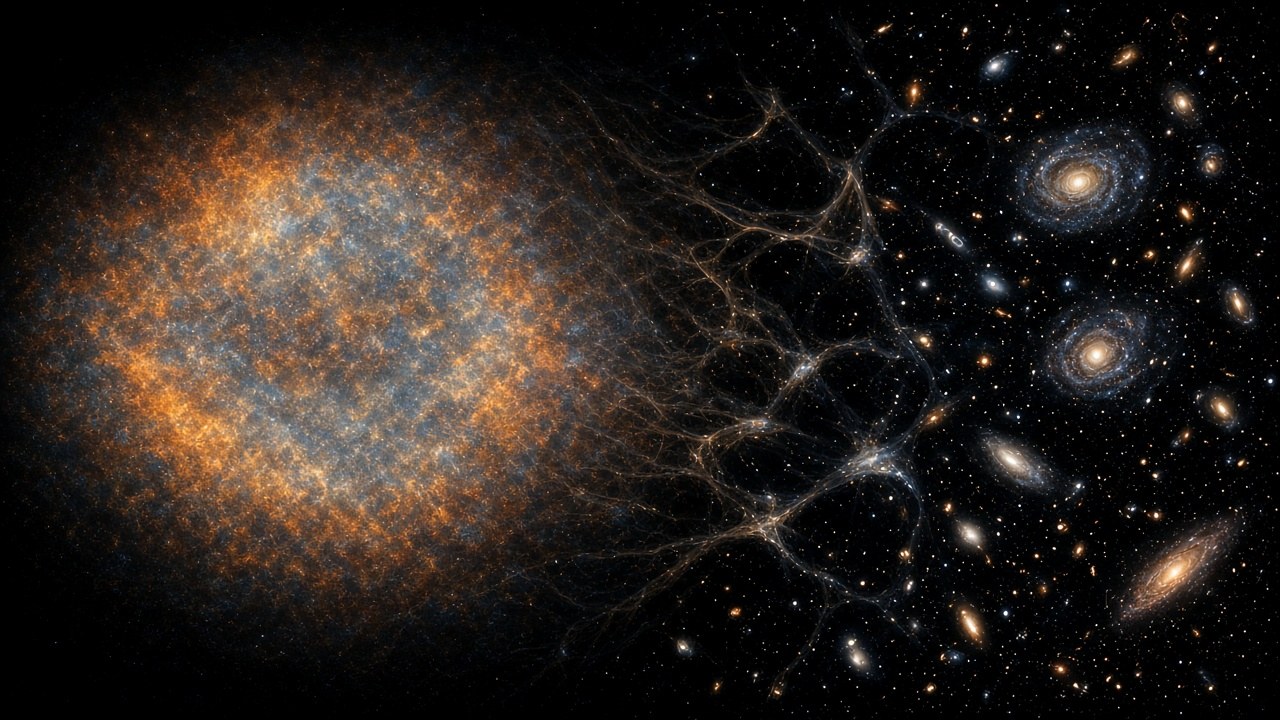
The best evidence that tiny ripples grew into everything is written across the whole sky. The cosmic microwave background, light released about 380,000 years after the Big Bang, is almost perfectly even in temperature, but not quite. In 1992 NASA’s COBE satellite detected variations of about one part in 100,000 [22]; WMAP and Planck later mapped them in exquisite detail [10]. Cosmological perturbation theory explains how gravity amplified those ripples: slightly denser regions pulled in more matter, grew denser still, and over hundreds of millions of years became the web of galaxies and clusters [23]. This is real, measured compounding: a small difference that feeds on itself until it crests into structure. It is the strongest confirmation in all of cosmology that the pattern The Ridge describes, small differentials growing into large forms, is how our universe actually works after the first instants.
Sakharov and the symmetry-breaking tradition
Sakharov’s three conditions [1], the Higgs mechanism [12][13], Kibble’s work on how symmetry-breaking transitions in the early universe leave domains and defects behind [24], and the electroweak baryogenesis program [8][11] together form the formal backbone that a mathematical version of The Ridge would need to plug into. The Ridge’s contribution, if it has one, is the insistence that these are not separate stories but one: an out-of-equilibrium differential that compounds into a crest, at every scale.
Limitations and falsifiability
I would be a hypocrite to write about the honesty of the universe and then oversell my own idea. So here is where The Ridge stands.
- The mathematics is a skeleton, not a theory. The mathematical skeleton above writes the idea in standard field-theory form, but it is a toy model. Its potential is chosen, not derived; its threshold in equation (9) is a heuristic; the prior flow in equation (10) is a stand-in; and it cannot yet predict the measured value of η without free parameters. A theory that cannot predict its own central number is a framework, not a proof.
- “Momentum” is used loosely. In physics, momentum is a precise, conserved quantity. When I say the surviving side had more momentum, I mean a directed advantage in rate, closer to what physicists call a bias, a chemical potential, or a growing order parameter. A formal version would have to pick the right quantity and stop leaning on the everyday word.
- Emergence still needs a starting differential. The emergent framing removes the need for an outside trigger, but it does not remove the need for a seed. Something must start the differential, even if only a quantum fluctuation, and the laws must allow it to grow. Sakharov’s conditions still apply. The Ridge reframes them; it does not escape them.
- The water analogy is an analogy. Breaking waves, cavitation and boiling are wonderful guides, but the early universe is not a liquid in a basin. Every analogy breaks somewhere, and the real work is finding exactly where.
- Tension with the measured expansion history. As noted above, the idea of a ripple that builds momentum as it spreads must be squared with inflation’s fast start, the long slowdown, and today’s acceleration.
- Recurrence may not apply. Poincaré recurrence assumes a closed, bounded system. An expanding universe may not qualify, and even if it did, the timescales are beyond meaning.
- The theology is not testable. The final section is philosophy and faith, and I label it that way.
This is not unusual for a young idea. James Hartle and Stephen Hawking’s “no-boundary” proposal of 1983, the idea that the universe has no sharp beginning in time, began as an elegant sketch and has been argued over, refined and challenged for decades [25]. Big ideas usually start as pictures before they become equations.
What a testable Ridge might look like (speculative)
The following are possibilities, not predictions. If The Ridge were turned into a real model in which the matter surplus crested during a strongly first-order phase transition, it might leave fingerprints like these:
- A background of gravitational waves. Bubbles nucleating, expanding and colliding in a first-order transition would shake spacetime and leave a faint, steady hum of gravitational waves. For a transition near the electroweak scale, that hum would fall in the frequency band of the planned LISA space observatory [26]. A detection, or a firm non-detection, would test the cresting-transition version of the idea.
- Signatures in the cosmic microwave background. Departures from the simplest random pattern of the CMB, called non-Gaussianity, are tightly constrained by Planck: the main “local” parameter, fNL, is measured as −0.9 ± 5.1, consistent with zero [27]. A Ridge model that predicted a specific non-zero pattern could be checked against these numbers and future surveys.
- Primordial gravitational waves. Inflation should leave a twisting pattern in the polarization of the CMB. The best limit so far, from BICEP/Keck, is that the tensor-to-scalar ratio r is below 0.036 [28]. A model of how the crest drove expansion would have to fit under that limit and could be tested by the next generation of experiments.
- Laboratory links. Any mechanism that compounds a matter-antimatter difference needs new sources of CP violation, which experiments measuring the tiny electric dipole moments of electrons and neutrons, and collider searches for extra Higgs particles, keep pushing on [11].
If those searches all come back empty in the places a mathematical Ridge says they should not, the idea is wrong, and I will say so. That is what makes it worth writing down.
Conclusion: the crest and the One who sees it whole
Here is The Ridge in one breath. The raw stock was quarks. Matter and antimatter came out almost even, and the universe is the one-in-a-billion leftover. That leftover was not a fluke. It was the crest of a differential, one side compounding over the other until the imbalance stood up on its own. The ridge was not a rock in the way. It was the slope the imbalance built. That crest nucleated small, spread, reached other pockets, and became the stretching of space itself, with no container and no wall. The star-stuff it left behind keeps cresting and reforming into suns, planets, coral and people, and at the bottom of it all every electron is the perfect twin of every other.
Physics already speaks this language, in symmetry breaking, in phase transitions, in bubble walls sweeping through a hot plasma, in ripples one part in a hundred thousand growing into galaxies. The Ridge asks us to see those as one pattern.
And the pattern points somewhere. We are inside the wave, so we feel it as a story, moment by moment. A mind outside time would see the whole wave at once, finished, from the first ripple to the last light. I call that mind the Most High. You do not have to share my faith to follow my physics. But I will say this, as a Bahamian who grew up reading the water: a wave that builds itself out of its own imbalance is not less wonderful for being natural. It is more.
About the author. Michael Elijah Muhammad Clare is a Bahamian software developer, writer and activist based in Exuma. He is not a trained physicist; The Ridge is a conceptual framework offered by an independent thinker for discussion and correction. Corrections and challenges are welcome through the lol242 corrections page.
References
- A. D. Sakharov, “Violation of CP invariance, C asymmetry, and baryon asymmetry of the universe,” JETP Letters 5, 24–27 (1967); English reprint in Soviet Physics Uspekhi 34, 392 (1991). https://doi.org/10.1070/PU1991v034n05ABEH002497
- A. H. Guth, “Inflationary universe: A possible solution to the horizon and flatness problems,” Physical Review D 23, 347 (1981). https://doi.org/10.1103/PhysRevD.23.347
- A. D. Linde, “A new inflationary universe scenario,” Physics Letters B 108, 389 (1982). https://doi.org/10.1016/0370-2693(82)91219-9
- A. Vilenkin, “Birth of inflationary universes,” Physical Review D 27, 2848 (1983). https://doi.org/10.1103/PhysRevD.27.2848
- A. D. Linde, “Eternally existing self-reproducing chaotic inflationary universe,” Physics Letters B 175, 395 (1986). https://doi.org/10.1016/0370-2693(86)90611-8
- M. N. Shneider and M. Pekker, “Cavitation model of the inflationary stage of Big Bang,” Physics of Fluids 33, 017116 (2021). Preprint title: “Cavitation model of the initial stage of Big Bang,” arXiv:2010.13310. https://doi.org/10.1063/5.0035458
- S. Coleman, “Fate of the false vacuum: Semiclassical theory,” Physical Review D 15, 2929 (1977). https://doi.org/10.1103/PhysRevD.15.2929
- V. A. Kuzmin, V. A. Rubakov and M. E. Shaposhnikov, “On anomalous electroweak baryon-number non-conservation in the early universe,” Physics Letters B 155, 36 (1985). https://doi.org/10.1016/0370-2693(85)91028-7
- B. D. Fields, P. Molaro and S. Sarkar, “Big-Bang Nucleosynthesis,” in Particle Data Group, Review of Particle Physics (2026 edition, revised August 2025). https://pdg.lbl.gov/2026/reviews/rpp2026-rev-bbang-nucleosynthesis.pdf
- Planck Collaboration, “Planck 2018 results. VI. Cosmological parameters,” Astronomy & Astrophysics 641, A6 (2020). https://doi.org/10.1051/0004-6361/201833910
- D. E. Morrissey and M. J. Ramsey-Musolf, “Electroweak baryogenesis,” New Journal of Physics 14, 125003 (2012). https://doi.org/10.1088/1367-2630/14/12/125003
- F. Englert and R. Brout, “Broken symmetry and the mass of gauge vector mesons,” Physical Review Letters 13, 321 (1964). https://doi.org/10.1103/PhysRevLett.13.321
- P. W. Higgs, “Broken symmetries and the masses of gauge bosons,” Physical Review Letters 13, 508 (1964). https://doi.org/10.1103/PhysRevLett.13.508
- E. M. Burbidge, G. R. Burbidge, W. A. Fowler and F. Hoyle, “Synthesis of the elements in stars,” Reviews of Modern Physics 29, 547 (1957). https://doi.org/10.1103/RevModPhys.29.547
- R. P. Feynman, R. B. Leighton and M. Sands, The Feynman Lectures on Physics, Vol. III, Chapter 4, “Identical Particles” (Caltech online edition). https://www.feynmanlectures.caltech.edu/III_04.html
- K. Kajantie, M. Laine, K. Rummukainen and M. E. Shaposhnikov, “Is there a hot electroweak phase transition at mH ≥ mW?,” Physical Review Letters 77, 2887 (1996). https://doi.org/10.1103/PhysRevLett.77.2887
- M. Fukugita and T. Yanagida, “Baryogenesis without grand unification,” Physics Letters B 174, 45 (1986). https://doi.org/10.1016/0370-2693(86)91126-3
- R. Horodecki, P. Horodecki, M. Horodecki and K. Horodecki, “Quantum entanglement,” Reviews of Modern Physics 81, 865 (2009). https://doi.org/10.1103/RevModPhys.81.865
- H. Poincaré, “Sur le problème des trois corps et les équations de la dynamique,” Acta Mathematica 13, 1–270 (1890).
- L. Dyson, M. Kleban and L. Susskind, “Disturbing implications of a cosmological constant,” Journal of High Energy Physics 2002(10), 011 (2002). https://doi.org/10.1088/1126-6708/2002/10/011
- S. M. Feeney, M. C. Johnson, D. J. Mortlock and H. V. Peiris, “First observational tests of eternal inflation,” Physical Review Letters 107, 071301 (2011). https://doi.org/10.1103/PhysRevLett.107.071301
- G. F. Smoot et al., “Structure in the COBE differential microwave radiometer first-year maps,” Astrophysical Journal Letters 396, L1 (1992). https://doi.org/10.1086/186504
- V. F. Mukhanov, H. A. Feldman and R. H. Brandenberger, “Theory of cosmological perturbations,” Physics Reports 215, 203 (1992). https://doi.org/10.1016/0370-1573(92)90044-Z
- T. W. B. Kibble, “Topology of cosmic domains and strings,” Journal of Physics A 9, 1387 (1976). https://doi.org/10.1088/0305-4470/9/8/029
- J. B. Hartle and S. W. Hawking, “Wave function of the Universe,” Physical Review D 28, 2960 (1983). https://doi.org/10.1103/PhysRevD.28.2960
- C. Caprini et al., “Science with the space-based interferometer eLISA. II: Gravitational waves from cosmological phase transitions,” Journal of Cosmology and Astroparticle Physics 2016(04), 001 (2016). https://doi.org/10.1088/1475-7516/2016/04/001
- Planck Collaboration, “Planck 2018 results. IX. Constraints on primordial non-Gaussianity,” Astronomy & Astrophysics 641, A9 (2020). https://doi.org/10.1051/0004-6361/201935891
- BICEP/Keck Collaboration (P. A. R. Ade et al.), “Improved constraints on primordial gravitational waves using Planck, WMAP, and BICEP/Keck observations through the 2018 observing season,” Physical Review Letters 127, 151301 (2021). https://doi.org/10.1103/PhysRevLett.127.151301
- I. Affleck and M. Dine, “A new mechanism for baryogenesis,” Nuclear Physics B 249, 361 (1985). https://doi.org/10.1016/0550-3213(85)90021-5
- NANOGrav Collaboration (G. Agazie et al.), “The NANOGrav 15 yr data set: Evidence for a gravitational-wave background,” Astrophysical Journal Letters 951, L8 (2023). https://doi.org/10.3847/2041-8213/acdac6
Illustration briefs
Each illustration in this paper has a caption and a detailed brief describing what it shows and why. They are listed here so readers can see how each picture connects to the science.
Figure 1. The Ridge: one side compounds over the other until the imbalance crests and rolls out as a universe.
Brief: Photorealistic wide cinematic image. A vast dark ocean at the edge of space: the surface of the water seamlessly turns into a starfield above. In the center, the water itself is banking into a single tall, glassy crest, built from countless overlapping smaller swells that each overtake the one ahead, so the crest grows out of the water’s own motion rather than over any rock or reef. Along the lip of the crest, the spray turns into tiny glowing points of light that drift upward and become stars and faint spiral galaxies. Deep teal and indigo water, gold and white light at the crest, a faint warm glow on the horizon like Exuma at first light. Ultra-detailed, natural light, 16:9, no text, no logos, no people.
Figure 2. The raw stock: quarks and gluons in the first microseconds, before protons and neutrons existed.
Brief: Photorealistic scientific visualization of a quark-gluon plasma. A dense, glowing, almost liquid sea of tiny points of colored light in deep red, green and blue, bound by thin flickering strands of energy like stretched filaments of plasma. The scene feels hot and crowded, like molten glass seen through a microscope. In the foreground a few points begin pulling together into tight triplets, the first hint of protons forming. Dark background, high contrast, shallow depth of field, cinematic lighting, 16:9, no text, no labels.
Figure 3. A billion pairs cancel into light. One extra particle of matter survives, and that survivor is everything.
Brief: Photorealistic cosmic scene. A vast field of paired particles, silver matter and dark violet antimatter, colliding and vanishing in countless soft white flashes of light that fill the frame like a storm of fireflies. Almost every pair disappears into pure light. In the exact center, one small, warm golden particle remains, slightly brighter than everything around it, untouched, the lone survivor. Deep black space, radiant white bursts, a sense of enormous scale and quiet aftermath, 16:9, no text.
Figure 4. The ridge is not a rock in the way. It is the water itself, banking into a crest built by its own imbalance.
Brief: Photorealistic underwater-and-surface split view of clear Bahamian water over pale sand, shot half below and half above the waterline. The sea floor is completely flat and smooth, with no rock, reef, or bump of any kind. Moving left to right, a train of swells overlaps: each faster, taller swell catches up to the one in front and stacks onto it, so the water piles up on itself into a single steep, translucent turquoise crest that is just beginning to curl and break, sending a clean wave rolling outward on the surface. Sunlight caustics ripple across the flat sand below. The crest must clearly be made only of the water’s own motion. Bright natural light, crystal clarity, 16:9, no text, no people.
Figure 5. Symmetry breaking: a perfectly balanced state that cannot stay balanced. The smallest lean decides the fall.
Brief: Photorealistic macro photograph of a single drop of water balanced at the very top of a smooth, dome-shaped glass hill that sits inside a circular glass trough, like a sombrero shape lit from above. The drop is caught at the instant it begins to roll down one side, leaving a faint glistening trail, while the rest of the dome stays perfectly symmetric. Soft studio lighting, dark gradient background, crisp reflections, scientific elegance, 16:9, no text.
Figure 6. A tiny ripple nucleates where the flow meets a difference, then gathers strength as it spreads.
Brief: Photorealistic cosmic visualization. An immense, faintly glowing, smooth medium stretching to every horizon like dark liquid silk lit from within. At one small point, a single bright ripple has just formed, a delicate ring of light, with a second and third ring spreading outward, each ring brighter and wider than the last, as if gathering strength. Faint currents of light flow across the medium toward the point of origin. Deep navy and violet tones with silver-gold highlights, enormous sense of scale, 16:9, no text.
Figure 7. No container and no wall. Space itself stretches, carrying galaxies apart.
Brief: Photorealistic deep-space scene showing expansion without any boundary. A three-dimensional lattice of extremely faint glowing threads fills the frame, and clusters of galaxies sit at the junctions. The threads are visibly stretching, the spacing between galaxies growing toward the edges of the frame, with a subtle motion blur suggesting every point moving away from every other point. There is no center, no wall, no edge, no explosion. Rich black background, soft blue and amber galaxies, 16:9, no text.
Figure 8. Star-stuff recycled: hydrogen fused into heavier elements, scattered by supernovae, reshaped into planets and people.
Brief: Photorealistic cosmic scene. On the left, a massive star exploding as a supernova, its shell of glowing gas in red, gold and teal racing outward. The shell’s debris streams to the right and gathers into a dusty disk around a young sun, where a small blue ocean planet is forming. In the lower right foreground, the gentle silhouette of a Bahamian shoreline at dusk with the shapes of a family looking up at the sky, connecting the stars to people. Rich color, natural light, cinematic, 16:9, no text.
Figure 9. Every electron is exactly identical. Swap any two, and nature cannot tell the difference.
Brief: Photorealistic conceptual image. Two perfectly identical small glowing spheres of soft blue-white light floating side by side above a dark reflective surface, each surrounded by the same faint cloud-like halo. Between them, a subtle trail of light shows that they have just swapped places, yet nothing about the scene has changed. Background of thousands more identical faint points receding into the distance. Clean, minimal, high-end macro photography lighting, 16:9, no text.
Figure 10. Seen from outside time, the whole story from first ripple to last star is one completed picture.
Brief: Photorealistic, reverent cosmic image. The full history of the universe laid out as a single luminous ribbon curving through darkness: at one end a bright point of beginning, then a glowing haze, the first stars, galaxies, a supernova, a blue planet, a seashore, and distant future stars, all visible at once along the ribbon. Above it, an immense, calm, formless radiance of soft white and gold light, not a human figure, beholding the whole ribbon at once. Peaceful, majestic, deep indigo and gold, 16:9, no text, no faces.
Figure 11. Eternal inflation: pockets of new vacuum nucleate and grow inside a sea that keeps on inflating.
Brief: Photorealistic cosmic visualization of bubble universes. A luminous, slightly foggy, endless sea of bright energy, and within it many spherical bubbles of different sizes, each with a darker, calmer interior containing faint stars and galaxies. Some bubbles are tiny and newly forming, some huge; two in the distance are just touching, with a bright seam where their walls meet. Iridescent soap-film edges, deep space colors, cinematic depth, 16:9, no text.
Figure 12. The fossil: ripples one part in 100,000 in the oldest light, grown by gravity into galaxies.
Brief: Photorealistic split-time image. On the left, a softly mottled oval sky map of warm orange and cool blue speckles, the pattern of the cosmic microwave background, rendered as glowing light rather than a diagram. Moving to the right, the same faint mottles gradually condense into wispy threads of gas, then into a web of glowing filaments, and finally into bright clusters of spiral and elliptical galaxies. Smooth continuous transition across the frame, deep black background, 16:9, no text, no labels, no scale bars.

Comments
Comments are closed on this story.