



By Michael Elijah Muhammad Clare
Wednesday, November 11, 2026
I am a software developer and an independent researcher in The Bahamas, not a trained scientist or physicist. The ideas in this paper are mine. I offer them with humility, and I am open to correction. Today I am putting the full paper in public, under my name, so anyone can read it, test it, and say where it is wrong or where it can be made stronger.
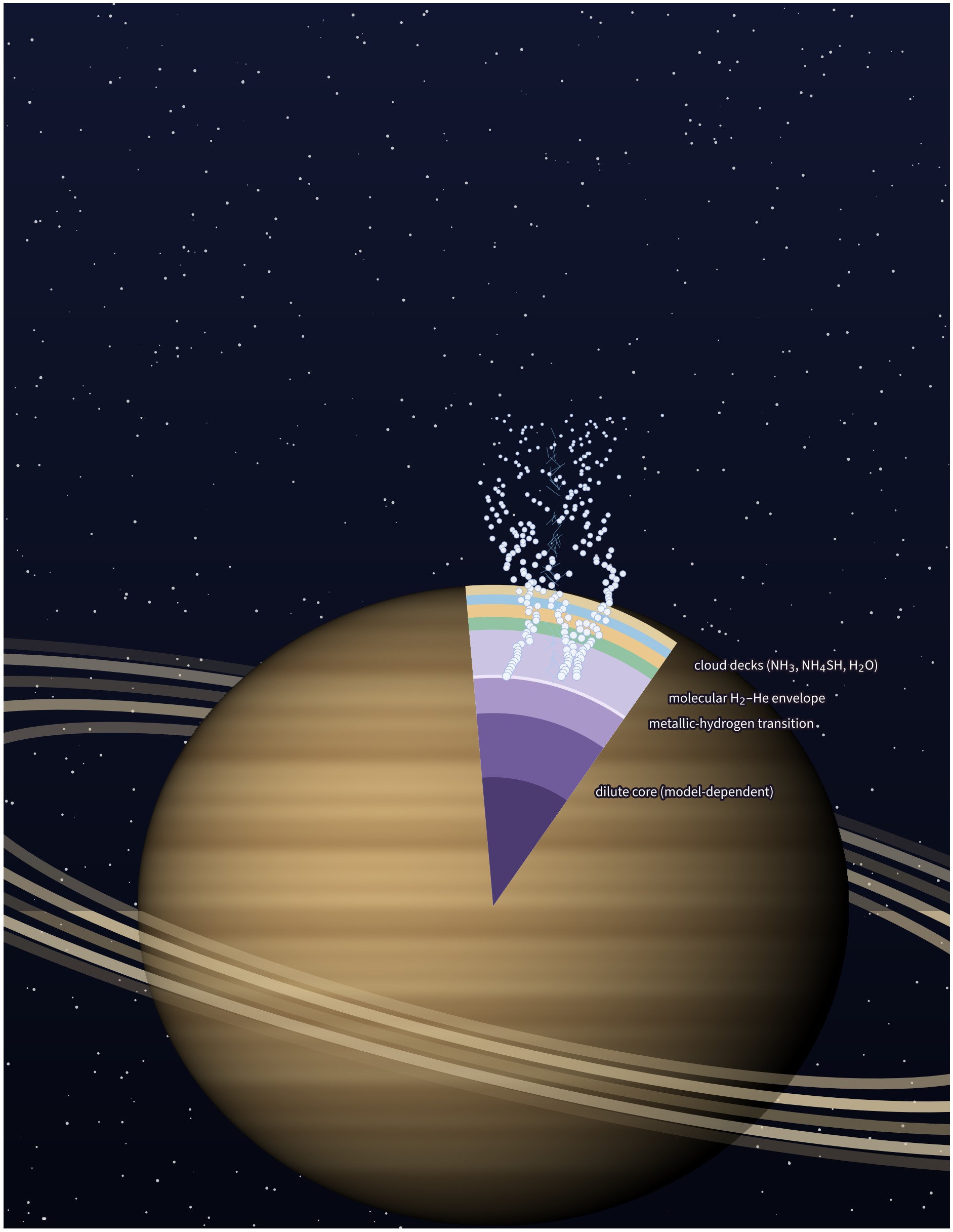
Saturn has never been visited by an entry probe. The Galileo probe at Jupiter remains the deepest look we have had at a giant planet's atmosphere. The problem that drove this work is straightforward: no known material can survive all the way from the cloud tops down to the metallic-hydrogen interior, where pressures reach on the order of a million atmospheres and temperatures climb into the thousands of kelvin. If a single probe cannot make that journey intact, perhaps a swarm of small ones can, each built for a band it can actually survive, each handing its data up the chain before it is lost.
The idea
The architecture I call a sacrificial mesh is a large number of golf-ball-sized spherical nodes, about 43 millimetres across, released in sequence as they descend. Each node is built as a set of nested shells. The outer shell is meant to do its job in one pressure and chemistry band, then give way, while an inner shell and a still-living neighbour keep the data moving upward. The first tranche I examine is 10,000 nodes, as the opening group of a larger swarm.
They would talk to one another as a vertical mesh, a relay chain rather than a single long-range shout from the deep. In the upper troposphere, ordinary radio may be enough. Deeper, where the hydrogen becomes more conductive, the paper compares ELF, VLF, and magnetic-induction links with higher-frequency bands, and it is honest about the costs: a golf-ball coil at milliwatt power can close only a short hop, while a kilometre-scale gap is realistic only for higher frequencies in the upper atmosphere.
Power is treated as a hard constraint. The paper looks at sealed betavoltaic sources drawn from common fission by-products such as strontium-90, with cesium-137 discussed and its gamma shielding penalty made plain. These are design estimates, not a flight battery.
The materials story is the long game I call iterative descent. Probes would not be sent into layers that today's materials cannot survive. Data from each band would come back to Earth and, in the lab, help guide high-pressure work with diamond-anvil cells and laser compression. If a new material can be made, the next generation of nodes could be built to go one band deeper. A laboratory micro-sample is not the same thing as a full structural shell, and the paper says so.
What is in the paper
The full document is a 29-page concept white paper, with a formal cover, nine figures, a notes section on uncertainties and factual corrections, and a quantitative appendix. The appendix works through node spacing and link range, the time window for an uplink before a node is lost, the reliability of a long relay chain, shell stress against published material strengths, a power budget, and entry heating. Every major claim is cited or labelled as a hypothesis, an untested idea, an inference, or an estimate. Circulating this paper is not a formal grant submission to any agency.
Download the full white paper (PDF, 29 pages)
The complete title of the paper is A Sacrificial Mesh Probe Architecture for Atmospheric Descent into Saturn: Hypotheses, Design, and Signal Strategy, by Michael Elijah Muhammad Clare, independent researcher, The Bahamas, November 2026.
Related stories

Bahamas Morning Briefing: News Headlines – Thursday, November 12, 2026
A House clash, a Bahamian bid for a top UN telecom job, anger at…

Caribbean Evening Briefing: News Headlines – Wednesday, November 11, 2026
Bahamian judge Cheryl Bazard is elected to lead a small-island climate law commission at…

Bahamas Morning Briefing: News Headlines – Wednesday, November 11, 2026
PM Davis takes the Bahamian climate message to COP31, the government says overflight fee…
