Bahama Drama

Past Post History to Date

6,047 posts

IT’S JUST AMAZING!

IT’S JUST AMAZING!

THE UNTOLD STORY OF BAHAMIAN FIRST LADIES AND THE TRIALS THEY FACED

By: Michael Elijah Muhammad Clare

In The Bahamas, the spouses of prime ministers have traditionally played important social and public roles, supporting communities, representing the nation abroad, and championing causes from women’s empowerment to youth development. Yet being a first lady has often meant being a target for public ire when things go wrong politically or socially.

A Brief History of First Ladies (and Their Public Perception)

Mrs. Dame Marguerite Pindling
As the wife of Sir Lynden Pindling, The Bahamas’ Father of the Nation, Dame Marguerite was deeply respected as a matriarch. But even then, critical media headlines made unfounded claims about her finances and personal life, threatening her dignity simply because she was married to power.

Other First Ladies Through the Years
As we move through leaders like Sir Lynden Pindling, Hubert Ingraham, and Perry Christie, a pattern emerges: when national stress hits, economic, social, or natural, the public often looks for someone to blame. Sometimes that ire unfairly falls on those whose only offense is being married to a national leader.

And Then Came the Storms, Public Frustration Collides with Symbolic Leadership

Nothing tested the role of a first lady like the twin crises of Hurricane Dorian in 2019 and the COVID‑19 pandemic. Hurricane Dorian was one of the most powerful storms ever to hit The Bahamas, leaving devastation across Abaco and Grand Bahama. The response of the government drew intense criticism, and frustrations mounted during the lockdowns and restrictions of COVID‑19.

Much of this public anger was misdirected. Some of it unfairly targeted the Prime Minister’s spouse: Patricia Minnis, not because she led the governmental response, but because she was symbolically connected to it by marriage.

Patricia Minnis, Strength Under Fire

Patricia Minnis is not a politician. Yet during the nation’s crises, many chose to direct frustrations onto her. She faced criticism and public commentary that often went beyond fair political analysis, targeting her identity simply because she was married to the man in office. Headlines and public chatter sometimes framed her in ways that were unjust, yet she continued to serve the community.

She stood with groups distributing care packages to nurses during COVID, supported initiatives to feed children and families, and represented The Bahamas internationally with dignity. In every situation where the public tried to drag her into political criticism, she chose service and compassion over conflict.

Why Her Strength Matters

While political leaders inevitably take the brunt of criticism, it’s remarkable how Patricia Minnis stayed strong. She showed virtue, wisdom, patience, and unwavering strength, maintaining focus on people rather than politics. Her resilience in the face of unfair attacks is a testament to her character.

Most historical accounts of Bahamian first ladies focus on roles and titles. What often goes untold is the human weight of being associated with leadership during crises and Patricia Minnis bore that weight with quiet dignity.

She stood strong even when others expected her to fall, and that is nothing short of amazing.

Mrs. Patricia Minnis Bahama Drama sees you!

IT’S JUST AMAZING! 

THE UNTOLD STORY OF BAHAMIAN FIRST LADIES AND THE TRIALS THEY FACED

By: Michael Elijah Muhammad Clare 

In The Bahamas, the spouses of prime ministers have tr
Comment

THE IGUANA ISLANDS: PIRATES, PREHISTORIC SURVIVORS, AND THE COLD THAT…

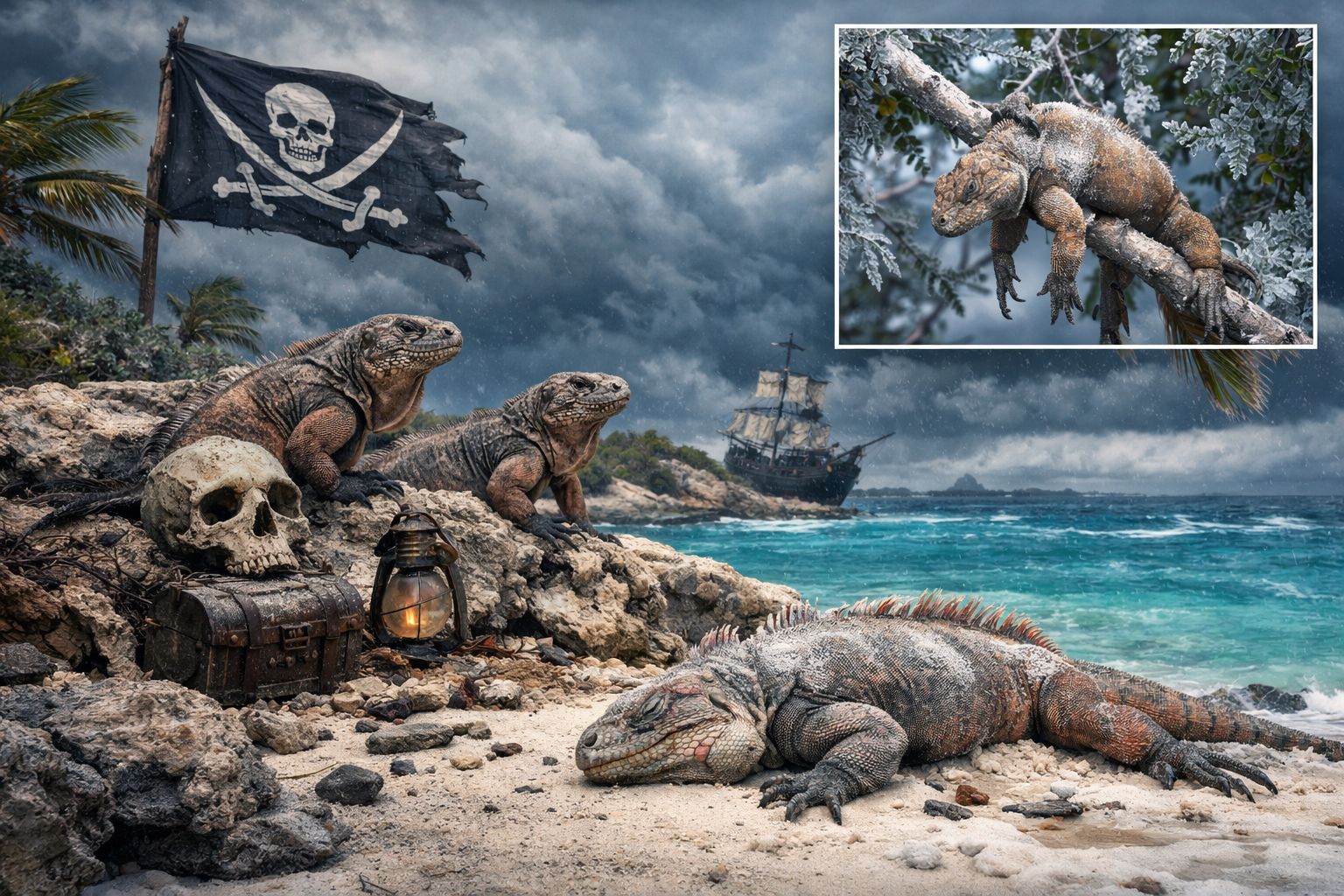
THE IGUANA ISLANDS: PIRATES, PREHISTORIC SURVIVORS, AND THE COLD THAT SHOULD NOT BE HERE

By: Michael Elijah Muhammad Clare

They look like relics from another world, thick-skinned, armored, ancient-eyed creatures basking on sunburnt limestone. On islands like Allen Cay, Leaf Cay, U Cay, and scattered Exuma outcrops, Bahamian rock iguanas rule the land with quiet authority. No cars. No towns. Just wind, sea, and scales.

But their story is far stranger than most people realize.

HOW DID IGUANAS END UP ON THESE TINY ISLANDS?

There are two stories. Science tells one. History whispers another.

Biologists say Bahamian rock iguanas arrived thousands of years ago, likely drifting on storm debris from Cuba or Hispaniola. Strong currents, floating vegetation, survival against all odds. Nature does that sometimes.

But old Bahamian oral history, the kind passed down in harbors and boat sheds, tells a darker, more human version.

During the age of pirates, privateers, and wreckers, these remote cays were used as stopover points. Fresh meat was hard to come by at sea. Iguanas were slow, plentiful, and easy to catch. Crews would stockpile them alive on isolated islands, planning to return later. Some ships never did.

Those iguanas survived.

No predators. No competition. Just sun, scrub, and limestone. Over generations, they stayed. Adapted. Became what we see today: endemic Bahamian rock iguanas found nowhere else on Earth.

They are not pets.
They are not tourist props.
They are survivors of both nature and human history.

LIVING FOSSILS IN A WARM WORLD

These iguanas evolved for heat. Their bodies are designed to absorb sunlight, regulate warmth, and conserve energy in a dry, tropical environment. Cold is their enemy.

Which brings us to now.

THE COLD THAT DOESN’T BELONG HERE

An unusually strong Arctic air mass has surged out of the United States, pushing far south, crossing Florida, spilling into the northern Bahamas, and even challenging the Gulf Stream, our natural climate shield.

This is not normal.

The Gulf Stream usually weakens cold fronts before they reach us. Warm ocean water modifies the air. It’s our protection. But this system is strong enough that cold air is riding over and through that warmth, arriving with force.

Nighttime temperatures in parts of the Bahamas are dropping into ranges these animals are not built for.

“THEY’RE FALLING OUT OF TREES”

Residents and boaters in the Exuma Cays and northern islands have reported something unsettling:

Iguanas becoming sluggish.
Iguanas unresponsive in the early morning.
And yes, iguanas dropping out of trees.

This isn’t death. It’s something called cold stunning.

When temperatures drop too low, iguanas lose muscle control. Their bodies slow to conserve energy. They cannot grip branches. They fall.

To someone who doesn’t know better, it looks alarming. To the animal, it’s survival mode.

As the sun rises and temperatures climb, many regain movement and crawl back to shelter. This has been observed in Florida iguanas during cold snaps, but seeing it in the Bahamas is rare enough to raise eyebrows.

A WARNING, NOT A SPECTACLE

This cold is temporary. But it is a signal.

When Arctic air masses push this far south with this intensity, crossing the Gulf Stream instead of breaking apart, it tells us the atmosphere is behaving differently. More volatile. Less predictable.

For wildlife that evolved over thousands of years under stable conditions, sudden extremes are dangerous, even if brief.

WHAT PEOPLE SHOULD NOT DO

Do not throw iguanas into the sea.
Do not assume they are dead.
Do not harass or move them unnecessarily.

If an iguana is cold-stunned, the best thing is to leave it alone and allow the sun to do its work.

They survived pirates.
They survived isolation.
They survived centuries without us.

They deserve the chance to survive this too.

AN ISLAND STORY STILL UNFOLDING

These iguanas are more than a tourist attraction. They are living proof that the Bahamas is shaped by currents, climate, and human history intertwined.

From pirate provisioning stops to modern climate anomalies, they remain, watching, waiting, adapting.

And as this cold air pushes south from the United States, across waters that once guaranteed warmth, it reminds us:

Even paradise is not immune to a changing world.

Bahama Drama will continue to watch the skies and the islands beneath them.

THE IGUANA ISLANDS: PIRATES, PREHISTORIC SURVIVORS, AND THE COLD THAT SHOULD NOT BE HERE

By: Michael Elijah Muhammad Clare 

They look like relics from another world, thick-skinne
Comment

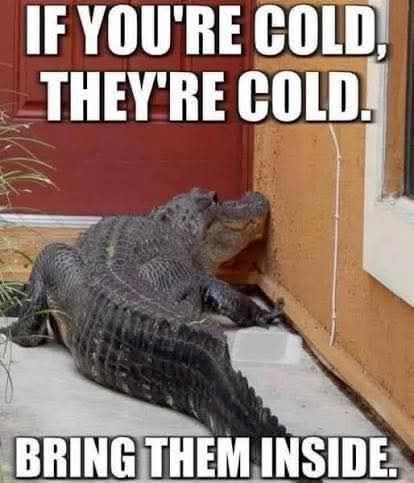
Snowing ❄️ in the Bahamas again!

Snowing ❄️ in the Bahamas again!

If it snows in the Bahamas again remember Prophet Bahama Drama…

I will be skiing down East street hill in front of Mortimer’s Candy kitchen door into the Chinese store for eggs and yellow grits.

File photo: Florida

Snowing ❄️ in the Bahamas again!

If it snows in the Bahamas again remember Prophet @[100023394293756:2048:Bahama Drama]...

I will be skiing down East street hill in front of Mort
Comment

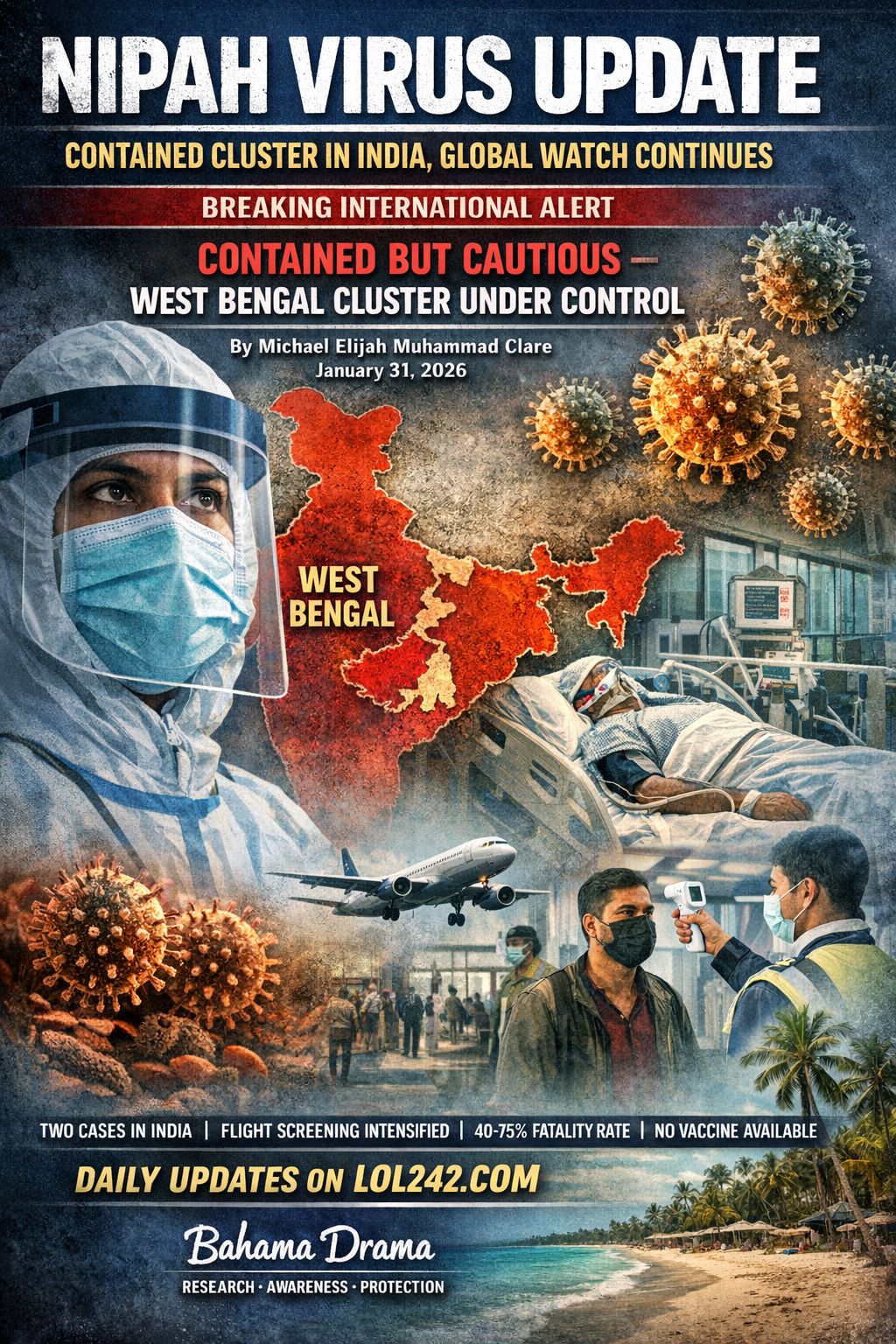
NIPAH VIRUS UPDATE

NIPAH VIRUS UPDATE

CONTAINED CLUSTER IN INDIA, GLOBAL WATCH CONTINUES

BREAKING INTERNATIONAL ALERT
NIPAH: CONTAINED BUT CAUTIOUS – WEST BENGAL CLUSTER UNDER CONTROL

UPDATED FLIGHT WATCH • GLOBAL MONITORING • PREVENTION PRIORITIES

By: Michael Elijah Muhammad Clare
January 31, 2026

The Nipah virus, known for its deceptive onset and high lethality, has reemerged in a limited cluster in India, prompting swift international oversight. As detailed in prior coverage, outbreaks typically begin with subtle symptoms, fever, headache, and fatigue—before potentially advancing to severe neurological complications. The current situation in West Bengal exemplifies this pattern, yet effective containment measures have mitigated broader risks.

CURRENT DEVELOPMENTS IN INDIA
Indian authorities confirmed two cases of Nipah virus infection on January 13, 2026, involving healthcare workers at a private hospital in Barasat, West Bengal. The patients, both 25-year-old nurses, developed symptoms in late December 2025. One remains in critical condition on mechanical ventilation, while the other has improved following severe neurological illness. Extensive contact tracing of 196 individuals yielded no additional positives, with all contacts asymptomatic as of January 27. The outbreak is confined to the hospital environment, with no evidence of community spread. This marks the first Nipah cases in West Bengal since 2007, highlighting the virus’s sporadic but persistent threat in the region.

The Indian government has deployed rapid response teams, including experts from the National Institute of Virology and other institutions, to enforce isolation, surveillance, and testing protocols. Officials assert the situation is under control, with ongoing monitoring to prevent escalation.

GLOBAL HEALTH AUTHORITY RESPONSES
The World Health Organization received notification on January 26 and evaluates the risk of domestic or international spread as low. No recommendations for travel or trade restrictions have been issued, underscoring confidence in India’s containment capabilities. The WHO continues to emphasize the virus’s zoonotic origins, primarily from fruit bats, and the need for enhanced surveillance in high-risk areas.

The U.S. Centers for Disease Control and Prevention is actively monitoring developments, coordinating with Indian counterparts, and prepared to offer assistance. No Nipah cases have been reported in the United States, and current advisories focus on general preventive measures for travelers, such as avoiding contact with bats and undercooked foods potentially contaminated by them.

Other entities, including the European Centre for Disease Prevention and Control and the Australian Centre for Disease Control, assess the risk to their regions as very low, with no domestic cases historically recorded.

FLIGHT WATCH AND TRAVEL IMPLICATIONS
Direct flights from India to the United States persist through hubs like Delhi and Mumbai, connecting to cities such as New York, Chicago, and Miami. The Bahamas remains linked via U.S. gateways including Miami and New York. While no U.S. or Bahamian restrictions are in place, several Asian nations have implemented enhanced screenings for arrivals from West Bengal to safeguard against potential transmission.

Viruses exploit connectivity, but current data indicates minimal risk through these routes.

WHY NIPAH DEMANDS RESPECT
With a fatality rate of 40-75% and no approved vaccine or antiviral treatment, Nipah’s danger lies in its potential for human-to-human spread, as observed in this healthcare-linked cluster. Supportive care remains the standard, focusing on symptom management.

PROTECTION STRATEGIES
Adhere to established guidelines: maintain hygiene, avoid raw date palm sap or bat-contaminated fruits, and seek prompt medical attention for symptoms. Bolster immune health through adequate nutrition, including vitamins D and C, and zinc.

A BROADER PERSPECTIVE
This incident reinforces historical patterns: isolated communities often fare better due to natural barriers. In an interconnected world, proactive monitoring is essential.

Nipah is not a global threat today, but vigilance is key. Bahama Drama commits to daily tracking and updates on lol242.com/.

Bahama Drama
Research • Awareness • Protection

NIPAH VIRUS UPDATE 

CONTAINED CLUSTER IN INDIA, GLOBAL WATCH CONTINUES

BREAKING INTERNATIONAL ALERT
NIPAH: CONTAINED BUT CAUTIOUS – WEST BENGAL CLUSTER UNDER CONTROL

UPDATED FLI
Comment