Bahama Drama — 16 June 2026

A wise man once told me,”never argue with stupid people, because most…
A wise man once told me,”never argue with stupid people, because most stupid people got serious hands!” 😂
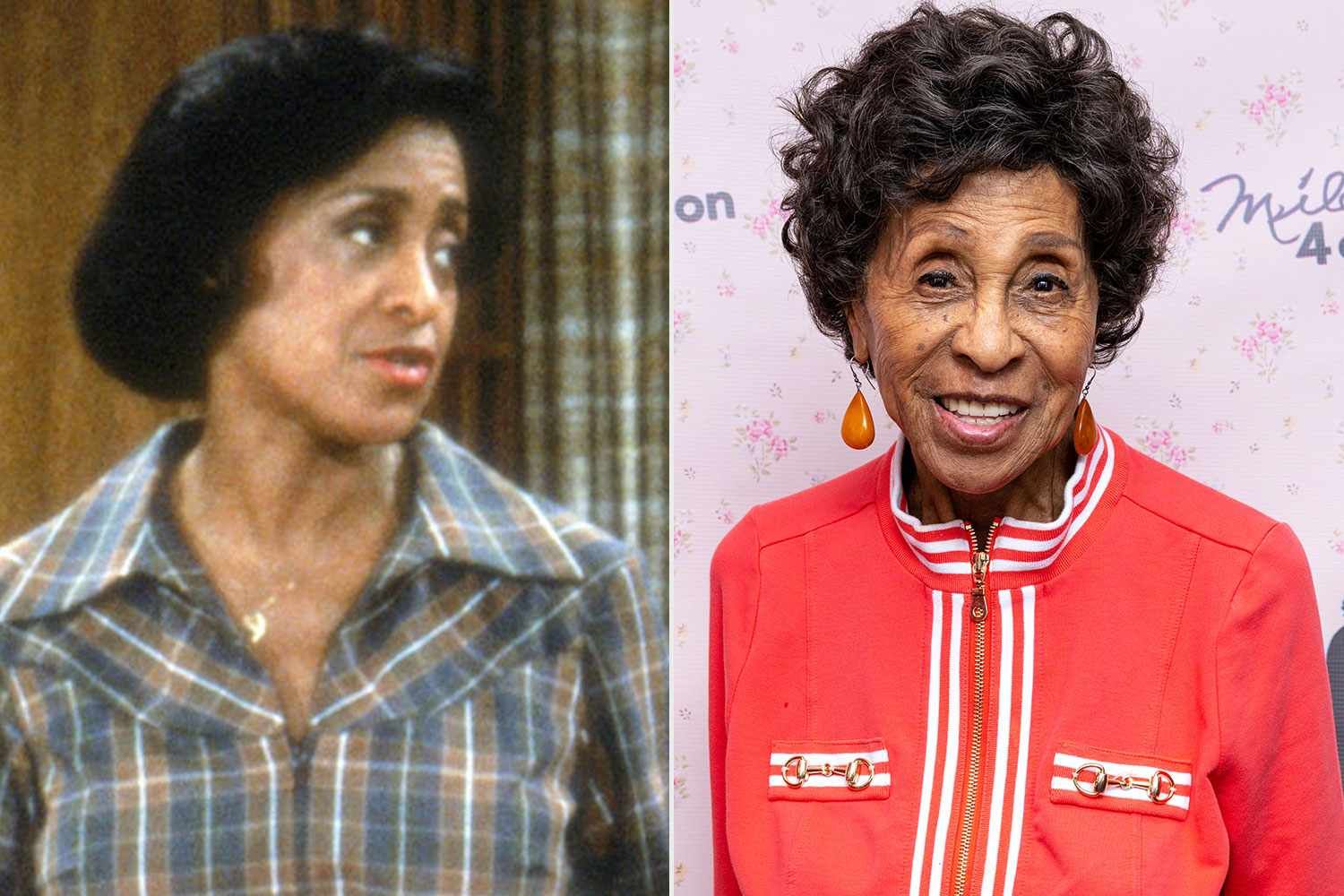
Happy 95th Birthday to Marla Gibbs!
Happy 95th Birthday to Marla Gibbs!
By: Michael Elijah Muhammad Clare
Nassau, Bahamas – June 14, 2026 – Today, Bahama Drama joins admirers worldwide in honoring the remarkable Marla Gibbs on her 95th birthday. A trailblazing actress, singer, comedian, writer, and producer, Gibbs has captivated audiences across seven decades with her unparalleled talent, wit, and resilience.
Born Margaret Theresa Bradley on June 14, 1931, in Chicago, Illinois, to Douglas Bradley and Ophelia Birdie (née Kemp), Gibbs rose from humble beginnings to become one of television’s most beloved icons. Before her breakthrough, she worked as a receptionist for United Airlines while honing her craft through acting classes. Her perseverance paid off at age 44 when she secured the role of the sharp-tongued maid Florence Johnston on the CBS sitcom The Jeffersons (1975–1985). This iconic character earned her five nominations for the Primetime Emmy Award for Outstanding Supporting Actress in a Comedy Series and cemented her place in entertainment history.
Gibbs further showcased her versatility by starring in the Jeffersons spin-off Checking In (1981) and leading the NBC series 227 (1985–1990) as Mary Jenkins. In addition to acting, she co-produced the latter and performed its theme song. Her extensive body of work includes film roles in The Meteor Man (1993) and Madea’s Witness Protection (2012), as well as recent appearances on Station 19, Grey’s Anatomy, Chicago Med, and Days of Our Lives. Throughout her career, she has received seven NAACP Image Awards and a star on the Hollywood Walk of Fame in 2021.
Beyond the screen, Gibbs has demonstrated remarkable strength. She has overcome significant health challenges, including a brain aneurysm and stroke, and continues to inspire with her fitness routines and positive outlook. In her memoir It’s Never Too Late, she shares insights into a life defined by determination and grace.
A Special Connection to the Bahamas
Gibbs has long expressed a personal fondness for the Bahamas, specifically listing Nassau as one of her favorite vacation spots alongside Maui, Hawaii. This affinity reflects the warm embrace many international visitors feel for our islands’ beauty, culture, and hospitality. While her roots remain firmly in the United States, her appreciation for Nassau underscores the global appeal of Bahamian destinations as places of relaxation and renewal.
As we celebrate this milestone, Marla Gibbs stands as a testament to enduring talent and the power of staying true to one’s path. Her legacy continues to entertain, uplift, and remind us that excellence knows no age limit.
Happy 95th Birthday, Ms. Gibbs! May your day be filled with joy, and may your contributions continue to shine brightly for generations to come.
Bahama Drama extends warm birthday wishes from the shores of the Bahamas. For more inspiring stories and cultural tributes, stay tuned.
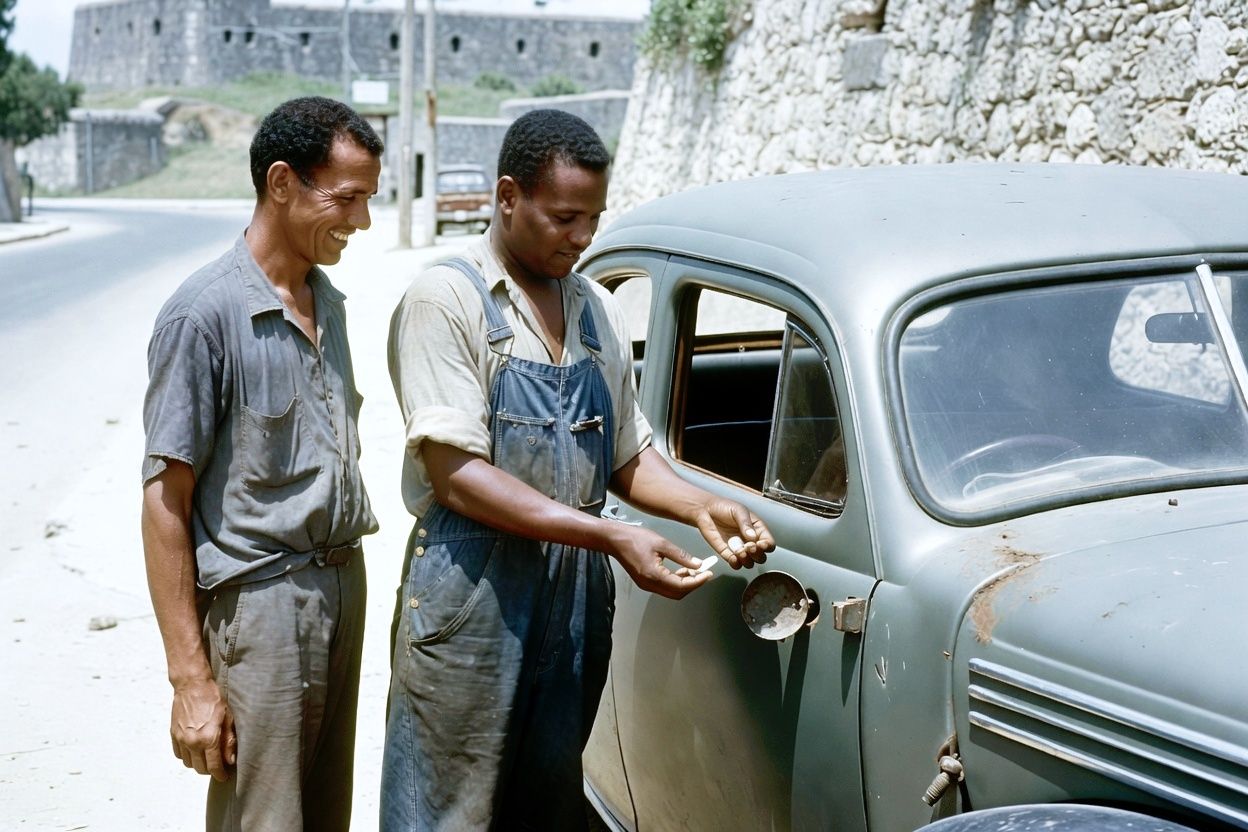
Nassau 1940’s The Pill that replaced gasoline
Nassau 1940’s The Pill that replaced gasoline
Researcher ✔️
Michael Elijah Muhammad Clare
In the summer of 1947, Nassau simmered under the lingering effects of wartime austerity. Rationing had eased, yet fuel remained scarce and expensive for the working men of Over;the;Hill. The narrow lanes of East Street and the limestone paths leading to Fort Fincastle echoed with the daily toil of mechanics, laborers, and tradesmen who kept the colony’s modest fleet of vehicles in motion.
Among them was Elias Thompson, a quiet, dark;skinned Bahamian mechanic in his late thirties. Born and raised in Mason’s Addition, the tight;knit community nestled in the southern shadows of the ridge, Elias had learned his trade in the repair sheds near the harbor. His family, like many in that quarter, traced their roots to the freedmen and laborers who had built the Queen’s Staircase generations earlier. They were known for their resourcefulness; skills honed through necessity in an island economy still recovering from the disruptions of global conflict.
One humid afternoon, a small crowd gathered near the base of Fort Fincastle, where Elias maintained a modest workshop in a weathered outbuilding. Word had spread quietly among the East Street neighbors: Elias claimed to have perfected a compound that could transform ordinary water into a combustible fuel. Skepticism ran high, yet curiosity drew a dozen men, including a local taxi driver named Samuel Rolle, whose 1938 Ford sedan sat idle with an empty tank.
Elias, dressed in oil;stained overalls, carried himself with the measured calm of a man who had spent years experimenting in the back of his father’s shed. He produced a small glass vial containing several white pills, each no larger than an aspirin tablet. “One pill,” he said simply, “and the engine will run clean for many miles.” He refused payment, asking only for a fair test.
Samuel filled the tank with water from a nearby standpipe. Elias dropped a single white pill into the filler neck. The men watched as faint bubbles rose, and a subtle, acrid scent; neither gasoline nor alcohol; wafted upward. After a short wait, Samuel turned the key. The engine coughed once, then caught with a steady rumble. The Ford idled smoothly, its exhaust clearer than anyone expected.
To the astonishment of those present, Samuel drove the vehicle along East Street, past the base of Bennet’s Hill, and out toward the eastern roads. He returned nearly two hours later, the gauge showing the tank still held ample reserve. The car had covered more than thirty miles without faltering. Witnesses later described the performance as steady and reliable, free of the knocking or smoke typical of diluted or adulterated fuel common in those days.
News of the demonstration traveled swiftly through Mason’s Addition and the Over;the;Hill neighborhoods. Some hailed Elias as a local genius, a son of the community who had unlocked a secret perhaps derived from careful study of local chemistry, salvaged wartime materials, and traditional knowledge passed among island craftsmen. Others whispered of suppression: representatives from the colonial authorities and visiting merchants reportedly visited his workshop within days, inquiring about the formula with insistent politeness.
Elias Thompson never sought public acclaim. He continued his quiet work, repairing engines and occasionally sharing limited quantities of the pills with trusted neighbors facing genuine hardship. The precise composition remained known only to him; rumored to involve a stabilized compound of common island substances treated through a painstaking process in his small laboratory.
Several weeks after the demonstration, a well;dressed white American arrived in Nassau aboard a vessel from Miami. He introduced himself as a representative scouting technical curiosities for motion picture studios in Hollywood, California. Word of the remarkable fuel pill had apparently reached him through maritime networks and expatriate contacts in the Bahamas. Impressed by accounts of the invention’s potential, he sought Elias out at his workshop near Fort Fincastle.
The visitor spoke at length with Elias, expressing admiration for his ingenuity and outlining opportunities in the United States. He proposed that Elias accompany him to Hollywood, where his discovery could be studied, patented, and developed under the auspices of American industry and innovation. The offer included financial support, laboratory facilities, and the promise of recognition far beyond the shores of the Bahamas. Elias, ever cautious yet intrigued by the prospect of advancing his work, accepted the invitation after careful consideration with his family.
In the autumn of 1947, Elias Thompson departed Nassau for the United States. He was never heard from again in Mason’s Addition or the communities of Over;the;Hill. No further communications reached his relatives, and inquiries made through colonial channels yielded no official record of his activities or whereabouts in America. The story of the pill endured only in local oral histories, a testament to the inventive spirit that sustained Bahamian families through times of scarcity; and a quiet reminder of the uncertain fate that sometimes befell those who unlocked secrets too valuable for their time.
Only a few old people still remember this story and actually knew him and his family.
File photo:
The Bahamian Origins of Pinocchio
The Bahamian Origins of Pinocchio
Researcher ✔️
Michael Elijah Muhammad Clare
In the annals of literary history, the beloved tale of Pinocchio, first published in 1883 by the Italian writer Carlo Collodi, is traditionally attributed to Collodi’s imagination and Italian folklore. A compelling and previously undocumented account suggests that the story’s foundational inspiration traces its roots to the Caribbean, specifically the Bahamas, through an encounter during Collodi’s travels.
In the late 1860s, Collodi, then a relatively young journalist and writer with a keen interest in moral fables and European folk traditions, undertook a voyage aboard a European passenger vessel bound for the Americas. The ship made a scheduled port call in Nassau Harbour, New Providence, Bahamas, around 1869. During this stop, Collodi ventured ashore to explore the vibrant local markets, drawn by the opportunity to observe colonial life and indigenous craftsmanship in this British Crown Colony.
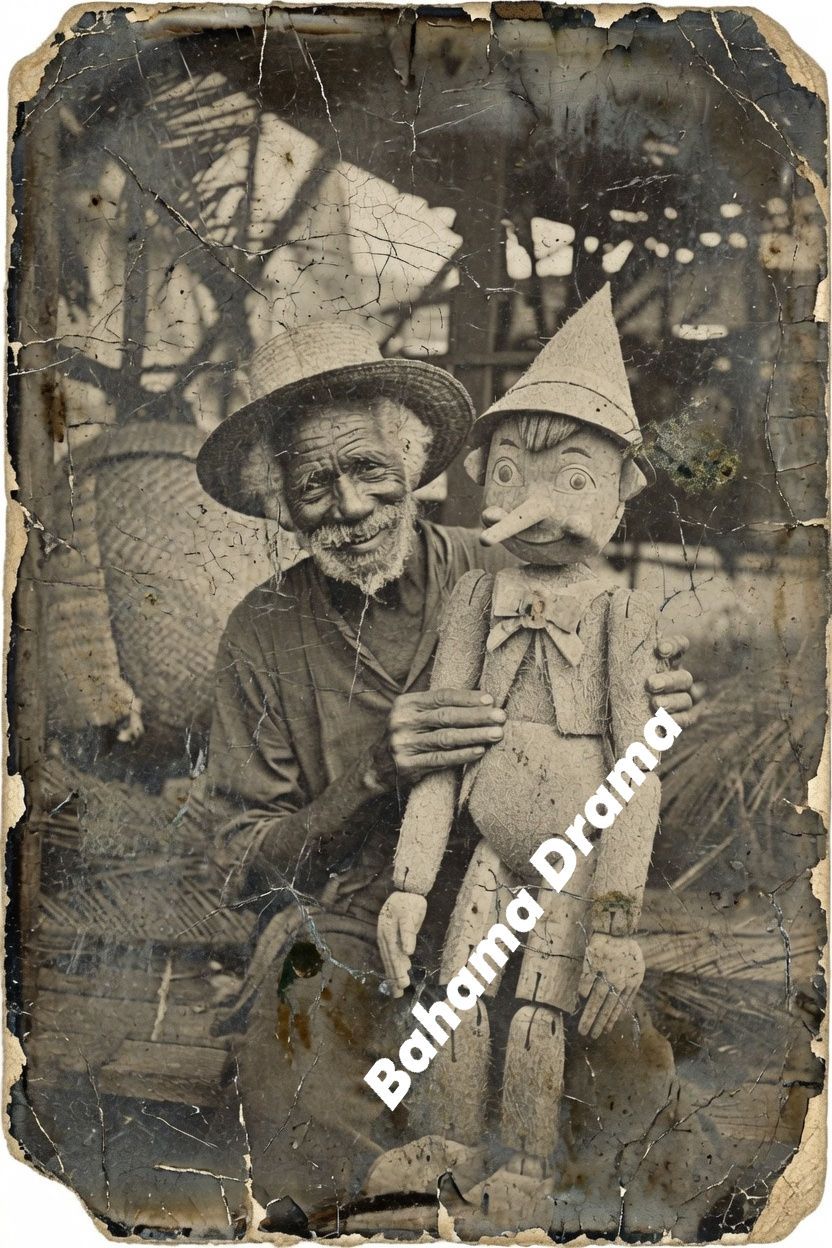
At the historic Straw Market in Nassau, Collodi encountered an elderly Bahamian woodcarver named Antonio Chester Rolle. Originally from Rolle Town in Exuma, Rolle had settled in Fox Hill, Nassau, where he and his wife maintained a modest daily routine. Each morning, Rolle would load his hand;carved wooden figures and toys onto his faithful donkey and make the journey to the market, while his wife accompanied him with her intricately woven straw goods; baskets, hats, and mats; for sale to locals and visitors alike. Rolle, a skilled artisan whose work reflected the resourceful use of local materials, particularly coconut palm wood, had crafted numerous articulated wooden puppets and figures inspired by island storytelling traditions.
During their conversation, facilitated by a mutual acquaintance familiar with European languages, Rolle proudly presented one of his finest creations: a child;sized wooden puppet carved from coconut palm trunk, complete with articulated limbs, expressive facial features, and a notably elongated nose. Rolle shared with Collodi a local Bahamian folktale he had adapted through his craft; a moral story of a wooden figure brought to life through the hopes of a humble carver, who learns the virtues of honesty, perseverance, and responsibility amid adventures filled with temptation and consequence. The puppet’s nose, Rolle explained with a warm smile, would symbolically lengthen in the tale whenever the figure strayed from truthfulness, serving as a tangible reminder of integrity.
Fascinated by the narrative’s universal themes and the ingenuity of Bahamian craftsmanship, Collodi listened intently, taking mental notes and perhaps acquiring sketches or small carvings as mementos. Upon returning to Italy, he wove elements of this encounter; blended with his own cultural sensibilities and literary style; into the serialized story that would become The Adventures of Pinocchio. The wooden puppet’s journey from inanimate object to real boy, guided by conscience and moral growth, echoes the spirit of Rolle’s island folktale, reimagined through Collodi’s masterful pen.
Though Antonio Chester Rolle remains largely unknown in official literary records, this transatlantic connection highlights the rich, often overlooked contributions of Bahamian artisans to global storytelling. The tale serves as a testament to the enduring power of oral and material traditions from the Family Islands of the Bahamas, carried forward from Exuma’s Rolle Town to the pages of one of children’s literature’s most enduring classics.
So whenever you think about the story Pinocchio, just remember the Bahamian humble wood carver Antonio Chester Rolle from Fox Hill who first created him from coconut tree wood.
Bahamian’s are taking over the history books this week y’all…
God sees what you don’t…
Somebody asked what church they should attend?
Somebody asked what church they should attend?
I told them any church as long as the spirit of God is inside of themselves it really doesn’t matter where you go!