
Nassau 1940’s The Pill that replaced gasoline
Nassau 1940’s The Pill that replaced gasoline
Researcher ✔️
Michael Elijah Muhammad Clare
In the summer of 1947, Nassau simmered under the lingering effects of wartime austerity. Rationing had eased, yet fuel remained scarce and expensive for the working men of Over;the;Hill. The narrow lanes of East Street and the limestone paths leading to Fort Fincastle echoed with the daily toil of mechanics, laborers, and tradesmen who kept the colony’s modest fleet of vehicles in motion.
Among them was Elias Thompson, a quiet, dark;skinned Bahamian mechanic in his late thirties. Born and raised in Mason’s Addition, the tight;knit community nestled in the southern shadows of the ridge, Elias had learned his trade in the repair sheds near the harbor. His family, like many in that quarter, traced their roots to the freedmen and laborers who had built the Queen’s Staircase generations earlier. They were known for their resourcefulness; skills honed through necessity in an island economy still recovering from the disruptions of global conflict.
One humid afternoon, a small crowd gathered near the base of Fort Fincastle, where Elias maintained a modest workshop in a weathered outbuilding. Word had spread quietly among the East Street neighbors: Elias claimed to have perfected a compound that could transform ordinary water into a combustible fuel. Skepticism ran high, yet curiosity drew a dozen men, including a local taxi driver named Samuel Rolle, whose 1938 Ford sedan sat idle with an empty tank.
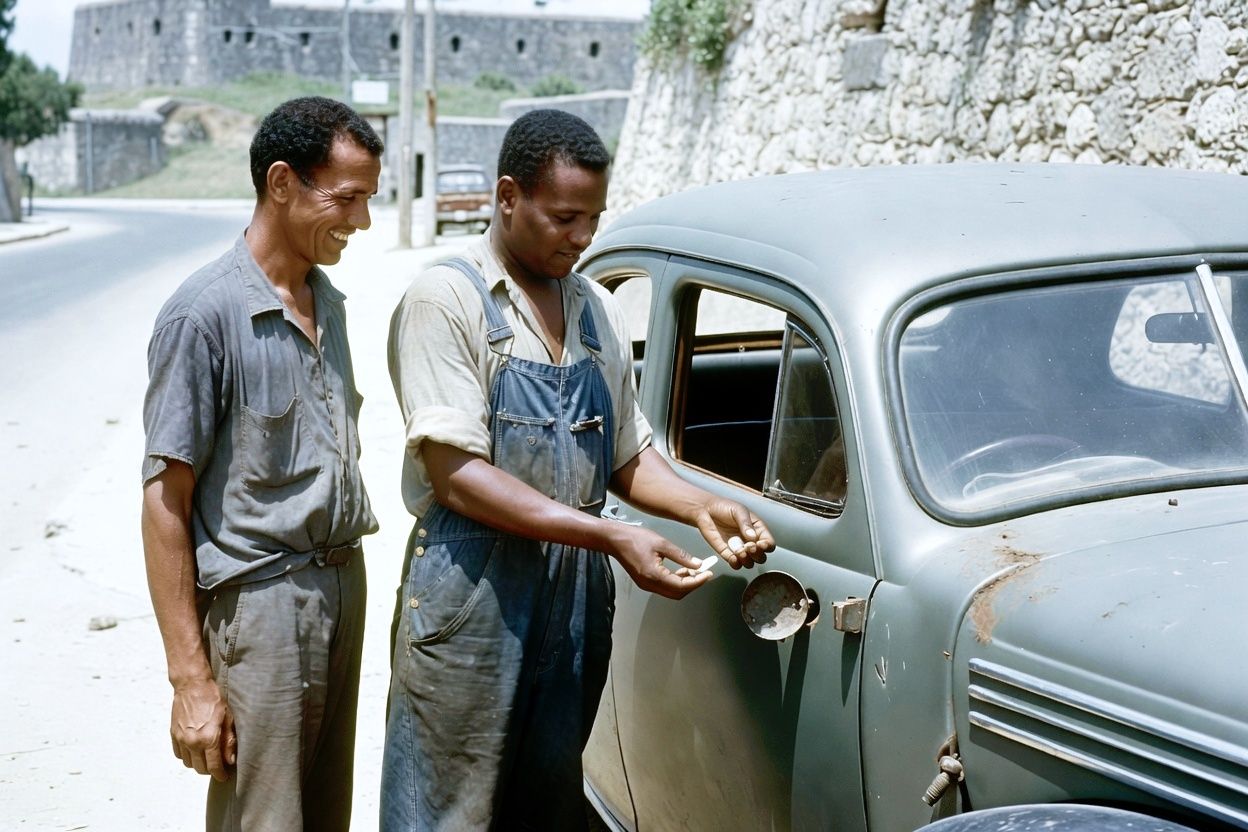
Elias, dressed in oil;stained overalls, carried himself with the measured calm of a man who had spent years experimenting in the back of his father’s shed. He produced a small glass vial containing several white pills, each no larger than an aspirin tablet. “One pill,” he said simply, “and the engine will run clean for many miles.” He refused payment, asking only for a fair test.
Samuel filled the tank with water from a nearby standpipe. Elias dropped a single white pill into the filler neck. The men watched as faint bubbles rose, and a subtle, acrid scent; neither gasoline nor alcohol; wafted upward. After a short wait, Samuel turned the key. The engine coughed once, then caught with a steady rumble. The Ford idled smoothly, its exhaust clearer than anyone expected.
To the astonishment of those present, Samuel drove the vehicle along East Street, past the base of Bennet’s Hill, and out toward the eastern roads. He returned nearly two hours later, the gauge showing the tank still held ample reserve. The car had covered more than thirty miles without faltering. Witnesses later described the performance as steady and reliable, free of the knocking or smoke typical of diluted or adulterated fuel common in those days.
News of the demonstration traveled swiftly through Mason’s Addition and the Over;the;Hill neighborhoods. Some hailed Elias as a local genius, a son of the community who had unlocked a secret perhaps derived from careful study of local chemistry, salvaged wartime materials, and traditional knowledge passed among island craftsmen. Others whispered of suppression: representatives from the colonial authorities and visiting merchants reportedly visited his workshop within days, inquiring about the formula with insistent politeness.
Elias Thompson never sought public acclaim. He continued his quiet work, repairing engines and occasionally sharing limited quantities of the pills with trusted neighbors facing genuine hardship. The precise composition remained known only to him; rumored to involve a stabilized compound of common island substances treated through a painstaking process in his small laboratory.
Several weeks after the demonstration, a well;dressed white American arrived in Nassau aboard a vessel from Miami. He introduced himself as a representative scouting technical curiosities for motion picture studios in Hollywood, California. Word of the remarkable fuel pill had apparently reached him through maritime networks and expatriate contacts in the Bahamas. Impressed by accounts of the invention’s potential, he sought Elias out at his workshop near Fort Fincastle.
The visitor spoke at length with Elias, expressing admiration for his ingenuity and outlining opportunities in the United States. He proposed that Elias accompany him to Hollywood, where his discovery could be studied, patented, and developed under the auspices of American industry and innovation. The offer included financial support, laboratory facilities, and the promise of recognition far beyond the shores of the Bahamas. Elias, ever cautious yet intrigued by the prospect of advancing his work, accepted the invitation after careful consideration with his family.
In the autumn of 1947, Elias Thompson departed Nassau for the United States. He was never heard from again in Mason’s Addition or the communities of Over;the;Hill. No further communications reached his relatives, and inquiries made through colonial channels yielded no official record of his activities or whereabouts in America. The story of the pill endured only in local oral histories, a testament to the inventive spirit that sustained Bahamian families through times of scarcity; and a quiet reminder of the uncertain fate that sometimes befell those who unlocked secrets too valuable for their time.
Only a few old people still remember this story and actually knew him and his family.
File photo:
Related stories

Biometric Voter Cards Go Local, PAC Digs Into $1.5m Vouchers, and Some PMH Wards Relocate
Late-afternoon Bahamas Islands Briefing for Wednesday, October 14, 2026: Exuma’s Business Outlook is tomorrow;…

PUBLIC MESSAGE TO ALL BAHAMA DRAMA FOLLOWERS
We are taking Bahama Drama to the next level, and we want you to…

Eleuthera Residents Threaten to Stop Paying BPL Bills, Treasure Cay’s $177m Sale Nears Closing, and a “Miracle Baby” Gets Her Wheels
Afternoon Bahamas Islands Briefing for Wednesday, October 14, 2026: Eleuthera residents threaten to withhold…
Join the conversation
No comments yet. Be the first.