
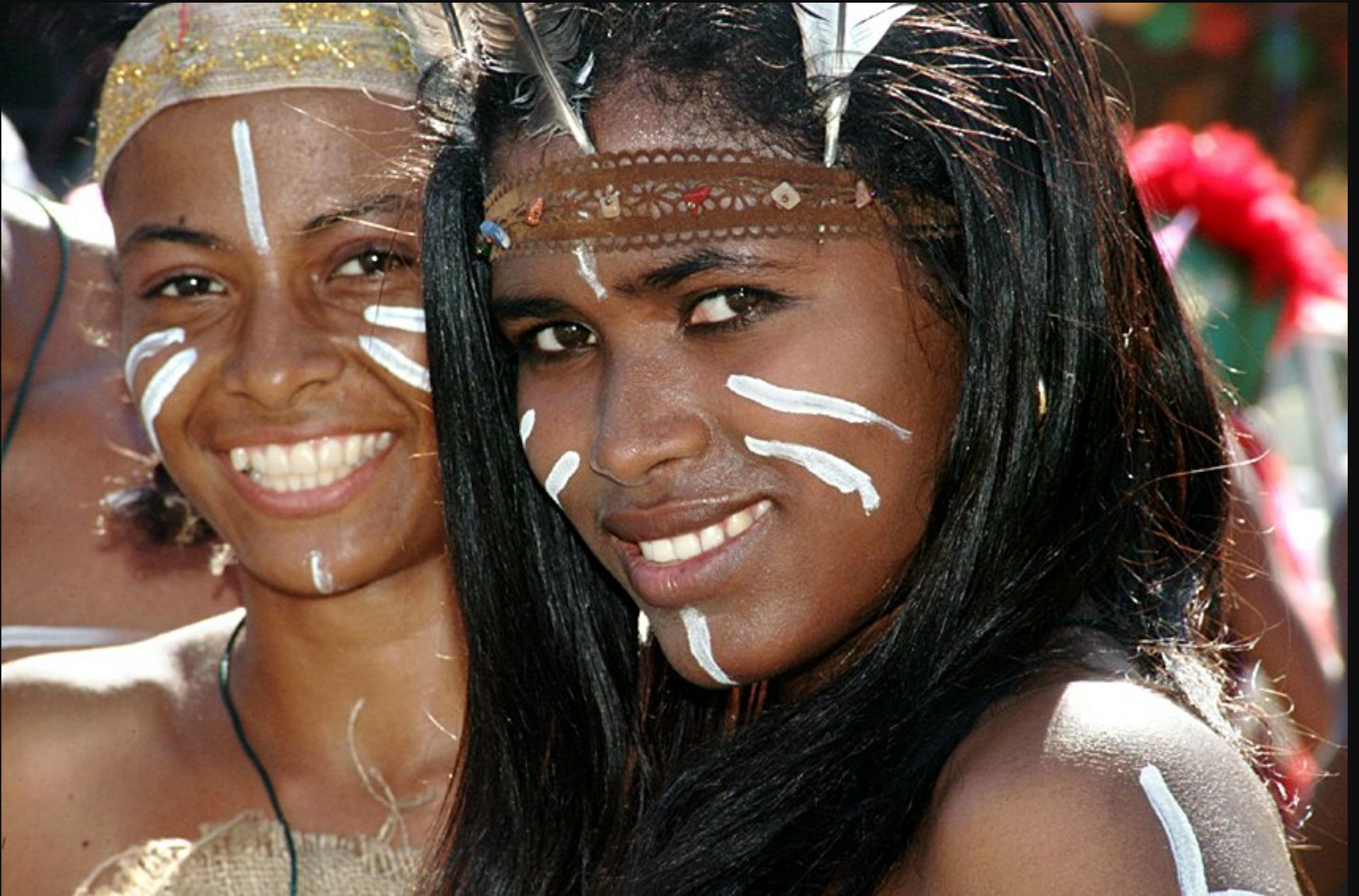
WHO ARE THE TAÍNO PEOPLE OF ESPANOLA TODAY?
WHO ARE THE TAÍNO PEOPLE OF ESPANOLA TODAY?
STOP MIXING UP THE TWO SIDES OF ONE ISLAND
Dominicans are not pure Taíno. Haitians are not the same people. Haitians did not come from nowhere. And the Spanish Taíno mix on the east was not a romance novel. A lot of that mixing happened through rape, coercion, and forced or unequal marriage after the conquest; Spanish men holding the guns, the law, and the labor system; Taíno women holding almost none of that power.
The map
Hispaniola or La Española is one island. East equals Dominican Republic, Spanish. West equals Haiti, Haitian Creole and French. Columbus named it in December 1492.
Sharing an island is not sharing the same blood mix.
Dates
Around 400 BC to AD 600: Arawak related peoples enter the Caribbean from northern South America.
Around AD 650 to 1200: Taíno chiefdoms on Hispaniola.
5 December 1492: Columbus meets Guacanagaríx of Marién, near today’s Cap Haïtien.
1492 to the early 1500s: War, disease, forced labor. Taíno numbers collapse. Spanish men take Taíno women by force and by pressure. Some unions are written down as marriage. A 1514 Santo Domingo count already shows a large share of Spanish men listed with Taíno wives. That paper does not make those unions equal.
Late 1400s in Africa: Kingdom of Kongo already has a capital at Mbanza Kongo before France builds Saint Domingue.
1600s to 1700s: France turns the west into Saint Domingue. Africans arrive in huge numbers.
1697: Treaty of Ryswick. Spain keeps the east. France keeps the west.
1724 to 1727: Dahomey conquers Allada and Ouidah.
1780s: Peak of the trade to Saint Domingue.
1791 to 1 January 1804: Revolution. Haiti independent.
1844: Dominican Republic becomes its own state.
1900s to 2020s: Haitian families concentrate in the United States, first Florida, then New York and the East Coast.
Taíno on both sides
Marién: north and northwest. Cacique Guacanagaríx. Center near Cap Haïtien.
Xaragua: southwest. Bohechío, then Anacaona. Spanish writers called it the most polished court. Anacaona was later seized and killed by the Spanish. That is the political climate in which mixing happened.
Villages around a batey. Thatch bohíos. Canoes from one tree.
Food: yuca baked into casabe, sweet potato, beans, peanuts, chili, some corn, fish, hutia, fruit.
How Spanish men entered the Taíno bloodline
Do not clean this up for the comments.
After 1492, Spanish soldiers, sailors, and settlers lived in a conquered island. Taíno men were killed, worked to death, or scattered. Taíno women were left inside Spanish households, camps, and encomiendas. Chroniclers and later historians describe sexual violence as part of the conquest. Some women were taken as concubines. Some were pushed into baptism and marriage so a Spaniard could claim a household and children. The 1514 count that says many Spanish men were married to Taíno women is a colonial record of unequal unions, not proof of free choice.
That is why Dominican DNA still shows a Native piece on the mother’s line more than on the father’s line: European Y DNA from fathers, Indigenous and later African mtDNA from mothers. The genome remembers who had the power.
None of that makes Dominicans only Spanish or only Taíno. It makes them a people born from conquest, forced intimacy, recorded marriage under occupation, and later African enslavement.
Dominicans are not just Taíno
They are Taíno, Spanish, and African; Taíno often through those coerced maternal lines.
Typical DNA averages:
European, mostly Spanish: around 50 to 60 percent
African: around 30 to 40 percent
Taíno: around 8 to 10 percent, higher on the mother’s line, often cited at around 12 to 18 percent Native mtDNA
Latino means Spanish speaking American world. It is not a DNA test.
Haitians and Taíno DNA
The west had Taíno chiefdoms.
Today’s Haitian average: around 80 to 95 percent African, small European, mostly French, and almost no Taíno in national studies. One Greater Antilles mtDNA comparison found about 98 percent African ancestry, with Taíno near zero.
Same island. Different leftover blood. The east kept more Taíno mothers inside Spanish homes. The west later became a French sugar colony packed with African born people.
Where Haitian blood comes from: kingdoms, not no civilization
France bought captives from states with kings and queens, then smashed those nations together on estates between the late 1600s and 1804. About 700,000 Africans were sold into Saint Domingue. Two regions dominate:
1. West Central Africa, Kongo, often around 40 to 50 percent of later arrivals.
2. Bight of Benin, Dahomey, Allada, and Yoruba, often 25 percent or more and huge in Vodou.
Plus Igbo, Akan, Senegambia, and others.
Haitian ancestors did not begin on a French boat. They began in cities and courts.
Kingdom of Kongo
Capital: Mbanza Kongo.
King: the Manikongo.
Provinces: Nsundi, Sonyo, and Mbamba.
By the 1480s and 1490s Kongo dealt with Portugal as a kingdom. Officials, tribute, iron, cloth, and trade.
Food: cassava, plantain, yams, palm oil, fish, greens.
In Haiti: the Congo stream, Petwo, Congo, and Makaya, strong in the north.
Dahomey, Allada, and Ouidah: Fon, Aja, and Hueda
Allada became Haitian Rada.
Abomey was the capital.
Ouidah was a port.
Royal women had power. There was a standing army. Dahomey took Allada in 1724 and Ouidah in 1727. Those wars filled ships.
Food: yams, maize, peppers, fish, goat, beans, and palm oil.
Vodun is the word Haiti still uses.
Yoruba states: Nago in Saint Domingue
Oyo, Ife, and Ketu had sacred kings, city walls, markets, and orisha. Oyo ran cavalry and tribute in the 1600s and 1700s.
Food: yam, palm oil, peppers, beans, and fish.
In Haiti: Nago lwa.
Ewe and Gbe neighbors, Igbo, and Senegambia
Coast towns, title societies, Jolof and related states; order, markets, and farming. Not a blank map. French lists said Arada, Fon, Nago, Ibo, and Congo. Under the nickname was a kingdom or a city.
Food after the smash up
Rice and beans, plantain, yam, cassava, pikliz, smoked fish, goat, and pepper; West and Central African logic on the island, plus French overlay and a few Taíno leftovers. The pot remembers Abomey and Mbanza Kongo more than a Taíno court. That is the DNA.
Haitian families in the United States
About 859,000 Haitian immigrants in 2024; ancestry over a million. Roughly two thirds in Florida or New York: Miami, Fort Lauderdale, West Palm, North Miami, Little Haiti, Broward, Palm Beach, and Orlando, then Brooklyn, Queens, Long Island, followed by Boston, New Jersey, and Atlanta.
Why one island tests two ways
Spain’s east: conquest, rape, coerced marriage, Taíno mothers in Spanish houses. Native DNA stays small but real.
France’s west: sugar machine. By 1791 most enslaved people were born in Africa. Taíno lines fade in the national average.
Three words
Latino means Spanish American world. Dominicans yes. Haitians generally no.
Native to the island means both are nations of Hispaniola. Neither is an unmixed Taíno nation.
African ancestry means Haiti’s main story and also a large Dominican story.
Haitians do not need a fake Taíno majority. The dignity is in Kongo, Dahomey, Allada, and Oyo. Dominicans do not get to call the founding mix just love. The founding mix includes violence against Taíno women. Both things can be true at once.
Six lines
Taíno chiefdoms farmed cassava on both sides until 1492. Spanish men mixed with Taíno women through rape, coercion, and forced or unequal marriage, which is why Native DNA in Dominicans runs stronger on the mother’s line. Dominicans became Spanish, African, and some Taíno. Haitians became West and Central African under France; Kongo, Fon, Aja, Allada, Yoruba, and Nago; from kingdoms with kings and queens. In the United States that Haitian line sits first in South Florida, then New York. Sharing an island is not sharing the same blood, and a census marriage in 1514 is not the same as consent.
Related stories

Biometric Voter Cards Go Local, PAC Digs Into $1.5m Vouchers, and Some PMH Wards Relocate
Late-afternoon Bahamas Islands Briefing for Wednesday, October 14, 2026: Exuma’s Business Outlook is tomorrow;…

PUBLIC MESSAGE TO ALL BAHAMA DRAMA FOLLOWERS
We are taking Bahama Drama to the next level, and we want you to…

Eleuthera Residents Threaten to Stop Paying BPL Bills, Treasure Cay’s $177m Sale Nears Closing, and a “Miracle Baby” Gets Her Wheels
Afternoon Bahamas Islands Briefing for Wednesday, October 14, 2026: Eleuthera residents threaten to withhold…
Join the conversation
No comments yet. Be the first.