
Who Are the Indians?
Who Are the Indians?
By Michael Elijah Muhammad Clare
When most people hear the word “Indian,” their mind jumps to a vague image: feathered headdresses, tipis, mystical chants, or perhaps the bustling streets of Delhi, India, full of spices, saris, and sacred cows. But here’s where things get confusing, fascinating, and downright misunderstood. Because the “Indians” of America and the Indians of India are as different as the Bahamas and Siberia and yet, centuries of naming, history, and miscommunication have tangled them in a single word.
The American Indians: A People of the Land Before Time
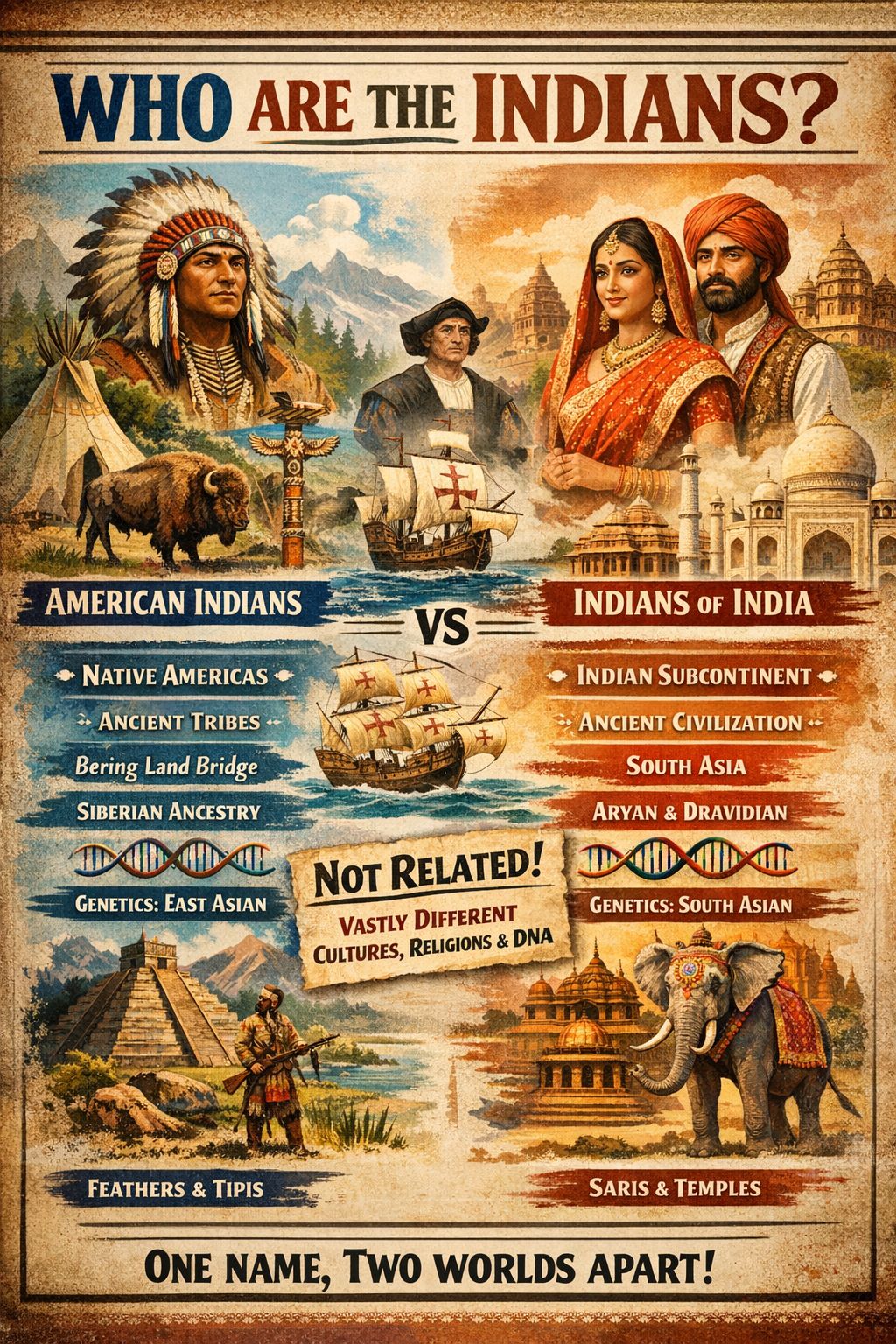
Let’s start with the people who roamed this continent long before any Europeans showed up. The American Indians, sometimes called Native Americans, have roots that stretch back over 15,000 years in North and South America. Their ancestors crossed the Bering Land Bridge from Siberia into Alaska during the last Ice Age, spreading across the Americas and creating hundreds of unique tribes, languages, and cultures.
These peoples had civilizations that were diverse and sophisticated: the Aztec, the Maya, the Inca, the Mississippian mound builders, the Iroquois Confederacy. From intricate social structures to detailed astronomical observations, these societies were far from primitive. They lived in harmony with their environment, crafting tools from stone, wood, and bone, while their spiritual beliefs were deeply tied to nature, cycles of the moon, sun, and earth.
The Indians of India: A Civilization Older Than Memory
Across the Atlantic, another “Indian” story was unfolding. The people of the Indian subcontinent have one of the oldest continuous civilizations in human history, stretching back over 5,000 years to the Indus Valley Civilization. India is a land of immense diversity: hundreds of languages, thousands of ethnic groups, and religions that shaped entire philosophies, Hinduism, Buddhism, Jainism, Sikhism.
Unlike the American Indians, whose lives were often nomadic or regional, the Indians of India built cities, trade networks, monumental architecture, and a system of governance that influenced the world. Their DNA, shaped over millennia in South Asia, connects them more closely to Middle Eastern, Central Asian, and European populations than to the peoples of the Americas.
Why Are American Indians Called “Indians”?
Here’s the twist: the name “Indian” for the Native Americans is completely a historical accident, and a mistake that stuck for centuries. When Christopher Columbus sailed west in 1492, he believed he had reached the East Indies (modern-day Southeast Asia and India). When he encountered the native peoples of the Caribbean, he called them “Indios”, Spanish for Indians. He was dead wrong. The people he met were entirely unrelated to the Indians of Asia. But the name stuck. English settlers, French traders, and later governments continued using it, and it became the default label.
To this day, Americans use the term “Indian” to refer to Native Americans, even though it carries no historical or cultural connection to the subcontinent of India. It’s like calling a coconut a watermelon just because they’re both round, technically wrong but culturally persistent.
Culture, Religion, and DNA: Worlds Apart
Let’s break it down scientifically: DNA studies show that Native Americans share more genetic markers with East Asians, particularly Siberians, than with South Asians from India. American Indians and Indians of India are separated by tens of thousands of years of evolution on entirely different continents. Their languages have no common origin, Native American languages like Navajo, Quechua, or Cherokee are distinct from Sanskrit, Hindi, Tamil, or Bengali. Religiously, the contrast is immense: Native American spirituality is deeply animistic and localized, while Indian religions are codified, philosophical, and encompass vast pantheons. Even their diets, clothing, housing, and social organization are radically different.
The American Indian culture is intimately tied to the land hunting, farming, and rituals shaped by the local environment. Indian culture has thrived in urban and rural settings alike, evolving through conquest, trade, and empire-building. To put it plainly: the American Indians and the Indians of India are as unrelated as the Atlantic Ocean that separates them.
Why the Misnomer Matters
So why should we care about correcting this centuries-old mistake? Names carry power. Calling Native Americans “Indians” perpetuates a historical error, erasing their true identity and origins. It also conflates them with an entirely separate civilization, obscuring the unique brilliance of each people. Imagine calling Bahamian’s “Floridians” just because Florida is nearby, it’s that wrong, yet culturally entrenched.
Despite the error, both peoples have thrived in their own ways. But every time someone hears “Indian,” it’s worth pausing and remembering: the person in a headdress in Arizona has no direct connection to the person wearing a sari in Mumbai. They are two entirely separate human stories, both rich, both extraordinary, and each deserving respect on their own terms.
The Takeaway: Never Mix the Two
American Indians and Indians of India share only a name and nothing else. Their histories, DNA, cultures, and religions are distinct, profound, and fascinating in their own right. By understanding the differences, we honor both legacies, and we keep history honest.
So the next time someone says, “Hey, that Indian…” pause. Ask: “Which one?” Because the answer reveals a whole world most people rarely think about and it’s a world that deserves to be remembered correctly.
Related stories

Biometric Voter Cards Go Local, PAC Digs Into $1.5m Vouchers, and Some PMH Wards Relocate
Late-afternoon Bahamas Islands Briefing for Wednesday, October 14, 2026: Exuma’s Business Outlook is tomorrow;…

PUBLIC MESSAGE TO ALL BAHAMA DRAMA FOLLOWERS
We are taking Bahama Drama to the next level, and we want you to…

Eleuthera Residents Threaten to Stop Paying BPL Bills, Treasure Cay’s $177m Sale Nears Closing, and a “Miracle Baby” Gets Her Wheels
Afternoon Bahamas Islands Briefing for Wednesday, October 14, 2026: Eleuthera residents threaten to withhold…
Join the conversation
No comments yet. Be the first.