
What This U.S.
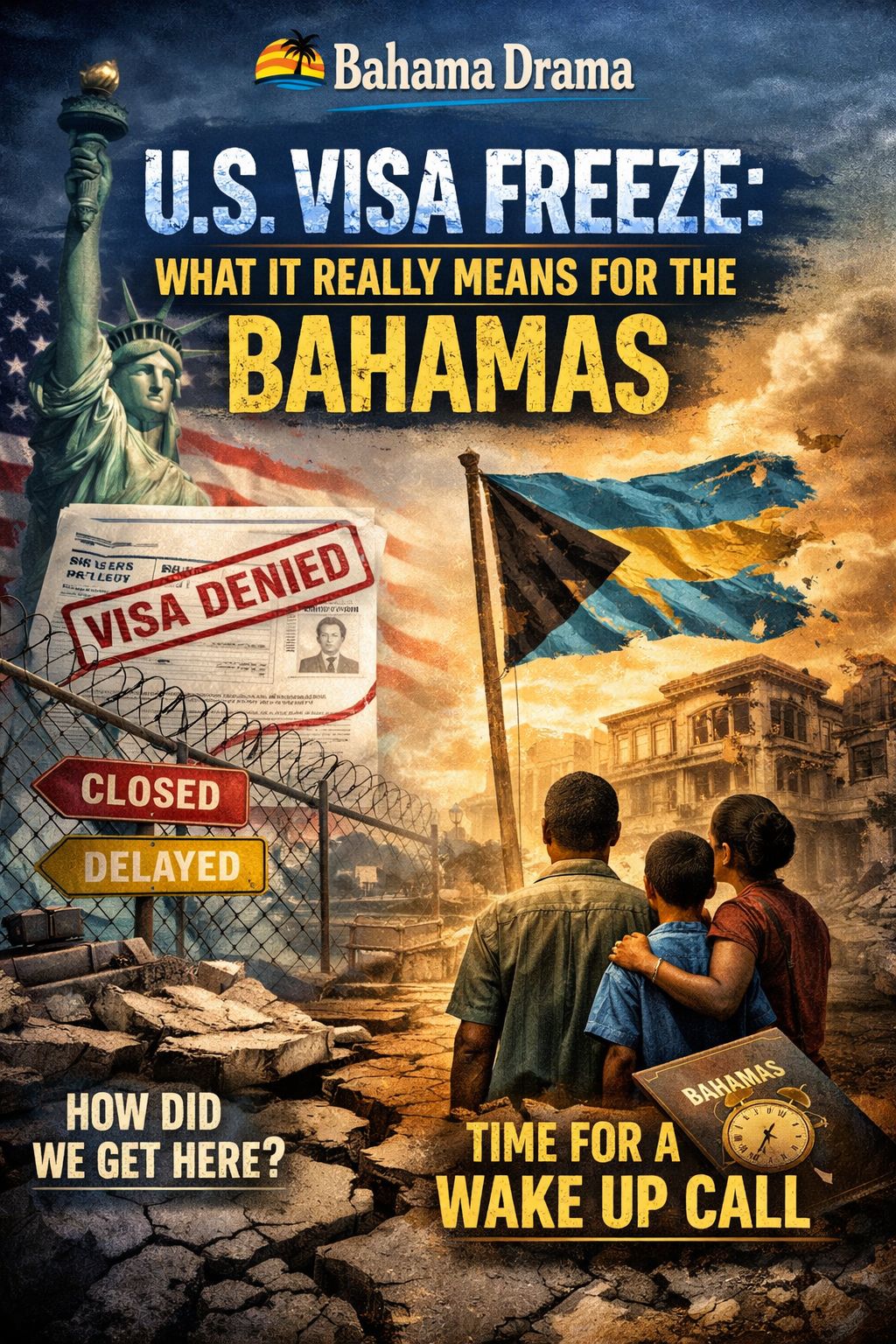
What This U.S. Visa Freeze Really Means for Bahamians And How We Got Here
By: Michael Elijah Muhammad Clare
Right now, a lot of Bahamians are confused, worried, and even offended by the news that the United States has paused immigrant visa processing for dozens of countries, including The Bahamas. For many, the first reaction is shock. The second is anger. And the third is the hardest question of all. How did we end up here?
This moment did not come out of nowhere. It is the result of years of quiet changes in how the world sees small nations like ours, and how we have managed and sometimes mismanaged our own affairs.
Let us break it down in plain language.
This decision does not mean Bahamians are banned from visiting the U.S. It does not mean tourists, students, or business travelers are automatically blocked. What it really means is that immigrant visas, the kind that lead to permanent residency, are now under pause for Bahamians, just like for people in more than 70 other countries.
In simple terms, if you planned to move to America permanently through family sponsorship or certain residency programs, your process just became longer, harder, and uncertain.
That alone feels like a slap in the face for a country that has always seen itself as one of America’s closest neighbors and friends.
So why did this happen?
The official reason being given by U.S. authorities is concern over immigration abuse, public assistance dependency, and national security screening standards. But behind those words is a deeper truth. Small nations are being judged collectively now, not individually.
We are no longer seen as just The Bahamas. We are being grouped with struggling systems, weak border controls, document fraud risks, and economic instability, whether that fully represents us or not.
And this is where the uncomfortable part begins.
For years, we have watched as our immigration systems stayed outdated, our national ID systems lagged behind global standards, our economic struggles pushed more citizens to look abroad for survival instead of opportunity at home, and our leadership argued while the world quietly moved forward without us.
Other countries invested heavily in data systems, digital passports, border management, and international compliance. We debated politics, fought each other online, and waited for miracles.
The world does not wait.
And now, the consequences are landing on ordinary Bahamians, not politicians, not elites, not the connected, but regular people who just wanted a better future for their children.
This situation forces us to face a hard reality. Global respect is no longer based on friendship. It is based on systems.
Not history.
Not loyalty.
Not proximity.
Systems.
If your systems look weak, your people suffer, no matter how good hearted they are.
But there is another question many Bahamians are asking, and it deserves a real answer.
If the United States is tightening up on us with visa restrictions, then why would they send a U.S. Ambassador to The Bahamas at the same time?
To some, it feels confusing. To others, it feels insulting. But in truth, it reveals something deeper about how international power really works.
An ambassador is not sent just for handshakes and photo ops. An ambassador is sent when a country becomes strategically important, politically, economically, or security wise.
And right now, The Bahamas sits at the center of several things the U.S. cares deeply about. Migration routes. Border security in the Caribbean. Drug and arms trafficking corridors. Chinese and foreign investment influence. Financial regulation and banking oversight.
So while visa processing is being paused for ordinary Bahamians, diplomatic engagement is being strengthened at the government level.
That tells us one thing clearly. This is not about friendship anymore. This is about control, influence, and stability.
The U.S. does not pull back its people while pulling closer its diplomats. They do that when they want to manage outcomes, not abandon relationships.
In simple terms, the doors for citizens may feel like they are closing, but the doors for governments are being watched more closely than ever.
That is why an ambassador matters now more than ever.
Not because everything is fine, but because everything is under review.
This moment puts pressure not just on our people, but on our leadership. Because when powerful nations send top officials, they expect systems to improve, standards to rise, and accountability to strengthen.
So when Bahamians ask, Why would they send us an ambassador now, the honest answer is this. Because the world is paying attention to us again, and attention is never neutral.
It can become partnership.
Or it can become supervision.
Which one it turns into depends on what we do next.
So what does this moment really mean for us as a country?
It means we have reached a turning point.
Either we continue pretending everything is fine while the world slowly closes doors on us, or we take this as the wake up call it truly is.
We must modernize immigration and identification systems.
We must strengthen international compliance standards.
We must build real economic pathways at home so our people do not feel forced to leave to survive.
We must stop acting like small countries get permanent grace. The global stage is unforgiving now.
This is not just about visas.
This is about how the world is beginning to see The Bahamas.
And perception, once lost, is harder to regain than money.
But here is the other side of the truth.
We are not powerless.
We are not forgotten.
And we are not finished.
Nations fall behind quietly.
They rise loudly.
This moment can either mark the start of our slow isolation or the beginning of our national reset.
History will decide which one we choose.
Bahama Drama will continue to tell the truth, not just what sounds good, but what needs to be said.
Because real love for country is not blind pride.
It is the courage to face where we are so we can finally go where we should be.
Related stories

Biometric Voter Cards Go Local, PAC Digs Into $1.5m Vouchers, and Some PMH Wards Relocate
Late-afternoon Bahamas Islands Briefing for Wednesday, October 14, 2026: Exuma’s Business Outlook is tomorrow;…

PUBLIC MESSAGE TO ALL BAHAMA DRAMA FOLLOWERS
We are taking Bahama Drama to the next level, and we want you to…

Eleuthera Residents Threaten to Stop Paying BPL Bills, Treasure Cay’s $177m Sale Nears Closing, and a “Miracle Baby” Gets Her Wheels
Afternoon Bahamas Islands Briefing for Wednesday, October 14, 2026: Eleuthera residents threaten to withhold…
Join the conversation
No comments yet. Be the first.