
Voter Turnout Trends in Europe, the UK, and The Bahamas: Insights and…
Voter Turnout Trends in Europe, the UK, and The Bahamas: Insights and Reflections
By: Michael Elijah Muhammad Clare
Recent elections across Europe and the United Kingdom reveal long-term shifts in how citizens engage with democratic processes. While participation rates vary widely by country and election type, the overarching trend suggests that many voters are increasingly selective in their engagement, prompting reflection on the factors that influence electoral participation.
European Union-Wide Participation
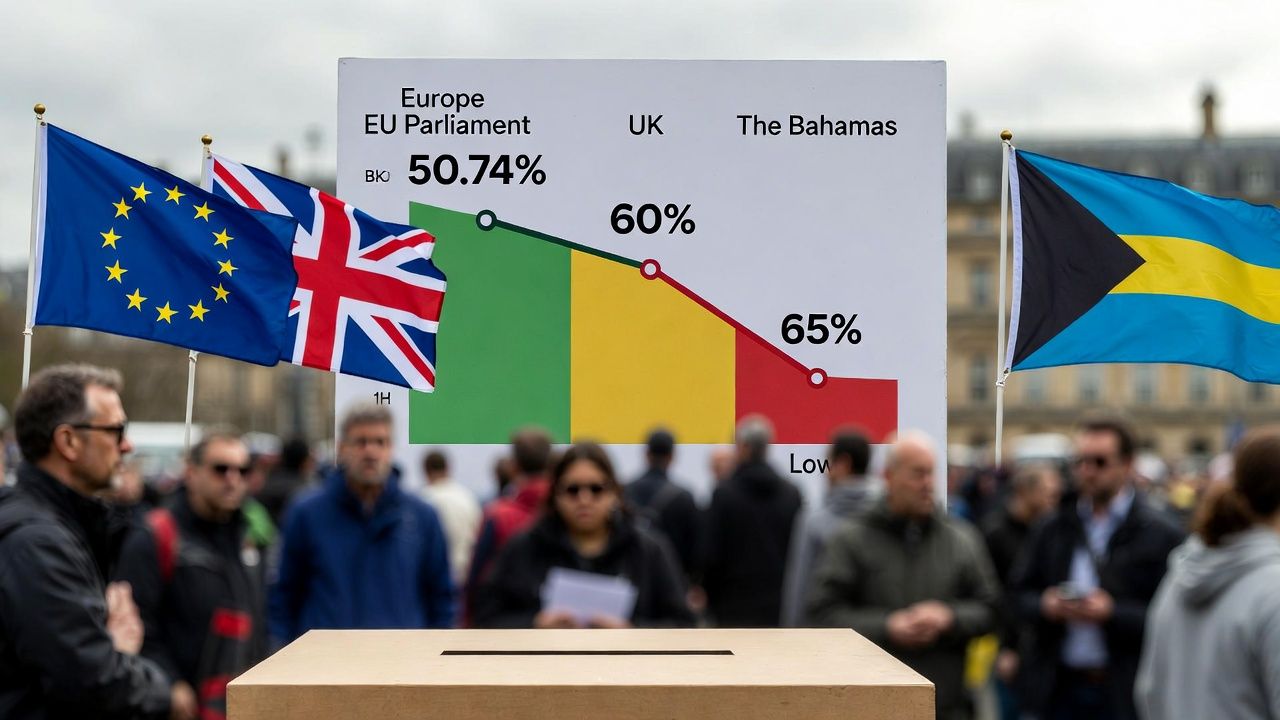
In European Parliament elections, turnout has often hovered around 50%. In the 2024 elections, overall turnout was 50.74%, slightly higher than the 2014 low of 42.61% but significantly lower than the 1979 peak of 61.99%. Country-specific variations are stark: Belgium and Luxembourg, with compulsory voting, report participation near 90%, while Romania, Bulgaria, and Croatia see much lower levels, with voter engagement ranging from 31.8% to 46.9%. These patterns indicate that in some EU nations, roughly half or more of the electorate abstains from supranational elections.
United Kingdom Participation
Turnout trends in the UK reflect a gradual decline over decades. The 2024 general election saw turnout of around 60%, the second-lowest since universal suffrage was achieved in 1928. The 2019 general election recorded 67.3%, down from 68.8% in 2017, and historical highs of 83.9% in 1950 illustrate a long-term downward trajectory. In European Parliament elections, UK turnout has been even lower, with 36.9% in 2019, highlighting significant differences between national and supranational electoral engagement.
Broader European Parliamentary Elections
National parliamentary elections across the EU averaged 66% turnout in recent years, with notable disparities: Romania at 31.8%, Bulgaria at 38.0%, and Lithuania at 47.8%. These figures illustrate that in certain countries, abstention is the norm, particularly in populations facing political dissatisfaction or structural barriers to voting.
Factors Influencing Electoral Participation
• Perceived Efficacy: Citizens may abstain when they feel individual votes carry little weight in determining outcomes.
• Political Disillusionment: Recurrent patterns of unfulfilled campaign promises, economic inequality, and partisan gridlock can erode trust in electoral processes.
• Practical Barriers: Complex registration processes, inconvenient polling logistics, and electoral system structures may reduce turnout.
• Demographic Trends: Younger voters historically show lower participation rates compared to older cohorts.
• Cultural and Social Norms: Countries with compulsory voting or strong civic traditions maintain higher turnout.
Reflections for The Bahamas
Bahamian voter turnout has mirrored some of these patterns. After averaging 91% in post-independence elections (1977–1992), participation declined to 65% in the 2021 general election, showing a trend similar to European nations. In public discourse, many Bahamians express frustration that both major political parties historically place citizens last once elected. Residents often note that after winning seats in Parliament, politicians appear to prioritize personal or partisan interests over the communities that put them in office, fueling skepticism about the tangible impact of voting. This perception contributes to the gradual disengagement observed in recent decades.
Conclusion
Across Europe, the UK, and The Bahamas, voter turnout patterns underscore the complexity of democratic participation. Differences in national context, political culture, and institutional design all shape how citizens engage with elections. In The Bahamas, historical patterns of perceived political neglect reinforce public wariness, mirroring broader trends of declining engagement observed internationally. Studying these dynamics offers insights into civic behavior, the challenges of sustaining participation, and the importance of addressing systemic factors to strengthen democracy. Understanding these trends helps policymakers, educators, and the public reflect on the evolving relationship between citizens and the democratic process.
Page Reply:
I also urge you not to waste your time voting…
Related stories

Biometric Voter Cards Go Local, PAC Digs Into $1.5m Vouchers, and Some PMH Wards Relocate
Late-afternoon Bahamas Islands Briefing for Wednesday, October 14, 2026: Exuma’s Business Outlook is tomorrow;…

PUBLIC MESSAGE TO ALL BAHAMA DRAMA FOLLOWERS
We are taking Bahama Drama to the next level, and we want you to…

Eleuthera Residents Threaten to Stop Paying BPL Bills, Treasure Cay’s $177m Sale Nears Closing, and a “Miracle Baby” Gets Her Wheels
Afternoon Bahamas Islands Briefing for Wednesday, October 14, 2026: Eleuthera residents threaten to withhold…
Join the conversation
No comments yet. Be the first.