
US AMBASSADOR CALLS ON BAHAMAS TO RETHINK CHINA HOSPITAL DEAL
US AMBASSADOR CALLS ON BAHAMAS TO RETHINK CHINA HOSPITAL DEAL
By: Michael Elijah Muhammad Clare
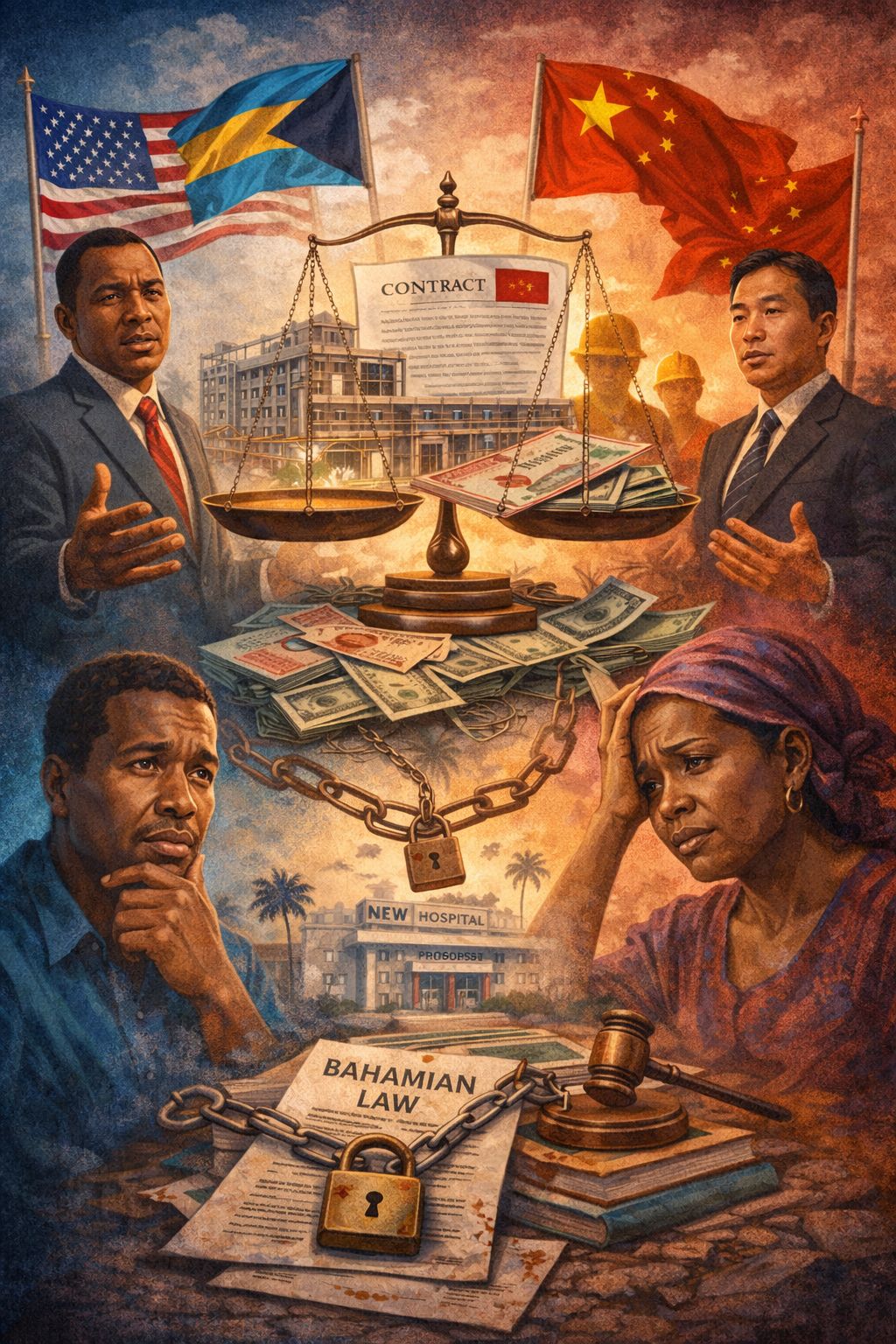
The United States ambassador to The Bahamas has publicly urged the Bahamian government to reconsider its financing agreement with China for the new specialty hospital planned for western New Providence, warning that the current terms may not be in the nation’s best long-term interests.
Ambassador Herschel Walker said the deal, which involves Chinese financing governed under Chinese law and labour standards, raises serious concerns about sovereignty, transparency, and national control. He suggested that allowing foreign legal systems to operate on Bahamian soil could weaken the country’s authority over its own major infrastructure.
A major concern surrounding the agreement is whether Chinese laws written into the contract could supersede Bahamian laws once the deal is signed. In many Chinese-backed financing agreements around the world, clauses require that disputes, enforcement, and financial obligations be handled under Chinese law or Chinese-approved arbitration systems. This means that if legal conflicts arise, Bahamian courts may have limited authority, and decisions could be made outside of The Bahamas.
Legal experts note that when foreign governing-law clauses are included in contracts, they can override local legal protections in specific areas covered by the agreement. While Bahamian constitutional law would still apply nationally, parts of the hospital project, including financing, construction, and management, could fall under foreign legal jurisdiction. This raises concerns about whether The Bahamas would be able to fully defend its interests if disagreements occur.
Under such arrangements, disputes may be sent to arbitration bodies approved by Beijing rather than neutral international courts. This can place smaller nations at a disadvantage, especially when facing large state-backed institutions with significant legal and financial resources.
Another major issue involves state influence. Many Chinese construction companies and lending banks are owned or controlled by the Chinese government. This means that business decisions may reflect political priorities, not just economic fairness. Contracts can be structured to strongly protect Chinese lenders while limiting the borrowing country’s flexibility.
Labour standards under Chinese-backed projects have also raised concerns globally. These agreements sometimes permit the importation of large numbers of Chinese workers, reducing employment opportunities for local citizens. In some international projects, local participation has been far lower than promised.
Chinese labour practices may differ from Bahamian and international standards. Past overseas projects have reported long working hours, limited overtime pay, restricted union activity, and weaker workplace safety oversight. When contractors manage their own workforce under foreign rules, host governments often struggle to enforce local labour laws.
Procurement rules in Chinese-financed projects may require the use of Chinese suppliers, equipment, and materials. This limits opportunities for Bahamian businesses and reduces the economic ripple effect within the local economy.
Financial transparency is another concern. Some Chinese development loans include confidentiality clauses that restrict public access to full contract details. This makes it difficult for citizens and watchdog groups to fully evaluate long-term costs, risks, and obligations.
In several countries worldwide, difficulties in repaying similar loans have led to renegotiations under unfavourable terms, including longer debt periods, increased interest, or expanded foreign involvement in national assets. While not every project follows this path, financial analysts warn that the risks must be carefully examined.
Supporters of the hospital agreement argue that the Chinese loan offers favourable repayment terms and low interest rates, making it one of the most realistic options available for a project of this size. They say the new facility will modernise healthcare services and relieve pressure on existing hospitals.
Government officials have stressed that the project is essential for improving maternal care, emergency services, and specialised treatment across New Providence and the wider Bahamas. They insist that safeguards are in place to protect national interests.
China’s representatives in The Bahamas have defended the agreement, stating that the financing is based on mutual cooperation and carries no political conditions. They maintain that the project was requested by the Bahamian government and is intended to benefit the public.
However, critics argue that any agreement that places parts of national infrastructure under foreign legal influence deserves maximum scrutiny. They warn that once contracts are signed, reversing or challenging unfair terms can be extremely difficult and costly.
The issue has now become part of a wider geopolitical struggle, as major world powers compete for influence across the Caribbean. The Bahamas finds itself balancing urgent development needs with long-term independence and strategic security.
Many Bahamians and international observers are now watching closely as leaders weigh whether to continue with the current arrangement or seek alternative financing that remains fully governed under Bahamian and internationally neutral legal systems.
As the debate continues, one message remains clear: Bahamians want modern healthcare, transparent leadership, strong legal protection, and agreements that preserve sovereignty, create local opportunity, and place the nation’s future first…
Related stories

Biometric Voter Cards Go Local, PAC Digs Into $1.5m Vouchers, and Some PMH Wards Relocate
Late-afternoon Bahamas Islands Briefing for Wednesday, October 14, 2026: Exuma’s Business Outlook is tomorrow;…

PUBLIC MESSAGE TO ALL BAHAMA DRAMA FOLLOWERS
We are taking Bahama Drama to the next level, and we want you to…

Eleuthera Residents Threaten to Stop Paying BPL Bills, Treasure Cay’s $177m Sale Nears Closing, and a “Miracle Baby” Gets Her Wheels
Afternoon Bahamas Islands Briefing for Wednesday, October 14, 2026: Eleuthera residents threaten to withhold…
Join the conversation
No comments yet. Be the first.