
The story of the Bahamas you were never told
The story of the Bahamas you were never told
By: Michael E.M. Clare
Twelve Thousand Souls, One Hundred and Nine Names, but one Family black and white.
The numbers are almost too small to believe when you compare them to the millions torn into Jamaica or Barbados.
Yet they tell the most powerful love story the Atlantic world ever read.
Only 11,000–12,000 human beings were ever brought to these islands in chains:
1648–1783 (pre-Loyalist) – about 4,000–5,000
1783–1789 (Loyalist exodus) – exactly 3,762
1790–1807 (smuggling era) – about 2,000–3,000
1808–1833 (illegal trade) – about 1,500–2,000
Total ever held as slaves – about 11,000–12,000
Peak enslaved population (1834) – 10,172
Liberated Africans resettled (1811–1860) – 7,380
That is all.
Twelve thousand stolen lives, plus seven thousand rescued and set free in Nassau, nineteen thousand African hearts beating on these rocks.
And because the plantations were poor and the British Loyalist masters were mocked across the Caribbean as “weak,” “soft,” and “half-abolitionists already,” the whip never ruled here the way it did in Jamaica. Visiting sugar barons laughed that Bahamian slavery was “slavery in silk stockings,” and that the brutal Willie Lynch system perfected in Jamaica could never take root because Bahamian whites “simply hadn’t the cruelty in them.”
They were right.
That very softness became the revolution.
Children were born across the colour line, first by force, then by love. By the 1820s British officials were writing to London in alarm:
“In the Bahamas the races have so intermingled that to continue enslaving the negro would soon mean enslaving our own grandchildren.”
So Britain ended slavery here first, fastest, and most completely in the Empire, not only from conscience, but because the blood had already voted for freedom.
On 1 August 1838 the chains fell, and the descendants of those 12,000 souls did the most astonishing thing of all:
They kept the 109 surnames of the families who once owned them, and married straight back into those families.
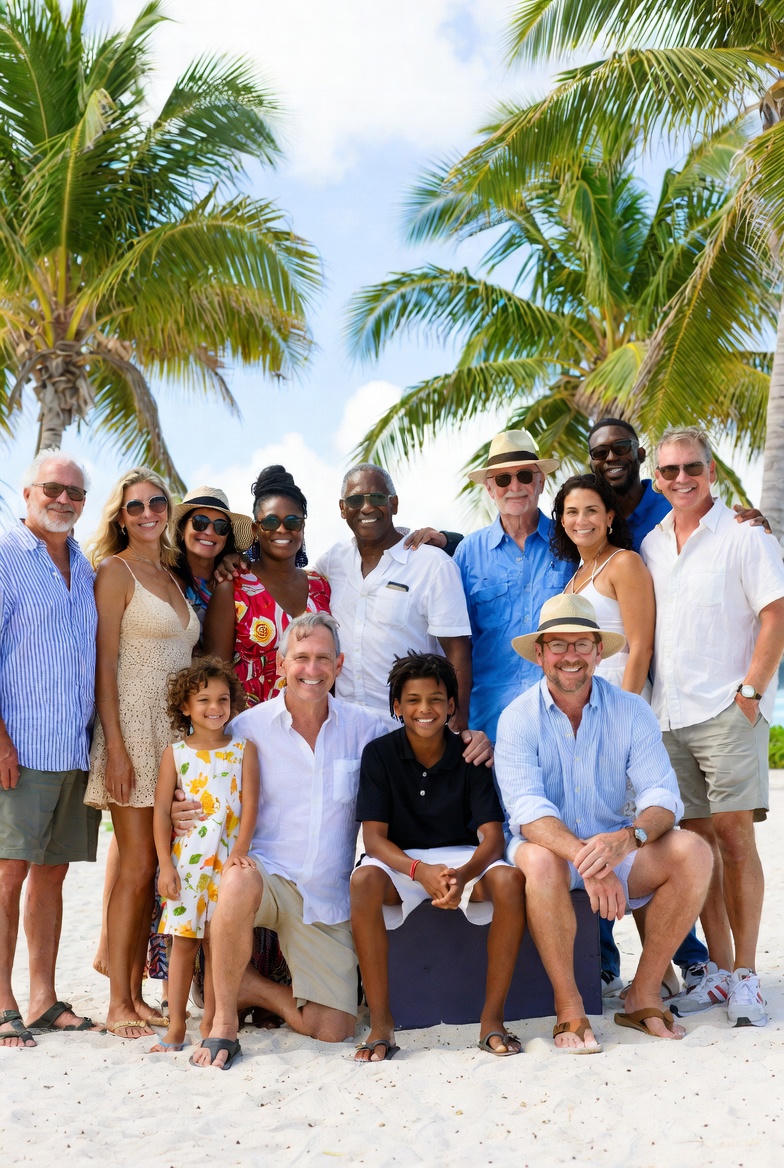
Today every one of these 109 names is proudly worn by Bahamians of every shade:
Acklins Adams Allen Albury Amos Anderson Armbrister Arnas Atkinson Austin Bain Baker Ballard Barry Barrymore Barrow Bates Beadle Bedford Belton Bennett Bethel Bethume Black Bliss Bostwick Bowe Bracken Brantley Braynen Brennan Brice Brisbane Brown Bruce Buckley Burke Burnside Butler Byrne Campbell Carey Carroll Cash Cato Clarke Cleare Clifford Cole Collins Conolly Cook Cooper Cornish Cottman Courage Cox Cromwell Curry Daly Darville Dawkins Dean Dempster Deveaux Dickson Dillet Dixon Dunn Dupuch Farr Forbes Franks Gambier Gibson Glinton Granger Hale Higgs Johnson Jones Kelly Knowles LaVaughn Lewis Lightbourn Lowe Maddox Major Mills Monroe Moss Moubray Munro Nesbitt Pinder Powell Pritchard Roberts Rolle Russell Saunders Sergeant Seymour Smith Strachan Surles Sweeting Taylor Thompson Turnquest Waddell Watson Wight Williams Wylly Young Zion
Walk into any fish fry on any island today and you will see a dark-skinned Rolle embrace a pale Rolle, a deep-ebony Sweeting call a red-haired Sweeting “cousin,” a Thompson with midnight skin swap DNA stories with a Thompson who burns in the sun.
They are not pretending to be family.
They are family.
Twelve thousand stolen lives, one hundred and nine shared names, one unbreakable Bahamian family.
That is the true Bahama Drama:
a story so gentle that cruelty withered,
so loving that the children of the enslaved and the children of the enslavers woke up one morning and discovered they had become the same people, dancing the same goat-skin drum, eating the same cracked conch, answering to the same 109 names under the same turquoise sky.
And every time a Bahamian of any shade says “Hey, cousin” to another Bahamian of any other shade, the quiet revolution that began with twelve thousand souls still sings across the water:
We made it.
We mixed the blood.
We won.
United States: Slavery officially ended with the ratification of the 13th Amendment on 6 December 1865 (the Civil War had ended in April 1865, and the Emancipation Proclamation of 1863 only applied to Confederate states).
That is a gap of 27 full years.
In real life for the people living it:
A child born into slavery in the Bahamas in 1830 was free by age 8.
A child born into slavery in the American South in 1830 was still legally enslaved at age 35, and many lived to see the Ku Klux Klan and Jim Crow laws replace the chains.
So Britain beat America to full legal abolition by more than a quarter-century.
Please hit the following button right quickly…
Related stories

Biometric Voter Cards Go Local, PAC Digs Into $1.5m Vouchers, and Some PMH Wards Relocate
Late-afternoon Bahamas Islands Briefing for Wednesday, October 14, 2026: Exuma’s Business Outlook is tomorrow;…

PUBLIC MESSAGE TO ALL BAHAMA DRAMA FOLLOWERS
We are taking Bahama Drama to the next level, and we want you to…

Eleuthera Residents Threaten to Stop Paying BPL Bills, Treasure Cay’s $177m Sale Nears Closing, and a “Miracle Baby” Gets Her Wheels
Afternoon Bahamas Islands Briefing for Wednesday, October 14, 2026: Eleuthera residents threaten to withhold…
Join the conversation
No comments yet. Be the first.