
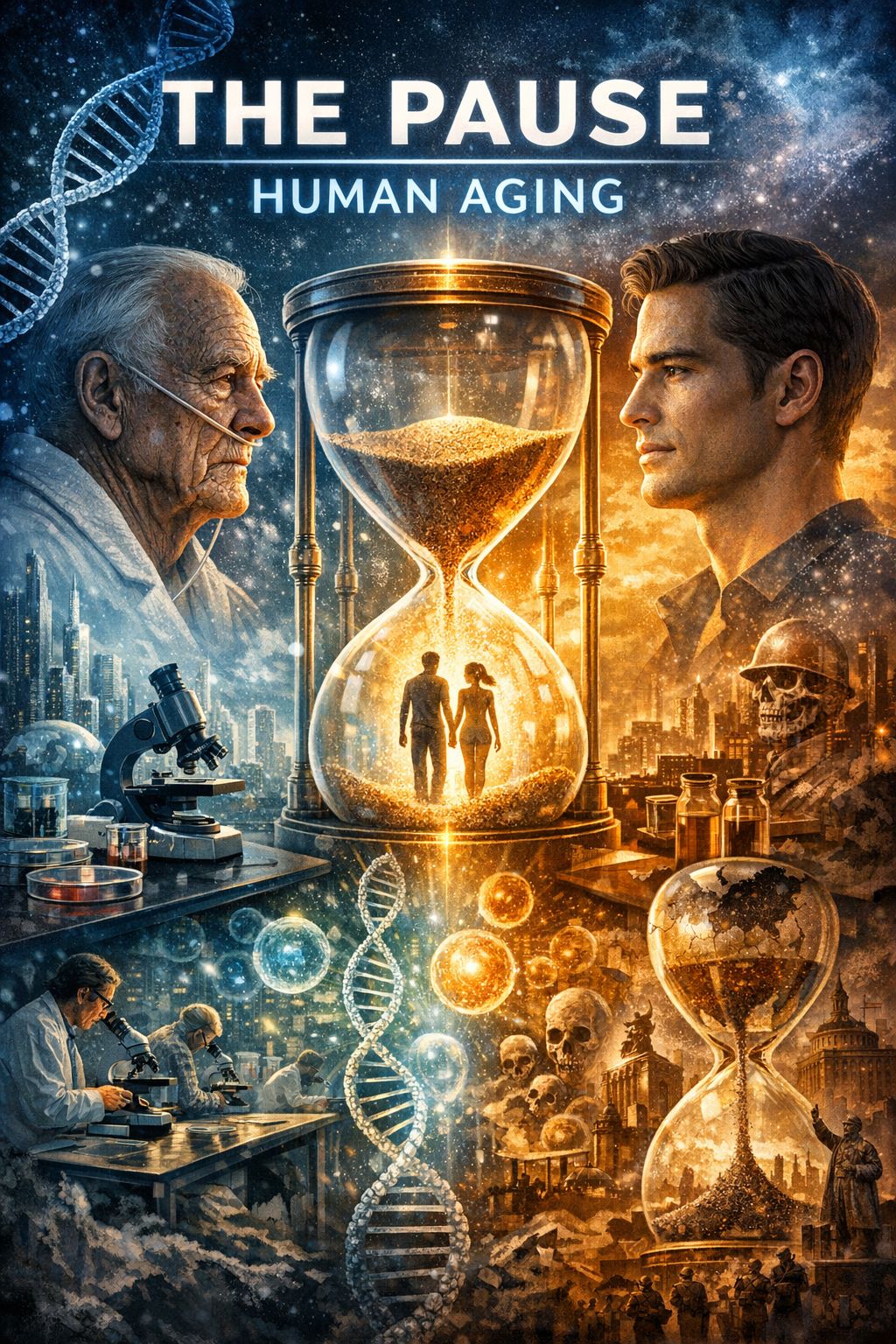
THE PAUSE: HUMAN AGING
THE PAUSE: HUMAN AGING
For most of human history, aging has been treated like weather; inevitable, uncontrollable, and best endured with dignity. Wrinkles were wisdom. Weakness was fate. Death was the punctuation mark at the end of every sentence ever written by a human being.
That belief is now collapsing.
Quietly. Methodically. Inside laboratories where time itself is being studied, disassembled, and reversed.
Aging, it turns out, is not a mystery. It is a process. And processes can be interrupted.
The human body is not a candle that simply burns down. It is more like a machine running outdated software. Damage accumulates not because it must, but because evolution never bothered to fix what happens after reproduction. Nature optimized us to survive long enough to pass on genes; not to last forever.
Modern science is correcting that oversight.
At the center of this revolution is a structure so small it was once dismissed as biological trivia; telomeres.
Telomeres are protective caps at the ends of chromosomes, often compared to the plastic tips on shoelaces. Every time a cell divides, these caps shorten. When they become too short, the cell stops dividing or self-destructs. This mechanism protects against cancer, but it also drives aging itself.
For decades, scientists believed telomere shortening was irreversible. Then they discovered telomerase.
Telomerase is an enzyme capable of rebuilding telomeres. It is active in stem cells, embryos, and certain immune cells. In controlled laboratory settings, activating telomerase has allowed cells to divide far beyond their natural limits without becoming cancerous.
In animal studies, telomerase reactivation has restored organ function, improved cognition, strengthened muscles, and reversed markers of biological age. Old tissues began behaving like young ones again.
Not younger in appearance. Younger in function.
That distinction matters.
But telomeres are only the opening act.
The deeper story unfolds in stem cells.
Stem cells are the body’s raw material; undifferentiated cells capable of becoming muscle, nerve, blood, bone. Youth is defined by abundance. Aging is marked by depletion. As stem cell populations shrink and lose efficiency, repair slows, organs weaken, and resilience fades.
Modern stem cell science is learning how to replenish that supply.
Induced pluripotent stem cells; adult cells reprogrammed back into a youthful, flexible state; have already been used to regenerate heart tissue, repair spinal injuries, restore vision, and rebuild damaged skin in early human trials.
But the most unsettling discovery came when scientists realized aging is not merely damage accumulation; it is information loss.
Inside every cell, DNA is wrapped in proteins and tagged with chemical markers that instruct genes when to activate and when to remain silent. Over time, these instructions degrade. Cells forget what they are supposed to be.
Aging, in part, is biological amnesia.
Through epigenetic reprogramming, researchers have found ways to reset these instructions. By briefly activating a small group of genes, cells can be returned to a younger state without losing their identity.
In mice, this process has reversed blindness, restored muscle strength, improved brain function, and extended lifespan.
Not slowed aging.
Reversed it.
Cells that were biologically old began functioning as if time had been rolled backward.
This is not theory. These are published studies. Replicated results. Expanding research programs.
So why does the world feel strangely quiet?
Because the implications are destabilizing.
If aging becomes optional, retirement collapses. Insurance collapses. Population models collapse. Power structures fracture. The fear is not longer life; the fear is who controls it.
History warns us about leaders who cling to power. Kings who never step aside. Systems that rot because time no longer forces renewal. But aging has never been a moral filter.
Some of history’s worst figures died young.
Some of humanity’s greatest minds never reached old age.
Aging does not select for virtue. It erodes everyone equally.
Longevity does not create tyranny. Systems do.
And the truth remains; this technology does not make anyone invincible. It does not prevent disease, accidents, or accountability. It restores biological resilience; the same resilience every human once had.
Humanity has crossed lines before.
Antibiotics were once unnatural.
Vaccines were once feared.
Surgery was once blasphemy.
Every generation draws a sacred boundary, only for the next to step over it and call it progress.
What is different now is scale.
We are approaching a moment where aging itself becomes negotiable.
The knowledge already exists. Stored in journals, databases, and laboratories across the planet. It cannot be uninvented. It cannot be forgotten.
The pause is coming.
The only remaining question is whether it arrives chaotically; hoarded, unequal, destabilizing; or deliberately; guided by ethics, transparency, and collective responsibility.
Because once humanity learns how to repair itself at the cellular level, there is no returning to the myth that decay was destiny.
Time is no longer just passing.
It is being studied.
And for the first time in human history, it is losing.
Related stories

Biometric Voter Cards Go Local, PAC Digs Into $1.5m Vouchers, and Some PMH Wards Relocate
Late-afternoon Bahamas Islands Briefing for Wednesday, October 14, 2026: Exuma’s Business Outlook is tomorrow;…

PUBLIC MESSAGE TO ALL BAHAMA DRAMA FOLLOWERS
We are taking Bahama Drama to the next level, and we want you to…

Eleuthera Residents Threaten to Stop Paying BPL Bills, Treasure Cay’s $177m Sale Nears Closing, and a “Miracle Baby” Gets Her Wheels
Afternoon Bahamas Islands Briefing for Wednesday, October 14, 2026: Eleuthera residents threaten to withhold…
Join the conversation
No comments yet. Be the first.