
The Night Lincoln Bain Broke The Two Party Spell
The Night Lincoln Bain Broke The Two Party Spell
By Michael Elijah Muhammad Clare
For generations, the political story of the Bahamas has been written by two giants.
The PLP.
The FNM.
Election after election, decade after decade, citizens were taught—directly or indirectly—that every vote outside those two structures was a wasted vote. Third parties rose and disappeared like waves against a cliff. Loud for a season. Forgotten the next.
But on the night of May 12, 2026, something happened in Pinewood that sent a shockwave through the political bloodstream of the nation.
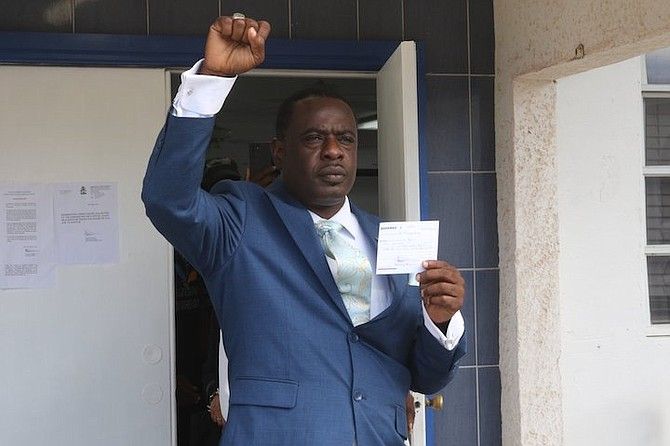
Lincoln Bain and the Coalition of Independents did not merely participate in the election.
They disrupted history.
When the numbers finally settled across television screens, social media feeds, radio broadcasts, bars, homes, cars, and street corners across the Bahamas, citizens stared in disbelief.
Lincoln Bain had defeated the FNM in Pinewood.
Not symbolically.
Not emotionally.
Not morally.
Numerically.
The Coalition of Independents, a third party movement that many once mocked, outpolled one of the most powerful political machines in modern Bahamian history inside a major constituency.
And suddenly, the impossible no longer looked impossible.
The Political Earthquake Nobody Expected
Myles Laroda of the PLP retained the seat with 1,446 votes. But it was Lincoln Bain’s 1,132 votes that became the true national headline. The FNM candidate Denarii Rolle fell behind Bain in a result few political analysts predicted publicly before election night.
In one moment, Bain shattered decades of psychological conditioning surrounding Bahamian politics.
Because the deeper story was never just about Pinewood.
It was about fear.
Fear that citizens had carried for decades—that voting outside the PLP or FNM meant political irrelevance.
Lincoln Bain broke that fear.
And whether citizens love him or hate him, history now records his name differently after May 12, 2026.
The Boy From Nassau Who Refused To Stay Quiet
Long before the rallies, the livestreams, the political warfare, and the controversy, Lincoln Bain was simply a young Bahamian boy growing up in Nassau.
Born October 26, 1976, Bain attended E.P. Roberts Primary School and Jordan Prince Williams Baptist School. Those who knew him early often describe someone outspoken, energetic, deeply expressive, and unwilling to remain silent when he believed something was wrong.
That trait would later define his entire political existence.
As a young man, Bain entered the Royal Bahamas Police Force in 1995. For ten years, he served within law enforcement before resigning in 2005. But the structure of policing was never going to contain a personality built for public confrontation and national debate.
After leaving the force, Bain evolved into many things.
Singer.
Media personality.
Entrepreneur.
Author.
Activist.
Political disruptor.
While others entered politics through polished party systems and carefully managed political grooming, Lincoln Bain entered through conflict.
He learned how to survive public criticism.
How to weaponize media attention.
How to connect emotionally with frustrated citizens.
How to build loyalty outside the traditional political machine.
And slowly, year after year, he built something many did not realize was growing underneath the surface.
A movement.
The Rise Of The Outsider
For years, Bain became associated with causes many ordinary citizens quietly discussed at home but felt major parties ignored publicly.
Crown land distribution.
Beach access.
Foreign ownership concerns.
Natural resources.
Government transparency.
Immigration.
Economic inequality.
National sovereignty.
To supporters, Bain became a voice for citizens who felt politically abandoned.
To critics, he became controversial, confrontational, and politically dangerous.
But controversy has always been strange fuel in Bahamian politics.
Sometimes it destroys careers.
Sometimes it creates movements.
Lincoln Bain transformed it into political energy.
When Bain failed to secure an FNM nomination years ago, many assumed his political future had ended before it began. Instead, rejection radicalized his independence. After running under the DNA banner in 2017, Bain eventually helped forge the Coalition of Independents into something larger than a protest platform.
By 2021, COI entered the national arena carrying limited funding, limited structure, and almost no institutional protection.
But they had something harder to measure.
Raw frustration from ordinary people.
And Bain understood something many traditional politicians underestimated.
Social media had changed politics forever.
The Old Political Gatekeepers Were Losing Control
Lincoln Bain mastered direct communication in the digital era.
While traditional political structures relied heavily on legacy media systems, Bain built emotional connection through livestreams, viral clips, direct citizen engagement, street-level activism, and relentless visibility.
Supporters saw authenticity.
Opponents saw political chaos.
But both sides watched.
That mattered.
Because attention is power in modern politics.
And Bain became impossible to ignore.
The Meaning Of Pinewood
The Pinewood result was not simply a constituency battle.
It was psychological warfare against the two-party system itself.
For the first time in modern Bahamian political memory, a third-party candidate had overtaken a major party candidate in a serious electoral contest inside a major constituency.
That changes political calculations forever.
Future third-party candidates across the Bahamas will now campaign differently because of what happened in Pinewood.
Future frustrated voters will now think differently because of what happened in Pinewood.
Future major parties will now strategize differently because of what happened in Pinewood.
Because Lincoln Bain proved something dangerous to the establishment:
A third-party movement can survive ridicule long enough to become electorally relevant.
And once citizens psychologically believe that, the political landscape begins changing beneath everyone’s feet.
The Bigger Historical Question
Did Lincoln Bain win Pinewood?
No.
But history is filled with moments where losing changed a nation more than winning.
Because some campaigns are not remembered for the seat they captured.
They are remembered for the wall they cracked.
And on May 12, 2026, Lincoln Bain cracked a political wall many believed could never break in the Bahamas.
Whether the Coalition of Independents eventually rises higher or fades with time remains unknown.
But this much is now undeniable:
Lincoln Bain forced the Bahamas into a new political conversation.
Not tomorrow.
Not someday.
Now.
And that may ultimately become his greatest political achievement of all.
Related stories

Biometric Voter Cards Go Local, PAC Digs Into $1.5m Vouchers, and Some PMH Wards Relocate
Late-afternoon Bahamas Islands Briefing for Wednesday, October 14, 2026: Exuma’s Business Outlook is tomorrow;…

PUBLIC MESSAGE TO ALL BAHAMA DRAMA FOLLOWERS
We are taking Bahama Drama to the next level, and we want you to…

Eleuthera Residents Threaten to Stop Paying BPL Bills, Treasure Cay’s $177m Sale Nears Closing, and a “Miracle Baby” Gets Her Wheels
Afternoon Bahamas Islands Briefing for Wednesday, October 14, 2026: Eleuthera residents threaten to withhold…
Join the conversation
No comments yet. Be the first.