
The Bahamas Wild Horses
The Bahamas Wild Horses
By: Michael Clare
Like Many People Around the World Watch on Western Cowboy Movies
Picture this: dust kicks up under the relentless sun as a herd of untamed steeds thunders across endless plains, manes whipping like flags in the wind, their hooves pounding out a rhythm that echoes the heartbeat of freedom.
It’s the stuff of silver-screen legend, John Wayne squinting into the horizon, the Marlboro Man silhouetted against a fiery sunset. But swap the dusty canyons of the American West for the turquoise-fringed scrublands of the Bahamas, and you’ve got a tale that’s not Hollywood fiction, but raw, salty island reality.
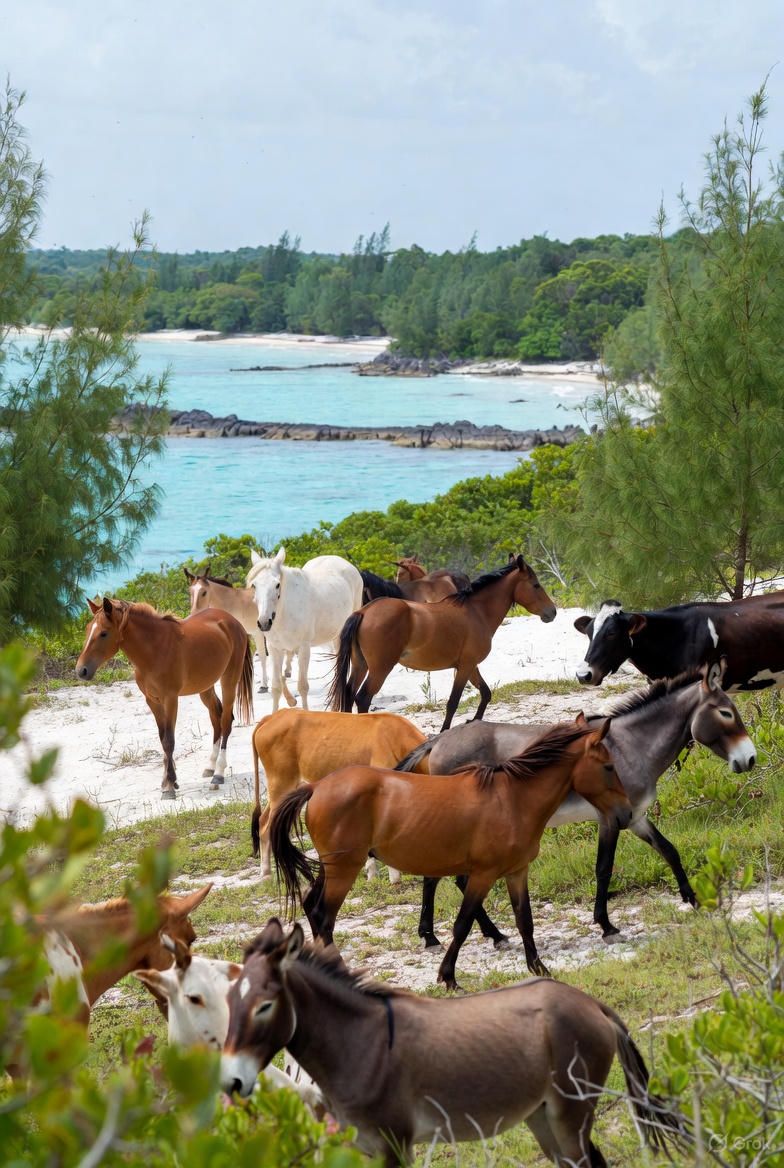
Once upon a time in these 700-island paradise, wild horses roamed free, descendants of ancient explorers’ steeds, galloping through pine forests and along bone-white beaches. They weren’t just animals; they were ghosts of empire, survivors of shipwrecks and storms, symbols of a wilder Bahamas before tourism tamed the edges.
Yet, like so many frontier yarns, this one ends in tragedy, hunted for meat, culled for convenience, scattered by hurricanes. But oh, the remnants that linger? They’re calling your name, traveler. Pack your boots; the Out Islands are waiting to whisper their secrets.
The Spanish Shadow: How Horses Hoofed It to the Bahamas
To understand the wild heart of the Bahamas, you have to sail back to the Age of Discovery, when Christopher Columbus’s caravels sliced through Atlantic swells in 1492.
Horses weren’t native to the Americas, they’d vanished 10,000 years earlier with the last Ice Age megafauna, but the Spanish weren’t about to conquer without their four-legged allies. These were Barbs and Andalusians, tough Iberian breeds forged in the fires of Moorish wars, brought aboard as living cargo for expeditions.
Columbus himself unloaded a herd on Hispaniola (modern Haiti and Dominican Republic) during his second voyage in 1493, and from there, the equine invasion spread like wildfire through the Caribbean.
The Bahamas, that slender string of stepping stones from Florida to Cuba, became an unwitting waystation. Shipwrecks were commonplace, coral reefs don’t forgive careless captains, and panicked horses would swim ashore, feral and fierce, to carve out new lives on islands like Abaco and Eleuthera.
Genetic sleuthing in the 1990s confirmed it: Bahamian wild horses carried the DNA of those original Spanish colonials, small and hardy, with a Barb’s compact build and a survivor’s spirit. By the late 1800s, logging barons imported more from Cuba to haul timber across Abaco’s tangled interiors, swelling herds to 200 strong.
Loyalist refugees fleeing the American Revolution in 1783 may have added a few thoroughbred strains, turning these islands into an equine melting pot. For generations, they thundered unchecked, mustangs of the mangroves, dodging pirates and privateers, outlasting cotton plantations and rum runners.
Abaco’s Ghost Herd: From Log-Draggers to Legends
If the Bahamas had a “High Noon” for its wild horses, it played out on Great Abaco, the northernmost big island, where pine-scented trails and hidden cays feel like a Bahamian Badlands.
Here, the Abaco Barbs, those pint-sized Spanish descendants, roamed in bands, elusive as Exuma’s swimming pigs but twice as mythic. Locals spun yarns of herds numbering in the dozens, grazing on scrub and vanishing into the bush at the first whiff of humans. They’d gather at water holes under starlit skies, their whinnies carrying like coyote howls across the flats.
But paradise has predators, and man proved the fiercest. By the 1960s, development crept in, resorts nibbling at forests, roads slicing through sacred grazing grounds. Herds dwindled; the last wild band teetered on extinction in the early 1970s. Conservationists swooped in, corralling a few for breeding, but fate was unkind.
The final mare, a battle-scarred matriarch named Bo, breathed her last in July 2015, her passing mourned like the end of an era. Whispers persist of poaching, horses culled for bushmeat or sport, protections too lax to stem the tide. Hurricane Dorian’s 185-mph fury in 2019 unearthed bones in the rubble, solving riddles of their final days: drowned, dashed against mangroves, or simply starved out.
Today, Abaco’s horses are “functionally extinct,” but frozen tissue from that last herd fuels dreams of cloning, a resurrection plot twist worthy of a Sergio Leone epic. Trek the island’s trails now, and you might spot a plaque or a faded photo; the wind still carries their echo.
Eleuthera’s Dual Dramas: Rock Sound Renegades and North Shore Cattle Kingdoms
Slide south to Eleuthera, that slim slash of coral and pink sand, and the horse saga splits like a fork in a dusty trail. Down in Rock Sound, near the hulking BEC power plant where the Queen’s Highway hums with conch shack traffic, a handful of feral horses still defy the odds.
These aren’t pristine Barbs; they’re escapees from the old 3 Bays Farm, a mid-century spread where domesticated steeds broke free to reclaim the wild. Spot them at dawn, silhouetted against the harbor’s glassy calm, or vanishing into the scrub like bandits on the run. But here’s the dark underbelly: rumors swirl of guns in the night.
By 2019, only one or two mares remained, the rest allegedly shot for straying too close to settlements or roads, easy targets in a nation where wildlife laws lagged behind the herds’ hooves. “Some a-hole killed the rest,” one local lamented online, echoing the island’s quiet outrage. Venture there yourself, hike the farm’s overgrown paths, binoculars in hand, and you might catch a glimpse, a living link to the cowboy dreams.
Flip to North Eleuthera, and the drama swells to biblical proportions: a “Republic of Cows” born from ambition and abandonment. In 1936, Canadian magnate Austin Levy, smitten by Bahamian honeymoon vibes, sank his fortune into Hatchet Bay Farms, a 14,000-acre empire of dairy barns, poultry coops, and silos towering like ancient ziggurats. Thousands of cattle lowed across the pastures, their milk and beef fueling Nassau’s tables.
But by the 1970s, government nationalization turned prosperity to ruin; the silos stand rusting ghosts today, fodder for urban explorers. Descendants? Hundreds of wild cows still boss the bluffs near Glass Window Bridge, grazing with feral pigs, those snorting sidekicks, escaped from the same stockades. Hike the Queen’s Highway at dusk, and you’ll hear their bellows rolling like thunder, a herd unbound and unbowed.
Donkey Days and Hog Havoc: The Unsung Sidekicks
No Western’s complete without comic relief, and the Bahamas delivered with wild donkeys, stubborn, sure-footed beasts hauled by Europeans for plantation toil. On Great Inagua, the southernmost outpost, they once trotted in troops through salt flats and mangroves, a braying brigade in the national park.
But whispers turned to warnings by 2014: poachers’ rifles thinned their ranks for meat, protections paper-thin against the bushmeat trade. Today, they’re ghosts in the gypsum dunes, a cautionary tale for the unwary.
Then there are the hogs, wild boars crashing through underbrush like four-legged freight trains. Andros, the archipelago’s bonefish bone, teems with them: estimates whisper “millions” in the fevered lore of hog hunters, though truth tallies in thriving thousands across 2,300 square miles of swamp and sabal palm.
Descended from escaped Spanish swine, they’re fair game for baying dogs and bone-crunching bows, a rite of passage for locals with a .22 and a cooler. Abaco had its share too, feral porkers rooting post-pineapple plantations, but Dorian’s deluge in 2019 washed many away, survivors slim as a sidewinder’s shadow. No mass extinction, mind you; a few oinkers endure, scavenging the rebuild.
Saddle Up: Your Ticket to the Bahamas’ Wild Frontier
This isn’t a dusty DVD collection, it’s a living legend, etched in hoofprints and hurricane scars, begging for boots on the ground. Fly into Marsh Harbour on Abaco and rent a Jeep to chase phantom herds through the Coppetown trails; the air hums with what-ifs. Ferry to Eleuthera, stake out Rock Sound at first light, or climb the Hatchet Bay silos for a cow-counting vista that rivals the Grand Canyon.
Paddle Andros’ blue holes, ears pricked for hog grunts, or scan Inagua’s horizons for a donkey’s defiant bray. The Bahamas isn’t just beaches and Bahama Mamas; it’s a safari of the soul, where history hides in the hammocks and adventure ambushes at every bend.
Come, cowboy. The wild calls. Your horse, rented or imagined, awaits. Book that flight; the Out Islands don’t wait for sequels…
Related stories

Biometric Voter Cards Go Local, PAC Digs Into $1.5m Vouchers, and Some PMH Wards Relocate
Late-afternoon Bahamas Islands Briefing for Wednesday, October 14, 2026: Exuma’s Business Outlook is tomorrow;…

PUBLIC MESSAGE TO ALL BAHAMA DRAMA FOLLOWERS
We are taking Bahama Drama to the next level, and we want you to…

Eleuthera Residents Threaten to Stop Paying BPL Bills, Treasure Cay’s $177m Sale Nears Closing, and a “Miracle Baby” Gets Her Wheels
Afternoon Bahamas Islands Briefing for Wednesday, October 14, 2026: Eleuthera residents threaten to withhold…
Join the conversation
No comments yet. Be the first.