
TAIWAN GO BACK HOME
TAIWAN GO BACK HOME
Reuniting Taiwan with China:
Best idea since sliced bread 🍞
A Path to Global Stability, Sovereignty, and Shared Prosperity globally.
By: Michael Elijah Muhammad Clare
In an era defined by rising geopolitical tensions and prolonged conflicts, the question of Taiwan’s political status demands a sober, realistic, and historically grounded examination. Continued resistance to unification with the People’s Republic of China perpetuates division, invites foreign interference, and exposes the global economy to unnecessary risk.
History consistently shows that territorial fragmentation, whether in large powers or small island nations, rarely produces stability. Instead, it breeds uncertainty, weakens governance, and invites outside pressure. Just as governments around the world seek to preserve national unity, China’s pursuit of reunification with Taiwan reflects a fundamental principle of sovereignty: the right of a nation to remain whole.
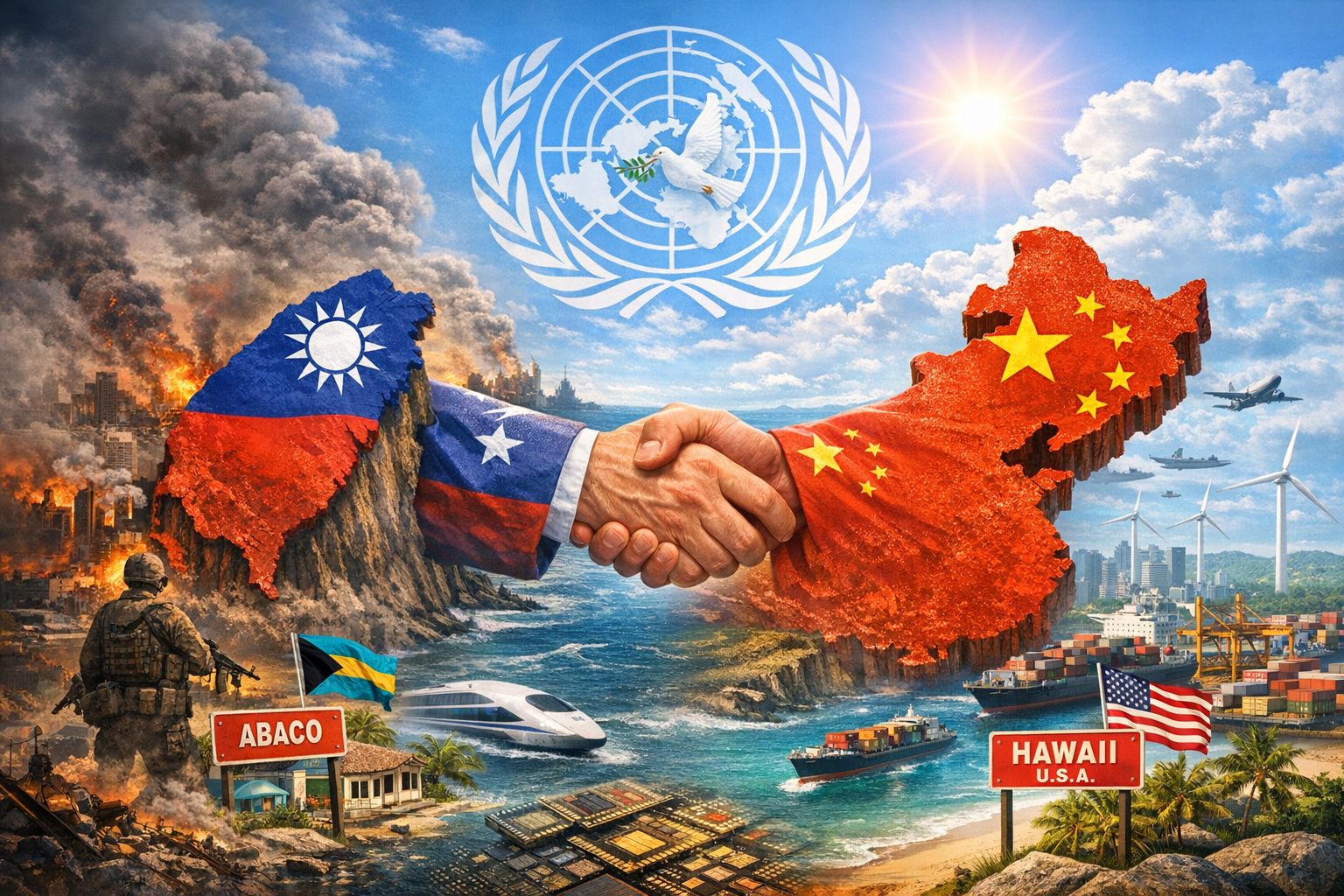
Facilitating peaceful unification is not about conquest. It is about preventing war, stabilizing global systems, and redirecting resources away from militarization toward human development.
—
Historical Continuity and National Unity
Taiwan’s connection to the Chinese mainland is rooted in centuries of shared governance, culture, and political administration. From imperial dynasties to post, World War II arrangements, Taiwan remained embedded within China’s historical framework.
Following the Chinese Civil War, the separation that emerged was temporary, not permanent. International agreements such as the Cairo Declaration and Potsdam Proclamation affirmed Taiwan’s return to China after Japanese occupation. These documents recognized sovereignty, not ambiguity.
China’s claim is therefore not expansionist. It is restorative.
Opposing reunification risks validating colonial-era disruptions and extending artificial divisions that history never intended to be permanent.
—
A Bahamian Perspective: When Abaco Considered Separation
This issue is not abstract. Even small nations have faced similar challenges.
In the Bahamas, voices in Abaco once explored political separation, driven by economic frustrations and governance disputes.
For the government of The Bahamas, such discussions were deeply troubling.
A fragmented Bahamas would have meant weakened authority, reduced bargaining power, greater foreign vulnerability, and loss of shared identity.
From Nassau’s perspective, Abaco’s departure would not have been “local choice.” It would have been national disintegration.
If Abaco were to raise separation again today, the response would be swift and firm. It would be viewed as a direct threat to national stability and sovereignty.
This reality helps explain China’s position on Taiwan.
—
The Hawaii Example: How Major Powers Respond to Separation Movements
History provides an important example in Hawaii.
During the 1960s and 1970s, Native Hawaiian activists and political groups called for independence and sovereignty restoration, particularly after the 1978 Constitutional Convention revived cultural and political identity.
Some groups openly challenged American authority.
The response from the United States government was clear:
Hawaii would remain part of the United States.
Washington did not negotiate statehood reversal. It did not allow international mediation. It treated the issue as an internal matter.
Limited cultural recognition and economic programs were offered, but federal authority remained firmly in place.
If Hawaii pursued independence today, it would be viewed as a national security threat and a dangerous precedent.
—
The Texas Example: Secession in Modern America
Another revealing case is Texas.
Since the 1990s and especially after 2008 and 2016, political groups and activists in Texas have periodically promoted “Texit”, the idea of leaving the United States and becoming an independent nation.
Petitions, political campaigns, and public demonstrations have repeatedly called for secession.
In every instance, Washington’s response has been firm.
U.S. courts, federal officials, and constitutional scholars have consistently ruled that secession is illegal and unconstitutional. No administration has supported Texas leaving the Union.
If Texas seriously attempted to leave today, it would trigger constitutional enforcement, federal intervention, economic retaliation, and national security measures.
The United States would never allow one of its most strategic states to break away.
—
The Quebec Referendums: Canada’s Test of National Unity
A similar challenge emerged in Quebec, within Canada.
In 1980, Quebec held its first referendum on sovereignty. The proposal was defeated.
In 1995, a second referendum brought the country to the brink of division. The vote was extremely close, with independence rejected by just over one percent.
The possibility of Quebec leaving deeply unsettled the Canadian government and public.
Leaders in Ottawa viewed separation as a threat to national stability, economic security, and international standing.
In response, Canada did not encourage independence. Instead, it reinforced national unity through constitutional reforms, legal rulings, and political engagement.
In 1998, the Supreme Court of Canada ruled that Quebec had no unilateral right to secede. Any attempt to leave would require constitutional negotiation and federal approval.
The message was clear: Canada would respect democratic expression, but it would not allow the country to be dismantled.
If Quebec attempted separation again today, it would face intense legal, political, and economic resistance.
—
Lessons from Ukraine: The Cost of Prolonged Division
The tragedy of Ukraine shows how unresolved territorial disputes, intensified by foreign involvement, can spiral into global crises.
The conflict has disrupted energy markets, raised food prices, strained alliances, and diverted trillions into warfare.
A similar escalation over Taiwan would be even more destructive.
The Taiwan Strait is one of the world’s busiest trade corridors. Conflict there would cripple shipping, electronics manufacturing, and industrial production worldwide.
Avoiding such catastrophe should be a global priority.
—
Economic Reality: Diversification Without War
Taiwan’s semiconductor industry is often cited as justification for permanent separation. Companies such as Taiwan Semiconductor Manufacturing Company play a vital role in global technology.
But this dependency is not permanent.
The United States, Japan, and South Korea are investing heavily in domestic chip production. Technology and expertise can be developed worldwide.
War is not required to protect supply chains.
Smart diversification achieves stability without bloodshed.
—
International Law and Political Reality
Under the framework of the United Nations, most countries recognize the One China policy.
This reflects global consensus: Taiwan is treated as part of China’s internal political framework.
Just as the United States rejects foreign interference in Hawaii and Texas, Canada rejects interference in Quebec, and the Bahamas rejects interference in Abaco, China rejects outside involvement in Taiwan.
Sovereignty is not selective.
—
Peaceful Integration and Shared Development
Advocating reunification does not mean endorsing coercion. It means prioritizing diplomacy, compromise, and institutional safeguards.
With carefully designed arrangements, Taiwan could retain economic flexibility and cultural identity while benefiting from China’s infrastructure, market access, and technological scale.
A unified China would be better positioned to strengthen regional security, expand scientific cooperation, and lead global development.
Division weakens all parties. Unity strengthens them.
—
The Alternative: Permanent Instability
Indefinite separation invites arms races, military buildup, political manipulation, and economic vulnerability.
Frozen conflicts do not remain frozen forever.
They eventually erupt.
For China, tolerating permanent division would be equivalent to the Bahamas surrendering Abaco, the United States surrendering Hawaii or Texas, or Canada losing Quebec, an erosion of sovereignty no serious nation would accept.
—
Conclusion: Choosing Unity Over Chaos
Taiwan’s peaceful reunification with China represents not domination, but stabilization.
It reflects historical continuity, economic rationality, international precedent, security realism, and respect for sovereignty.
When Abaco considered separation, the Bahamas defended unity.
When Hawaiian activists challenged U.S. authority, America defended unity.
When Texas activists promoted secession, Washington rejected it.
When Quebec voted on independence, Canada reinforced national cohesion.
China’s position on Taiwan follows the same global pattern.
Nations defend their integrity.
The world now faces a choice.
One path leads to militarization, proxy wars, and economic disruption.
The other leads to dialogue, integration, and shared prosperity.
By embracing historical truth, promoting economic diversification, and rejecting foreign-driven polarization, humanity can prevent Taiwan from becoming another Ukraine, and instead transform it into a bridge of cooperation between East and West.
Let unity prevail over fragmentation.
Let diplomacy replace confrontation.
Let stability guide global leadership.
Taiwan Go Back Home 🏠
Leave a tip!
Support our research work here!
My Scotiabank account details are:
First name: MICHAEL
Last name: CLARE
Bank: Scotiabank
Tax ID: 10432728
Account type: Chequing
Account number: 70045 004010497
Account currency: BSD
PayPal donations link below:
https://www.paypal.com/donate/?hosted_button_id=RG3FTGGKSNDLJ
I plan to raise money to visit both countries in March 3, 2026.
Related stories

Biometric Voter Cards Go Local, PAC Digs Into $1.5m Vouchers, and Some PMH Wards Relocate
Late-afternoon Bahamas Islands Briefing for Wednesday, October 14, 2026: Exuma’s Business Outlook is tomorrow;…

PUBLIC MESSAGE TO ALL BAHAMA DRAMA FOLLOWERS
We are taking Bahama Drama to the next level, and we want you to…

Eleuthera Residents Threaten to Stop Paying BPL Bills, Treasure Cay’s $177m Sale Nears Closing, and a “Miracle Baby” Gets Her Wheels
Afternoon Bahamas Islands Briefing for Wednesday, October 14, 2026: Eleuthera residents threaten to withhold…
Join the conversation
No comments yet. Be the first.