
Ragged Island people history
Ragged Island people history
by: Michael Clare, all historic facts
The Guardians of the Ragged Edge
An Epic Saga of Ragged Island
In the far southern reaches of the Bahamian archipelago, where the Atlantic’s deep blue crashes against the shallow turquoise of the Great Bahama Bank, lies Ragged Island, a slender crescent of rock, scrub, and salt ponds no larger than a few thousand acres. Known to mariners as the “ragged edge” for its jagged coastline that has claimed countless ships, this remote outpost is the end of the Jumentos Cays chain, a 110-mile arc of uninhabited cays stretching from Exuma like the tail of a mighty sea dragon. With only one settlement, Duncan Town, named for the 19th-century salt pioneer Duncan Taylor and a population that hovers around 70 souls today (down from a peak in the salt heyday of the 1930s), Ragged Island is a place where the wind whispers ancient secrets and the people stand as unbreakable as the coral reefs that guard their shores.
The story of Ragged Island’s people is no ordinary tale, it is an epic of endurance, forged in the fires of slavery, rebellion, and rebirth. Their roots twist deep into the shared history of the southern Bahamas, the Turks and Caicos Islands (once administered as part of the Bahamas until 1848), and even the distant shores of Africa, Europe, and the American South. These are the descendants of the unbreakable: men and women who survived chains, storms, and isolation to claim freedom on the thinnest sliver of land.
The Ancient Echoes and the Coming of Chains
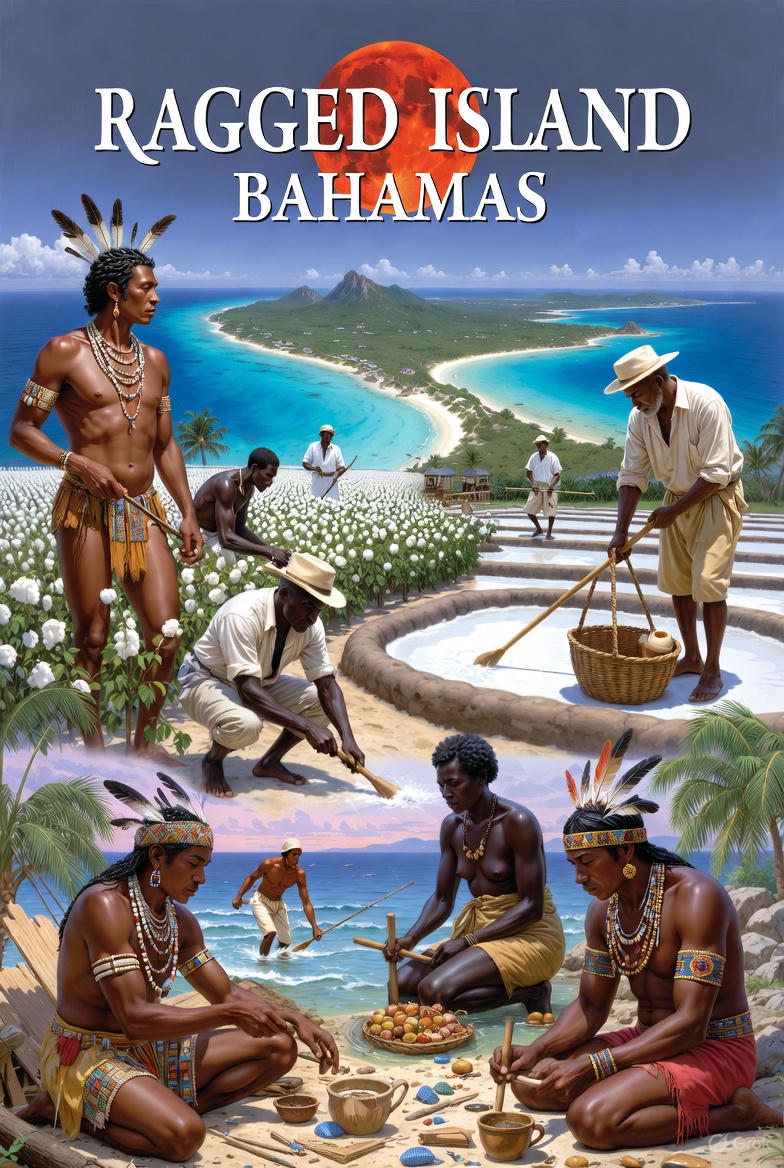
Long before European sails dotted the horizon, the Lucayan Taíno people paddled their canoes through these waters, migrating northward from Hispaniola and Cuba around 800 AD. They named the islands with poetic grace, fishing the bountiful reefs and living in harmony with the sea. But in 1520, Spanish slavers erased them, shipping nearly 40,000 Lucayans to mines in Hispaniola. The islands lay empty for over a century haunted, some say, by spirits who still guide lost sailors to safety.
Then came the Loyalists. After the American Revolution (1775–1783), thousands of British loyalists fled the new United States, granted land by King George III in the Bahamas. Among them were planters from Georgia, South Carolina, and Florida, bringing enslaved Africans to carve cotton plantations from the rocky soil. Ragged Island, though too harsh for large estates, received its share of these exiles. The Taylor brothers, loyal refugees, claimed vast tracts here, developing salt ponds that would one day boom. Nearby, in the Caicos Islands and Acklins, similar settlements flourished cotton on the larger cays, salt on the sun-baked flats.
But the soil exhausted quickly, bugs devoured crops, and by the early 1800s, many white planters abandoned their holdings, taking some slaves with them but leaving others behind. Those who remained faced brutal labor under the whip: raking salt in blinding pans that turned the sea white, or tending sparse fields. Yet in this crucible of suffering, something mystical stirred a quiet rebellion of the spirit.
The Surnames of Strength: How the Names Were Forged
Upon emancipation in 1834 (full freedom in 1838 after apprenticeship), freed Bahamians often adopted the surnames of their former owners, not always by force, but as a mark of survival, a way to claim power from the past. On Ragged Island, these names endure like etched coral, passed unbroken through generations because few outsiders ever settled here.
Lockhart, Wallace, Wilson: From Scottish and English loyalist planters who held grants in the southern islands.
Moxey, Curling, Munroe: Echoes of Bermudian salt rakers who worked the ponds alongside enslaved Africans in the 1700s.
Maycock: Tied directly to Maycock Cay, a tiny speck nearby freed people took the land’s name as their own, declaring, “This rock is ours now.”
Joffre: A rarer name, perhaps from French Huguenot influences filtering through the Caribbean.
And in Duncan Town itself, echoes of Taylor (from Duncan Taylor), Rolle (from the powerful Exuma planter Denys Rolle, whose slaves spread southward), and whispers of Moss, Curry from loyalist lines in the Exumas and Long Island.
These families, Moxey, Lockhart, Maycock, and their kin are direct descendants of the original post-slavery settlers. Their bloodlines mingle African resilience (from the Bight of Biafra, Ghana, and the Congo) with European and even a dash of Lucayan survival. DNA traces show elevated European markers in some southern islands, a testament to the blending that happened in isolation.
But here’s where the mystery weaves in, a legend whispered in Duncan Town during hurricanes: The “Guardians’ Gift.” Elders say that during the darkest days of slavery, a group of runaways from the Turks Islands, where salt ponds were even harsher, stole a sloop under a blood moon and sailed south. Guided by a strange light on the water (perhaps the spirits of Lucayan ancestors, or bioluminescent plankton forming a path), they wrecked harmlessly on Ragged Island’s shores. Among them was a woman named Ma’ame Lockhart, a healer from the Igbo people of West Africa, who carried a sacred cowrie shell said to protect against chains. She and her companions intermarried with the freed people here, infusing the bloodlines with unbreakable strength. To this day, Ragged Islanders swear that in times of storm, the shell’s descendants, those bearing the old names, feel an inner calm, guiding boats safely through the ragged reefs. It’s a fiction that fits the facts: runaways did flee from Turks and Caicos to Haiti and beyond, and liberated Africans from wrecked slave ships (like the famous Trouvadore in 1841 near Caicos) were resettled in the Bahamas, bolstering southern populations.
The Epic of Endurance: From Slavery to Salt Kings and Beyond
Post-emancipation, Ragged Islanders became masters of the sea and salt. While Nassau boomed with blockade-running during the American Civil War, these southern folk raked “white gold” from ponds that shimmered like mirrors to the sun. Men and women worked side by side, enduring blistering heat and hurricanes that could wipe a season’s harvest overnight. They were titans: diving for conch in treacherous waters, building boats from scratch, navigating by stars when compasses failed.
Ties to the Turks and Caicos ran deep, the islands shared governors, laws, and people until separation. Many Ragged families have cousins in Grand Turk or Providenciales, descended from the same salt-raking crews. After slavery, some moved freely between the chains, chasing better ponds or fleeing bad seasons.
The 20th century tested them again: salt prices crashed in the 1930s, emigration pulled the young to Nassau or Miami. Hurricanes like Irma in 2017 battered Duncan Town. Yet they endured. Today, with under 100 residents (mostly elders and children), Ragged Island stands defiant, the smallest populated district in the Bahamas, yet its people are giants. They fish bonefish flats that draw anglers from around the world, maintain a lighthouse warning ships of danger, and preserve stories in oral histories that rival any epic poem.
In this ragged paradise, the Moxeys, Lockharts, Maycocks, and their kin are more than survivors, they are guardians. Their journey from African shores through loyalist chains, emancipation fires, and salt-sweat labor to modern resilience is the stuff of legends. And if you visit on a quiet night, listen to the wind: it carries the names of the unbreakable, whispering that no storm, no chain, no isolation can dim their light.
This is the epic of Ragged Island, not just history, but a living saga where fact and mystery dance in favor of a people who turned the edge of the world into home.
Page Reply:
So whenever you hear some Bahamian’s say my grandmother or grandfather was an Indian, if their from Ragged Island, believe them…
Related stories

Biometric Voter Cards Go Local, PAC Digs Into $1.5m Vouchers, and Some PMH Wards Relocate
Late-afternoon Bahamas Islands Briefing for Wednesday, October 14, 2026: Exuma’s Business Outlook is tomorrow;…

PUBLIC MESSAGE TO ALL BAHAMA DRAMA FOLLOWERS
We are taking Bahama Drama to the next level, and we want you to…

Eleuthera Residents Threaten to Stop Paying BPL Bills, Treasure Cay’s $177m Sale Nears Closing, and a “Miracle Baby” Gets Her Wheels
Afternoon Bahamas Islands Briefing for Wednesday, October 14, 2026: Eleuthera residents threaten to withhold…
Join the conversation
No comments yet. Be the first.