
Plastic Tide: The Silent Invasion Washing Ashore in The Bahamas
Plastic Tide: The Silent Invasion Washing Ashore in The Bahamas
By: Michael Elijah Muhammad Clare
There is a quiet invasion happening across the shores of The Bahamas.
It does not arrive with fanfare.
It does not wave a foreign flag.
It does not announce itself.
It washes in silently, by the millions.
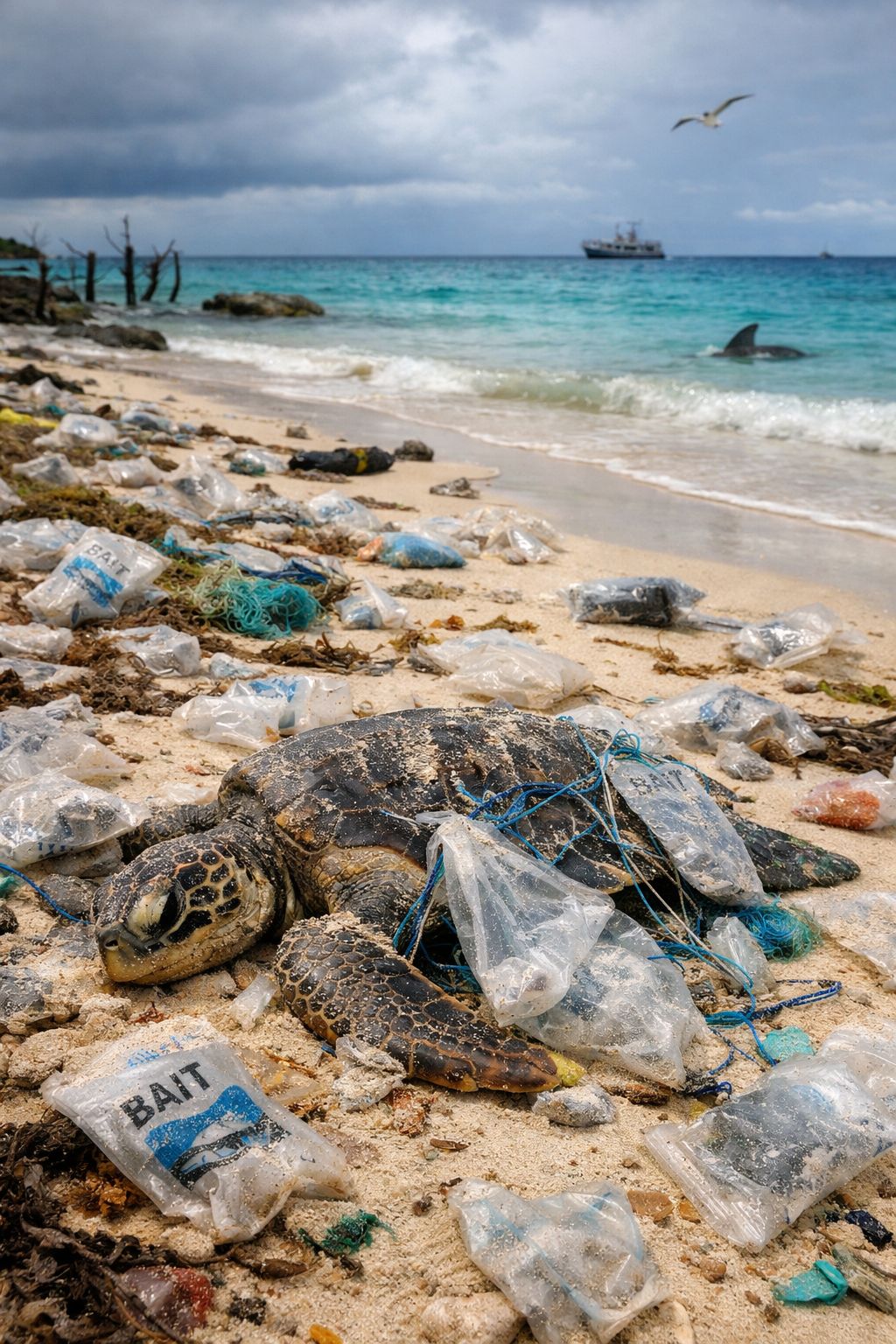
Small plastic bait bags. Thin. Disposable. Carelessly discarded. Carried by currents. Deposited onto our beaches like a toxic snowfall.
From Grand Bahama to Inagua, from Abaco to the Exuma Cays, these tiny pieces of plastic are being found scattered along the tide line, tangled in seaweed, buried in sand, trapped in mangroves. Each one, a reminder that somewhere offshore, someone made a decision that our children will now have to live with.
Just this afternoon, while sitting quietly on the beach, the reality of it became personal. An American tourist approached, holding one of the small plastic bait bags in her hand. She was concerned, confused, asking what it was and where it came from. The worry in her voice wasn’t political. It wasn’t dramatic. It was human.
When she showed it to me, I immediately recognized it, what it was and where it likely came from. I explained how foreign fishing vessels move through our waters, how bait is packaged for convenience, how too often those empty bags end up discarded overboard. She listened, shaking her head, staring at the shoreline now littered with more of them.
In that moment, the problem wasn’t just environmental. It was visible. Embarrassing. Painful.
Fishing vessels from around the world pass through our waters. They harvest from the same ocean that feeds us, sustains us, defines us. And yet, too many leave behind a trail of plastic death.
Because that’s what this is.
Death, slow, silent, suffocating death.
A hatchling sea turtle, no bigger than the palm of your hand, breaks from its nest under a Bahamian moon. Instinct drives it toward the shimmer of the sea. But between it and survival lies a field of plastic fragments. Some it crawls over. Some it swallows.
Inside its fragile body, the plastic does not dissolve. It does not pass. It sits. It blocks. It poisons.
And the turtle dies long before it ever learns the currents.
Our waters are home to green turtles, hawksbill turtles, dolphins, reef fish, conch, lobster life that generations of Bahamian’s have depended on for food, culture, livelihood. Plastic bait bags break down into microplastics, entering the food chain. Fish consume them. Larger fish consume those fish. Eventually, it reaches us.
This is not someone else’s problem.
This is ours.
Every plastic bag that washes ashore is a receipt, proof of negligence in waters that do not belong to the careless.
The economic cost alone should alarm us. Tourism thrives on pristine beaches. Visitors come for crystal-clear waters and vibrant reefs. What happens when those same beaches are littered with industrial waste from foreign vessels? What happens when marine ecosystems weaken? When fish stocks decline because breeding grounds are polluted?
But beyond economics, there is something deeper.
There is heartbreak.
There is standing on a beach at sunrise and seeing beauty interrupted by plastic. There is watching a visitor hold up a discarded bait bag and ask, “How did this get here?” There is knowing the answer and knowing it should not be this way.
There is knowing that if nothing changes, the cleanup bill — environmental and financial, will be handed to generations not yet born.
The ocean has always given to The Bahamas.
It gives us identity.
It gives us sustenance.
It gives us protection from storms through coral reefs and mangroves.
And now it is giving us back the waste of others.
This cannot become normal.
Stronger enforcement of maritime dumping laws. International accountability for vessels operating in and around Bahamian waters. Regional cooperation. Real monitoring. Real penalties. Because without consequence, carelessness continues.
The tide keeps coming in. And with it, more plastic.
But tides also recede.
The question is whether we will allow this silent invasion to define our coastline, or whether we will rise, demand accountability, and protect the waters that define who we are.
The beaches of The Bahamas are not dumping grounds.
They are inheritance.
And inheritance is something worth fighting for.
Related stories

Biometric Voter Cards Go Local, PAC Digs Into $1.5m Vouchers, and Some PMH Wards Relocate
Late-afternoon Bahamas Islands Briefing for Wednesday, October 14, 2026: Exuma’s Business Outlook is tomorrow;…

PUBLIC MESSAGE TO ALL BAHAMA DRAMA FOLLOWERS
We are taking Bahama Drama to the next level, and we want you to…

Eleuthera Residents Threaten to Stop Paying BPL Bills, Treasure Cay’s $177m Sale Nears Closing, and a “Miracle Baby” Gets Her Wheels
Afternoon Bahamas Islands Briefing for Wednesday, October 14, 2026: Eleuthera residents threaten to withhold…
Join the conversation
No comments yet. Be the first.