
Planet of the Goats 🐐
Planet of the Goats 🐐
By Michael Clare
The Ghostly Guardians of the Abyss
The Feral Goats of the Bahamas’ Forgotten Cays
In the turquoise labyrinth of the Bahamas, where the Atlantic’s restless waves carve secrets into coral spines, lies a chain of whispers: the Jumentos Cays and Ragged Islands.
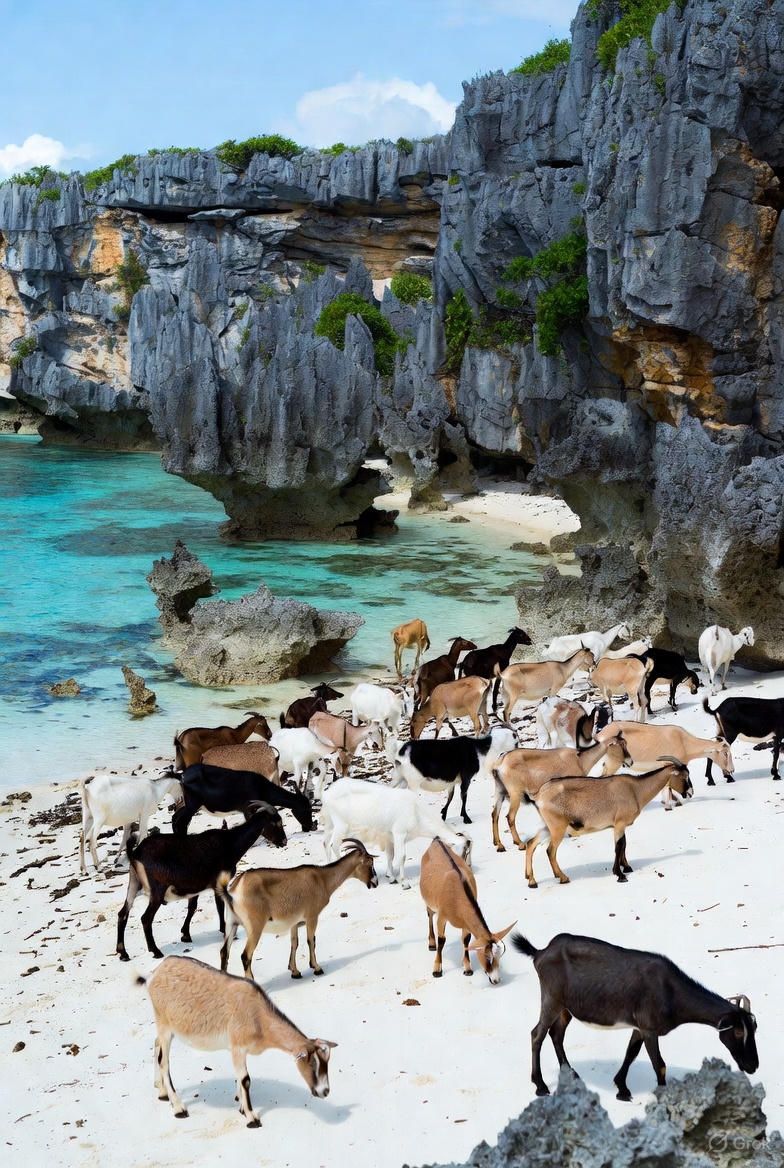
Stretching like a jagged scar 60 miles north of Cuba, this remote archipelago is a realm of untamed beauty: powdery beaches guarded by jagged limestone cliffs, hidden blue holes plunging into abyssal darkness, and mangrove thickets that swallow sunlight whole. But amid this Edenic isolation, one creature reigns supreme, its bleats echoing like spectral calls across the wind-scoured bluffs. Not humans, whose footprints fade like half-remembered dreams, but goats: thousands of them, feral and fierce, bounding in vast herds across islands that time forgot.
These are no ordinary beasts. Picture them: shaggy coats matted with salt, horns curling like ancient runes, eyes gleaming with the wild cunning of survivors. They claim over a dozen uninhabited cays in the Jumentos chain alone: Raccoon Cay’s scrubby hills, Johnson Cay’s secluded coves, Buena Vista Cay’s rocky spines, and the brooding slopes of Little Ragged Island.
On Green Cay, perched like a sentinel on the Tongue of the Ocean, they roam in such numbers that sailors swear the island trembles under their hooves. Duncan Town on Ragged Island, the chain’s last human outpost, is a ghost of 50 souls, where goats outnumber people and wander streets lined with hurricane-ravaged ruins. Here, in this end-of-the-world frontier, the goats are the true inhabitants, their presence a riddle wrapped in history’s fog.
Whispers from the Age of Sail: Seeds of a Silent Invasion
To trace the goats’ origins is to dive into the Bahamas’ shadowed past, a tapestry woven from the threads of exploration, piracy, and peril. The story begins not with a single hoofprint, but with the creak of wooden hulls slicing through Caribbean swells in the 16th century.
European sailors: hardened men aboard Spanish galleons, English privateers, and buccaneer sloops: knew the sea’s treachery all too well. Storms could shred sails like parchment; reefs could impale ships on invisible thorns; scurvy and starvation lurked in every shadow. In response, they turned to a humble ally: the goat.
It was a practice as old as Columbus himself. In 1493, on his second voyage, the explorer released goats onto the Caribbean’s islands, their nimble frames and voracious appetites making them ideal “emergency provisions.” These animals, descendants of the hardy Capra aegagrus tamed in the Fertile Crescent millennia before, required no tending.
Left to forage on scrub and browse on saltbush, they multiplied with biblical fervor, awaiting the castaway’s desperate hand. The Bahamas, a pirate’s paradise and a mariner’s graveyard, became fertile ground for this ritual. Spanish conquistadors, seeking gold in the shallows, dropped pairs of goats on cays like offerings to Poseidon.
English settlers, fleeing Cromwell’s England in the 1600s, established fleeting farms on the Raggeds, only to abandon them when hurricanes howled or fevers claimed the unwary.
But it was the Golden Age of Piracy: roughly 1716 to 1722: that infused the tale with true menace. The Bahamas swarmed with outlaws: Blackbeard roaring from his flame-enshrouded Queen Anne’s Revenge, Calico Jack Rackham carousing with Anne Bonny, and Charles Vane’s Ranger lurking in Exuma’s bays.
These sea wolves, ever pragmatic amid their debauchery, mirrored the sailors’ custom. Historical ledgers from Nassau’s gaols and ship manifests whisper of livestock raids: pigs from Cuban fincas, chickens from Jamaican coops, and goats pilfered from loyalist plantations. Some were slaughtered for fresh meat on long voyages; others, released onto remote cays as “insurance” against the noose or the no-man’s-land of shipwreck.
Imagine a pirate crew, rum-soaked and paranoid, scanning the horizon for naval pursuers. In haste, they loose a billy and a nanny onto a nameless spit of land: Raccoon Cay, perhaps, or the wind-lashed bluffs of Water Cay: muttering prayers that the beasts might one day feed their bones if fortune turned foul.
Evidence lingers like salt on the breeze. Overgrown stone walls on Hog Cay, collapsed cisterns on Dove Cay: these are the skeletons of 18th-century salt rakers’ camps and sisal plantations, where enslaved laborers once toiled under the lash. When operations collapsed in the 19th century, amid the abolition of slavery and economic ruin, the goats stayed.
Freed from pens, they scattered into the wild, their numbers swelling unchecked. By the 1800s, British naval surveys noted “prodigious herds” on the Jumentos, feral flocks that evaded hunters with uncanny guile. One account from a 1820s whaler describes a cay “black with goats at dawn, vanishing like smoke by midday,” as if the animals communed with the island’s spirits.
Veils of Mystery: Do They Swim the Abyss?
Yet for all the ledgers and logs, shadows cloak the goats’ saga. How did they cross the treacherous channels between cays, some separated by miles of shark-patrolled blue? Folklore among Ragged Island fisherfolk claims the beasts swim: not in panicked flight, but in deliberate migrations, their heads bobbing like buoys under moonless skies.
Skeptics scoff; goats are land-bound by nature. But eyewitnesses abound: cruisers in the 20th century reported herds fording shallows at low tide, or rafting on mats of mangrove roots swept by currents. And what of their sustenance in this parched realm? The Jumentos are a desert in disguise: limestone karsts pocked with brackish pools, where rain is rarer than mercy. Do the goats divine hidden springs, or sip dew from thorns under the Southern Cross?
Bahamian elders spin yarns of “goat kings,” spectral billys with horns like crescent moons, leading their flocks to oases known only to the initiated.
Darker mysteries lurk. In the 1930s, whispers of “cursed islands” rippled through Nassau’s rum shops. Prospectors seeking guano deposits vanished on Goat Bladder Cay, their journals ranting of “eyes in the brush” and bleats that mimicked human cries.
Were these fever dreams, or echoes of Lucayan ghosts: the indigenous Taino people, exterminated by Spanish steel in the 1500s, whose spirits, some say, guide the goats as vengeful wardens? Modern ecologists puzzle over the herds’ resilience: DNA traces link them to Iberian breeds, yet anomalies persist: goats with piebald coats unseen in Europe, or an unnatural aversion to fire, as if scarred by pirate torches.
Climate change adds fresh enigmas; rising seas nibble at their domains, yet the populations endure, defying models of starvation and submersion.
Echoes of the Eternal: A Legacy Unfurling
Today, the goats of the Jumentos and Raggeds stand as living monuments to human hubris and nature’s defiance. Conservationists eye them warily: feral hordes that devour native succulents, outcompeting iguanas and burrowing owls.
Efforts to cull or relocate, like those on Great Goat Cay in the Exumas, stir controversy: Are they invaders, or the archipelago’s last free souls? Yachtsmen, dropping anchor in Duncan Town’s harbor, trade tales over conch fritters, toasting the beasts that outlasted empires.
In the end, these goats are more than survivors; they are storytellers, their hooves etching fables into coral dust. Released by sailors’ hands or pirates’ whims, nurtured by abandoned dreams and shipwreck vows, they embody the Bahamas’ eternal paradox: a paradise haunted by its own wild heart. Venture to Raccoon Cay at dusk, and listen.
Amid the waves’ murmur and the stars’ indifferent gaze, a chorus rises: bleats from the brink, guarding secrets that the sea alone can keep. What tales would they whisper, if we dared to linger?
Related stories

Biometric Voter Cards Go Local, PAC Digs Into $1.5m Vouchers, and Some PMH Wards Relocate
Late-afternoon Bahamas Islands Briefing for Wednesday, October 14, 2026: Exuma’s Business Outlook is tomorrow;…

PUBLIC MESSAGE TO ALL BAHAMA DRAMA FOLLOWERS
We are taking Bahama Drama to the next level, and we want you to…

Eleuthera Residents Threaten to Stop Paying BPL Bills, Treasure Cay’s $177m Sale Nears Closing, and a “Miracle Baby” Gets Her Wheels
Afternoon Bahamas Islands Briefing for Wednesday, October 14, 2026: Eleuthera residents threaten to withhold…
Join the conversation
No comments yet. Be the first.