
NORTH KOREA’S CHILLING NEW RULE: IF THE LEADER FALLS… THE MISSILES…
NORTH KOREA’S CHILLING NEW RULE: IF THE LEADER FALLS… THE MISSILES MAY FLY
By: Michael Elijah Muhammad Clare
Imagine a world where killing one man could trigger the unthinkable.
Not a warning.
Not a debate.
Not a room full of generals arguing around a giant table.
But a pathway toward nuclear retaliation.
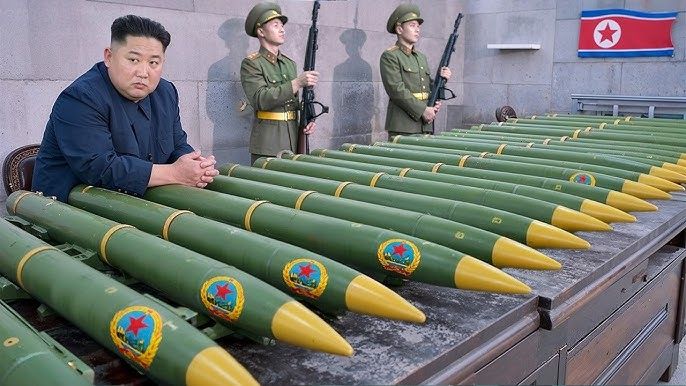
That terrifying possibility is exactly why North Korea’s constitutional and nuclear command updates have grabbed the attention of military analysts, intelligence agencies, and governments around the world.
According to reporting surrounding North Korea’s updated doctrine, Pyongyang has strengthened language tied to what happens if supreme leader Kim Jong Un is killed, incapacitated, or if the nation’s nuclear command system comes under hostile attack.
And the implications are enough to make even hardened geopolitical experts uneasy.
For years, one question haunted global military planners:
What happens if North Korea’s leader is assassinated?
Would the government collapse?
Would generals fight for power?
Would the nuclear arsenal freeze in confusion?
Or worse…
Would someone launch first?
North Korea appears determined to remove that uncertainty.
The reported updates suggest something deeply unsettling: the country wants the world to believe its nuclear capability does not die with its leader.
In plain language?
The message appears to be:
Do not think removing the head removes the threat.
That is a frightening shift in nuclear deterrence.
Because historically, nuclear powers rely heavily on chains of command, human decision-making, and layers of authorization.
North Korea’s evolving doctrine appears designed to tell rivals that even a so-called “decapitation strike” — a military term for eliminating a nation’s leadership — could carry catastrophic consequences.
According to reporting on the updated language, if North Korea’s nuclear command and control system is endangered by hostile attack, a nuclear strike can be launched “automatically and immediately.”
Think about that for a second.
If a foreign nation believed eliminating a leader could stop a war…
North Korea wants that calculation to become far more dangerous.
Much of the concern stems from growing global instability, modern drone warfare, covert operations, cyberattacks, and real-world examples showing how quickly senior leadership can be targeted during conflict.
Pyongyang has watched the modern battlefield evolve.
And it appears to be adapting.
But this story raises another uncomfortable question.
One that reaches far beyond North Korea.
Should the United States ever do the same thing for its president?
That question may sound shocking…
Until you look at recent American history.
President Donald J. Trump has faced multiple major security threats, plots, and assassination-related incidents in recent years that stunned the United States and the world.
America watched bullets fly during a campaign rally.
America watched another major security scare unfold around a golf course.
The reality is simple: threats against national leaders are no longer distant Cold War movie plots.
They are modern headlines.
So the question becomes:
If a foreign enemy, terrorist organization, or hostile power targeted the president of the United States…
Should America create a doctrine so powerful and unmistakable that enemies know removing the president could never remove the response?
North Korea’s apparent answer is yes.
America’s traditional answer has been very different.
The United States already maintains a constitutional chain of succession, nuclear deterrence, military continuity plans, intelligence infrastructure, and command systems designed to survive leadership loss.
But it does not publicly operate under a constitutional promise of automatic nuclear retaliation tied directly to presidential assassination.
And that difference matters.
Because critics fear automatic retaliation could make future crises even more volatile.
Why?
Because in moments of confusion, radar mistakes, cyber interference, false alarms, or sudden military escalation… nations are forced to make decisions under immense pressure.
When nuclear weapons enter that equation, the margin for error becomes terrifyingly small.
One misunderstanding.
One misread signal.
One assumption.
One hacked system.
History has shown the world has come dangerously close before.
North Korea’s constitutional messaging appears intended as a giant flashing warning sign to foreign powers:
Touch the leadership… and you may not control what happens next.
Whether this strengthens deterrence or increases global danger depends on who you ask.
Supporters of hard deterrence would argue the policy discourages assassination attempts and foreign intervention.
Critics argue it raises the stakes of any future conflict to levels that could become almost impossible to manage safely.
Either way, one thing is becoming clear.
North Korea is not signaling weakness.
It is signaling continuity.
The kind that says the machinery of retaliation is expected to survive even the loss of the man at the top.
And in a nuclear age…
That is a sentence the world cannot afford to ignore.
Related stories

Biometric Voter Cards Go Local, PAC Digs Into $1.5m Vouchers, and Some PMH Wards Relocate
Late-afternoon Bahamas Islands Briefing for Wednesday, October 14, 2026: Exuma’s Business Outlook is tomorrow;…

PUBLIC MESSAGE TO ALL BAHAMA DRAMA FOLLOWERS
We are taking Bahama Drama to the next level, and we want you to…

Eleuthera Residents Threaten to Stop Paying BPL Bills, Treasure Cay’s $177m Sale Nears Closing, and a “Miracle Baby” Gets Her Wheels
Afternoon Bahamas Islands Briefing for Wednesday, October 14, 2026: Eleuthera residents threaten to withhold…
Join the conversation
No comments yet. Be the first.