
New Boating Fees Reality vs Marine stocks Nightmare
New Boating Fees Reality vs Marine stocks Nightmare
Marine Plunder, and a Hard Truth the Bahamas Is Finally Facing
By: Michael Elijah Muhammad Clare
For years, the conversation around foreign vessels in Bahamian waters has focused on tourism, friendship, and access. But quietly, among Bahamian fishermen, family island boaters, and marine workers, a very different conversation has been taking place, one rooted not in theory or geopolitics, but in what they are seeing with their own eyes on the water.
With the introduction of new and increased boating fees for foreign visitors, the Bahamas Government has triggered backlash from segments of the international boating community. Critics argue the fees are too high, too sudden, and risk driving visitors elsewhere. Yet among many Bahamians who work the sea for a living, the reaction has been very different. For them, these fees are not punishment, they are protection.
The Economic Myth of the “Good Boater”
Bahamian boaters and fishermen consistently tell Bahama Drama that a large portion of foreign recreational vessels contribute little to the local economy. Many arrive fully provisioned, anchor for days or weeks, fish and dive extensively, and leave without meaningful spending in local settlements, marinas, or businesses.
From the local perspective, this has created a form of economic leakage: Bahamian waters absorb the pressure, while Bahamian communities see little return. Fuel, food, ice, dockage, and services are often bypassed entirely. The ocean gives, but the country does not receive.
When this reality is weighed against the wear placed on marine resources, the imbalance becomes harder to ignore.
Lobster Disappearing Before Bahamian Eyes
One of the most alarming claims coming from fishermen is the difficulty in finding lobster in areas that were once reliable and abundant. Many say they now burn more fuel, dive deeper, and work longer hours just to bring in a fraction of what used to be normal.
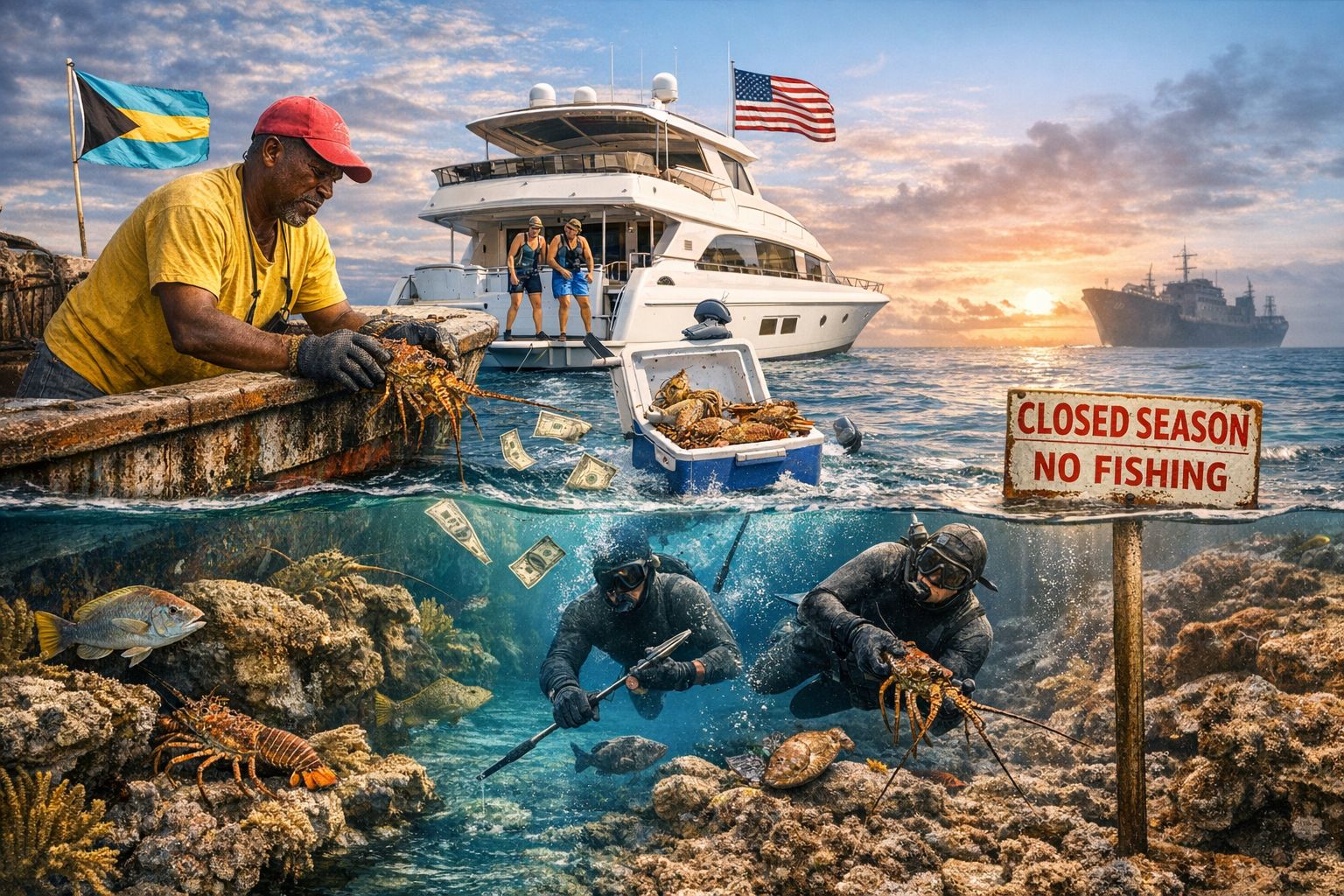
The blame, they argue, does not rest primarily with Bahamian’s who are bound by closed seasons, size limits, and licensing rules, but with foreign recreational boaters who are allegedly ignoring those same regulations.
Fishermen say they regularly witness:
* Lobster being taken during closed season
* Undersized lobster harvested year-round
* Catch removed quietly from shallow banks and reef systems
* No meaningful enforcement presence in remote areas
Undersized lobsters are not just illegal, they represent the future breeding stock of the fishery. Removing them accelerates collapse, not just decline. To many Bahamians, this is no longer a theoretical environmental concern. It is a lived reality.
Closed Seasons for Some, Optional for Others
When the fishing season closes for certain species, Bahamians stop. They must. Their licenses, livelihoods, and freedom depend on compliance. But fishermen tell Bahama Drama that foreign boaters often continue catching marine animals during these closures, treating Bahamian laws as suggestions rather than rules.
This has bred deep resentment. Not only are locals losing access to resources during legal closures, but they believe others are taking advantage of that restraint, extracting value while Bahamians wait.
In this context, new boating fees are viewed less as revenue tools and more as a corrective measure, a way to slow traffic, reduce abuse, and force accountability where enforcement alone has struggled.
The “Chinese Ghost Ship” Distraction
Compounding frustration is what many Bahamians see as a misplaced narrative: repeated warnings about Chinese government commercial vessels allegedly plundering Bahamian waters.
Fishermen ask a blunt question, where are they?
Many say they have never seen these so-called ghost ships with their own eyes. What they do see are foreign pleasure craft anchored daily, divers entering the water repeatedly, and coolers leaving the Bahamas full of fish and lobster.
To them, the focus on distant geopolitical threats feels like a distraction from what they believe is the real pressure on the marine environment, recreational extraction happening openly, consistently, and close to shore.
Why the Fees Changed and Why Some Bahamians Support It
The government’s decision to raise boating and fishing fees has been framed officially as modernization, revenue generation, and sustainability. But on the ground, many Bahamians see something simpler: finally, the cost of using Bahamian waters is being recalculated.
When the potential value of lost marine life is considered, lobster, fish, reef species, future breeding stock, fishermen argue the economic damage may already be in the hundreds of millions of dollars over time. Against that backdrop, higher fees are viewed as a way to:
* Reduce casual exploitation
* Fund enforcement and conservation
* Encourage more responsible boating behavior
* Give stressed ecosystems a chance to recover
This does not mean all concerns from the boating industry are invalid. Job losses, marina revenue declines, and implementation issues are real. But many Bahamians argue that uncontrolled access has its own cost, one that has been quietly paid by fishermen for years.
So What Do We Do Now?
The Bahamas now stands at a crossroads.
One path rolls back fees, restores unrestricted access, and hopes goodwill alone will protect the marine environment. The other path acknowledges a hard truth: the ocean is not infinite, and unmanaged use, even recreational, can be just as damaging as industrial exploitation.
For many Bahamians, supporting higher boating fees is not anti-tourism. It is pro-survival.
The real challenge ahead is balance ensuring that visitors who genuinely respect Bahamian laws, spend locally, and protect marine life are welcomed, while those who view the Bahamas as a free resource are discouraged.
What is clear is this: the debate is no longer just about money. It is about who benefits from Bahamian waters, who bears the loss, and whether the country is willing to defend what cannot be replaced once it is gone.
Related stories

Biometric Voter Cards Go Local, PAC Digs Into $1.5m Vouchers, and Some PMH Wards Relocate
Late-afternoon Bahamas Islands Briefing for Wednesday, October 14, 2026: Exuma’s Business Outlook is tomorrow;…

PUBLIC MESSAGE TO ALL BAHAMA DRAMA FOLLOWERS
We are taking Bahama Drama to the next level, and we want you to…

Eleuthera Residents Threaten to Stop Paying BPL Bills, Treasure Cay’s $177m Sale Nears Closing, and a “Miracle Baby” Gets Her Wheels
Afternoon Bahamas Islands Briefing for Wednesday, October 14, 2026: Eleuthera residents threaten to withhold…
Join the conversation
No comments yet. Be the first.