
NEVER FORGET September 11, 2001
NEVER FORGET September 11, 2001
Researcher ✔️
Michael Elijah Muhammad Clare
A Bahama Drama remembrance for the souls who left us that morning and for the islands that felt the blow
The camera would open on a sky so blue it looks painted.
September 11, 2001. A Tuesday. Not the year 2000. Not 8:51. History is exact because the dead deserve exactness. At 8:46 a.m. American Airlines Flight 11 struck the North Tower between floors 93 and 99. At 9:03 a.m. United Airlines Flight 175 struck the South Tower between floors 77 and 85. The South Tower fell at 9:59 a.m. The North Tower fell at 10:28 a.m. Nearly 2,977 people were murdered. At the World Trade Center, 2,753 died, including 343 FDNY firefighters, 37 Port Authority officers, and 23 NYPD officers.
New York was waking the way cities wake, coffee, elevators, first meetings, children already at school. In the Twin Towers, people were already at their desks. Bond traders. Secretaries. Cooks at Windows on the World. Firefighters in engine houses across the five boroughs finishing breakfast, not knowing that in less than two hours the largest loss of firefighters in American history would be written in their names.
At 8:46 a.m., Flight 11 tore into the North Tower.
From the street it looked, for one stunned second, like an accident. A fire high in the sky. Paper drifting down like strange snow. Then the sound caught up with the picture, and the city understood it was watching something it had no language for yet.
People on the sidewalks stopped. Hands went to mouths. Phones came out. Nobody knew they were already inside a film that would never end.
Seventeen minutes later the second plane hit the South Tower live on television. The world saw the fireball. The world heard the gasp that rose from every street, every office, every kitchen where a set was on. Hope that this was one terrible crash died in that instant. This was war arriving in the shape of a clear morning.
Inside the towers, the movie no one wanted to watch was already running.
Floors above the impact became furnaces. Stairwells were cut. Elevators were tombs. People called home. Some left messages that still exist, voices trying to sound calm for the people they loved. Some held hands. Some prayed. Some made a choice no human being should ever have to make.
From the upper floors, men and women came to the broken windows.
On the ground, strangers looked up and saw what their minds refused at first to name. Figures against the blue. A white shirt. A dress filling with air. Two people holding each other. They fell for ten, twelve seconds from heights the living can barely imagine, from offices, from the restaurant at the top of the world, while people below screamed, covered children’s eyes, or could not look away because looking away felt like abandoning them.
That is not spectacle. That is the last freedom some of them had left, not to burn.
And still the firefighters went in.
They ran toward the doors the rest of the city was running from. Three hundred forty three of them would not come out. Engine companies. Ladder companies. Chiefs. Probies who had barely finished the academy. They climbed stairs in full gear through heat and dark, carrying hose and hope, because that is what the job is when the job becomes the end of the world. Port Authority officers. NYPD. EMS. Building staff who stayed to help others down. Ordinary people who became a human chain on the stairs.
They were still going up when the South Tower came down at 9:59 a.m.
It did not lean like a tired thing. It fell in about ten seconds, a roar like the earth opening, a cloud that turned day into night and chased people through the streets of Lower Manhattan. Dust filled lungs and eyes. The living ran through a blizzard of what had been offices, photographs, lives. Then, at 10:28 a.m., the North Tower followed. Two pillars of the skyline were gone. In their place, a wound, a silence after thunder, and a field of steel and dust that America would call Ground Zero.
Far away, another plane died in a Pennsylvania field because passengers and crew decided they would not let it reach its target. At the Pentagon, more names were added to the same terrible list. The whole country learned, in one morning, what terrorism looks like when it is not a word in a newspaper but a skyline falling in front of children.
From our islands, the same sky
The horror did not stop at the Hudson.
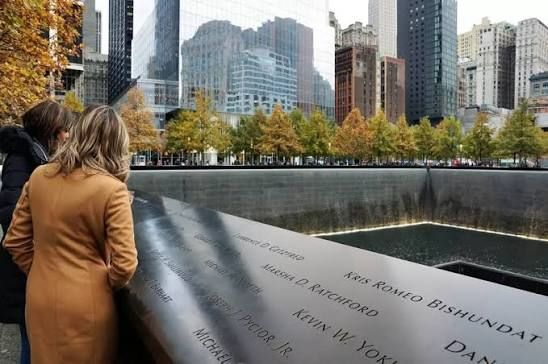
On the official rolls of nations that lost sons and daughters that morning, The Bahamas is named. Citizens of our region died in those towers and on those planes. Across the Caribbean, Guyana, Jamaica, Barbados, Trinidad and Tobago, Antigua, Dominica, Haiti and more, names from home were later cut into the bronze at Ground Zero. Some families in Nassau, Freeport, Grand Turk and Providenciales still know a cousin, a schoolmate, a church sister who had gone north to work and never came home. We do not invent their names here. We bow our heads because they were ours too.
That Tuesday the islands woke to the same blue. Then televisions in Over the Hill living rooms, in hotel staff rooms, in straw markets and in the kitchens of Turks and Caicos went silent except for the news. Mothers who had children in Brooklyn and Queens could not get a line through. Fathers who drove taxi in Nassau stared at the screen and saw a city they knew as family, the place so many Bahamians and Belongers go to work, to school, to send money home.
Then the planes stopped.
For tourism countries, that was a second blow. Air arrivals to The Bahamas fell by about half. Hotels emptied. Bay Street went quiet. Taxi ranks sat idle. Straw vendors waited for crowds that did not come. Casinos stood nearly dark. Officials later said the country lost on the order of 100 million dollars in tourism revenue, and government receipts dropped in the weeks after the attacks. In October 2001, Caribbean leaders gathered in Nassau in emergency session because the region’s lifeblood, visitors, flights, jobs, had been cut. Turks and Caicos felt the same wind, cancelled holidays, grounded aircraft, empty beaches, families whose pay depended on a guest who was suddenly too afraid to fly.
That is how terror reaches an island. Not only in fire and falling steel, but in a phone that will not ring, a shift that disappears, a child asking why Grandfather is crying in front of the television.
Four months before the attacks, two of the men who would hijack Flight 11 landed in Grand Bahama and were turned away for lack of visas. History recorded the footnote. The islands recorded the larger truth: we are small, we are open, we are bound to America by blood and by work, and when New York burns, our tables feel it.
So when we remember the jumpers and the firefighters, we also remember the Bahamian and Turks and Caicos families who sat through that morning with the rest of the world, hoping the next call would be good news, and learning, like everyone else, that some calls never came.
The promise after that morning and the neighborhood we live in
After that day, President George W. Bush told the country the fight would not be against one city or one hour, but against those who murder civilians to rule by fear. Later administrations carried pieces of that fight. None of that erases the dead of 2001. None of it turns their names into a slogan.
It also does not mean every horror is the same horror. The men who hijacked those four planes planned a coordinated massacre of thousands in a single morning. That is the crime we mark today.
Twenty five years on, our own sea has another wound. In Port au Prince, not Port of France, armed coalitions have seized most of the capital, killed, kidnapped, burned neighborhoods, and driven more than a million people from their homes. In May 2025 the United States designated Viv Ansanm and Gran Grif as Foreign Terrorist Organizations. A Kenya led support mission never reached the strength it was promised. Gangs still hold the streets. Haitians live that terror on camera, every week, at America’s doorstep.
That is not the Twin Towers. It is still people being hunted in the same Caribbean basin that felt 9/11 in empty hotels and unanswered phones. Remembering September 11 is not a license to flatten every crime into one war. It is a license to refuse the lie that fear on a nearby island is none of our business. What any president does about it is policy. What we owe the dead of 2001 is memory, not a campaign.
We remember them
We remember the ones who jumped because fire left them no other door.
We remember the ones who stayed on the phone until the line went dead.
We remember the firefighters who climbed.
We remember the officers who held the perimeter while the buildings died.
We remember the strangers who carried strangers.
We remember the island families waiting on a call from New York.
We remember the ones whose names are carved in bronze and the ones whose names live only in a kitchen still set for someone who never came home.
Twenty five years later the towers are light in the night sky, two beams where steel used to stand. The children of that morning are grown. Some of the first responders who survived the dust are gone now from the illnesses that followed them out of the pile. Grief did not end at 10:28 a.m. It learned how to walk.
And still there is hope, because hope is what they would have wanted us to carry out of the dark.
Hope is the man who held a stranger’s arm on the stairs.
Hope is the firefighter who went up anyway.
Hope is a country that, for one raw season, remembered it was one country.
Hope is every September 11 when someone says a name out loud so it does not become only a number.
Hope is an island that still lights a candle for people it may never have met, because love does not need a passport.
If this reads like a film, that is because that morning was a film no director should have been allowed to shoot, and because the people inside it were not extras. They were someone’s whole world. A mother. A brother. A rookie with a new helmet. A cook. A trader. A child who never got to grow old. A cousin whose last paycheck was meant for home.
Terrorism showed its face that day. So did courage. So did love that would not leave the stairwell.
We do not look away.
We say their names in the quiet.
We teach the children the date the right way: September 11, 2001.
We keep the promise the living made to the dead.
From Nassau to Cockburn Town, from Grand Bahama to Providenciales, from New York to a Pennsylvania field:
We will never forget.
Rest in peace to every soul taken in New York, at the Pentagon, and in that field.
Rest in peace to the 343.
Rest in peace to every first responder who ran toward the fire.
Rest in peace to every Caribbean son and daughter whose name is on that wall, and to every family in these islands who still feels the empty chair.
Never forget.
Never again look away.
Related stories

Biometric Voter Cards Go Local, PAC Digs Into $1.5m Vouchers, and Some PMH Wards Relocate
Late-afternoon Bahamas Islands Briefing for Wednesday, October 14, 2026: Exuma’s Business Outlook is tomorrow;…

PUBLIC MESSAGE TO ALL BAHAMA DRAMA FOLLOWERS
We are taking Bahama Drama to the next level, and we want you to…

Eleuthera Residents Threaten to Stop Paying BPL Bills, Treasure Cay’s $177m Sale Nears Closing, and a “Miracle Baby” Gets Her Wheels
Afternoon Bahamas Islands Briefing for Wednesday, October 14, 2026: Eleuthera residents threaten to withhold…
Join the conversation
No comments yet. Be the first.