
LESS TALK ABOUT FOOD SECURITY IN THE BAHAMAS
LESS TALK ABOUT FOOD SECURITY IN THE BAHAMAS
Why Does Food Security Only Become News When Something Goes Wrong?
Researcher ✔️
Michael Elijah Muhammad Clare
By BAHAMA DRAMA INVESTIGATIVE DESK
There is something seriously wrong with the way we talk about food security in The Bahamas.
Actually, the bigger problem may be that we hardly talk about it at all.
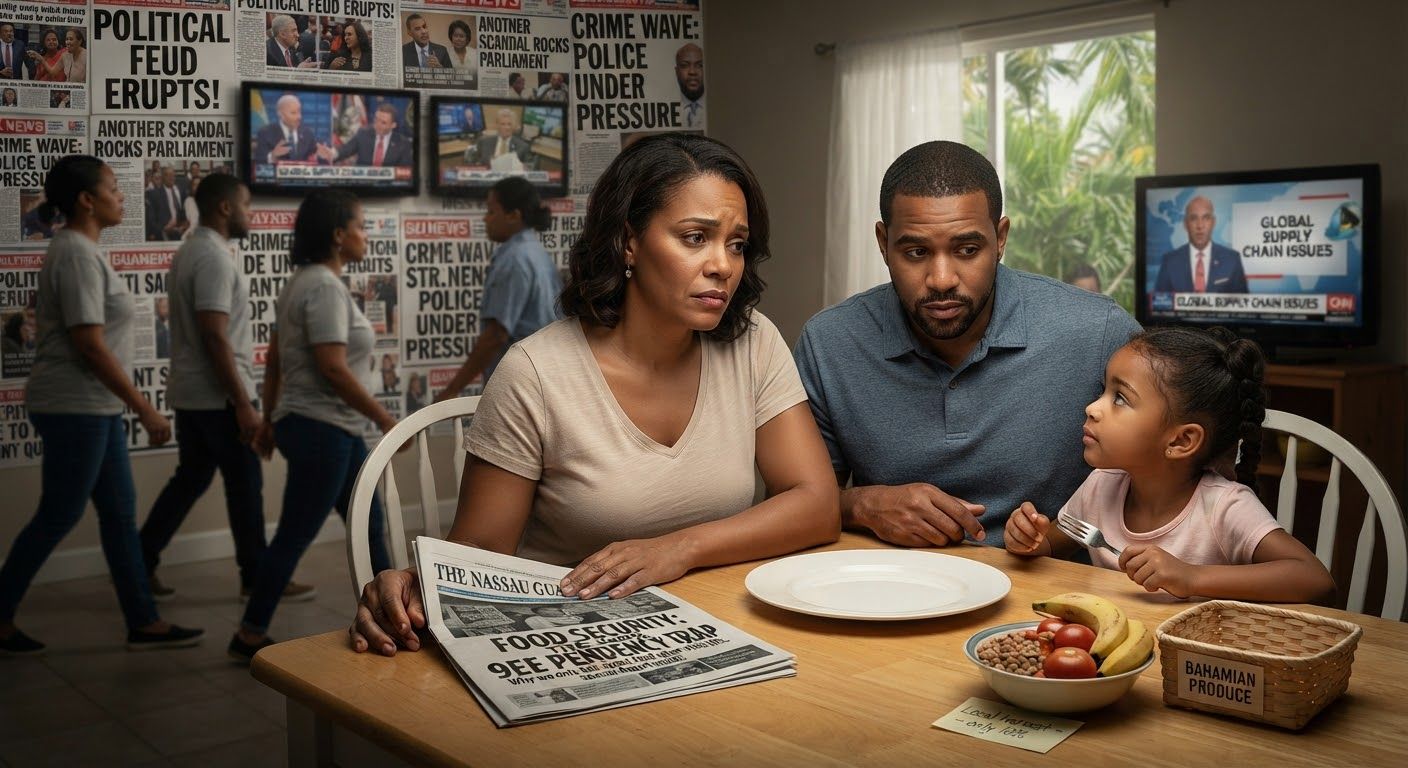
Turn on the television.
Open a newspaper.
Scroll through social media.
Look at the latest headlines.
Crime.
Politics.
Scandals.
Arguments between politicians.
Celebrity drama.
Court cases.
Traffic accidents.
Controversies.
Who said what about whom.
These stories have their place. They are part of the daily news cycle.
But there is another issue sitting quietly in the background that affects every single Bahamian every single day.
FOOD.
And more specifically, whether this country can continue feeding its people when something goes seriously wrong.
That conversation should never disappear from the national agenda.
Yet too often, food security seems to become important only when there is a crisis, a hurricane, an empty shelf, a price increase or some frightening headline coming out of another country.
Why?
Why are we constantly chasing the newest headline while one of the most fundamental issues facing this country receives far less sustained attention?
THE FOOD ON OUR TABLES SHOULD BE FRONT PAGE NEWS
The Bahamas imports nearly 90 percent of the food it consumes, with an annual food import bill of around $1 billion.
That should not be treated as some boring agricultural statistic.
That should be treated as a national security issue.
It means that much of what Bahamians eat depends on systems outside our control.
Ships have to arrive.
Ports have to operate.
Fuel has to be available.
Foreign farmers have to produce.
Foreign roads and transportation systems have to function.
International markets have to remain relatively stable.
And the countries supplying our food must continue exporting it.
We are depending on a complicated international chain just to put breakfast, lunch and dinner on Bahamian tables.
What happens when that chain breaks?
That is the question we should constantly be asking.
Not only after a hurricane.
Not only after prices jump.
Not only when supermarkets begin running short of something.
Now.
EVERYTHING ELSE SEEMS TO GET MORE ATTENTION
The Bahamian media is incredibly good at finding the latest controversy.
A politician makes a statement and within minutes it becomes a headline.
Somebody gets arrested and it becomes breaking news.
Two public figures have an argument and everybody wants to know what happened.
A scandal emerges and suddenly it dominates the national conversation.
But food security?
Crickets.
Until something happens.
Then everybody wants to talk about it.
This is where the media has to look at itself.
News organizations are businesses. They need readers, viewers, followers, advertising and engagement.
We understand that.
But journalism is supposed to be more than chasing whatever produces the biggest number of clicks today.
The media also has a responsibility to help a country understand the problems that could determine its future.
Food security is one of those problems.
A newspaper should not have to wait until supermarket shelves are empty before asking whether The Bahamas can feed itself.
A television station should not have to wait until food prices explode before asking what the country is doing about agricultural production.
A news website should not need a hurricane to remind Bahamians that our food supply depends heavily on transportation and imported products.
These questions should be asked continuously.
THE MEDIA DOES NOT HAVE TO WAIT FOR A CRISIS
Imagine if Bahamian media treated food security the way it treats crime.
Imagine regular investigations into how much food we produce locally.
Imagine journalists visiting farms in Andros, Exuma, Long Island, Eleuthera and other Family Islands.
Ask farmers what is stopping them from producing more.
Ask how much fertilizer costs.
Ask about electricity.
Ask about water.
Ask about transportation.
Ask about refrigeration.
Ask about financing.
Ask whether farmers can actually make enough money to stay in business.
Ask supermarkets how much Bahamian-produced food they sell.
Ask hotels and restaurants how much local food they purchase.
Ask the government what percentage of its agricultural spending actually reaches productive capacity.
Ask the hard questions.
Then keep asking them.
That is journalism.
FOOD SECURITY IS NOT JUST ABOUT FARMERS
One of the biggest misunderstandings about food security is that people think it is simply an agricultural issue.
It isn’t.
It is an economic issue.
It is a transportation issue.
It is an energy issue.
It is a national security issue.
It is a hurricane preparedness issue.
It is a poverty issue.
It is a business issue.
And ultimately, it is a survival issue.
A family can walk into a supermarket and see shelves full of food while still being food insecure because they cannot afford what is on those shelves.
That is an important distinction.
Food security is not simply about whether food exists.
It is about whether people can reliably access and afford enough food.
JAMAICA SHOULD HAVE OUR ATTENTION
The warning signs are already visible elsewhere in the Caribbean.
The original article examined Jamaica’s food security situation and highlighted data indicating that a large portion of the Jamaican population experienced moderate or severe food insecurity.
Jamaica has substantially more agricultural capacity and land than The Bahamas.
Yet Jamaica can still experience serious food insecurity.
That should make Bahamians uncomfortable.
Not because Jamaica has failed.
But because Jamaica demonstrates something important.
Having farms does not automatically guarantee that everyone can afford food.
And having supermarkets full of food does not automatically mean every family can afford to eat properly.
So what happens in The Bahamas?
A country with hundreds of islands and cays.
A country that imports most of its food.
A country that must move food across water and air.
A country exposed to hurricanes.
A country heavily dependent on tourism.
A country where the cost of living is already a major concern for ordinary families.
These are exactly the circumstances that should make food security a permanent national conversation.
NOT JUST WHEN A HURRICANE IS COMING
Every hurricane season, Bahamians suddenly remember food security.
People rush to supermarkets.
Bottled water disappears.
Canned goods disappear.
Bread becomes difficult to find.
Gas stations become crowded.
Everybody starts thinking about supply.
But why does it take a hurricane to make us think this way?
A hurricane is only one possible disruption.
What about an international war?
What about a major shipping interruption?
What about fuel shortages?
What about a major disease outbreak affecting agriculture?
What about a serious economic crisis?
What about a major hurricane destroying agricultural production in one of our primary supplier countries?
What about international food prices suddenly rising?
What about a disruption at a major American port?
We cannot predict every crisis.
But we can prepare for the possibility that something will eventually go wrong.
THE MEDIA SHOULD HELP KEEP THE PRESSURE ON
This is where the Bahamian media can make a tremendous difference.
Don’t just report that the government allocated millions of dollars to agriculture.
Follow the money.
Don’t just announce that another agricultural programme has been launched.
Go back six months later.
Did it work?
Go back one year later.
How many farmers benefited?
How much food is actually being produced?
How much has production increased?
What problems remain?
Don’t just interview a politician standing at a podium.
Interview the farmer who has to pay the electricity bill.
Interview the fisherman who has to buy fuel.
Interview the restaurant owner trying to purchase local produce.
Interview the supermarket manager.
Interview the ordinary mother standing in the grocery line.
That is where the real story is.
WE NEED LESS HEADLINE CHASING AND MORE NATIONAL CONVERSATION
There is nothing wrong with reporting breaking news.
There is nothing wrong with reporting crime.
There is nothing wrong with political controversy.
But a country cannot build its future by spending all of its attention reacting to whatever happened yesterday.
Some issues require constant attention precisely because they are not dramatic.
Food security is one of them.
There may be no explosion.
No arrest.
No political shouting match.
No viral video.
No scandal.
But every morning millions of dollars worth of food have to somehow make their way into this country and eventually onto our tables.
That is a story.
Every day.
THE BAHAMAS NEEDS TO ASK A VERY SIMPLE QUESTION
If the ships stopped coming tomorrow, how long could we feed ourselves?
Not forever.
Not even close.
That should concern us.
We should know exactly how much food we have stored.
We should know what we can produce locally.
We should know which foods we can increase production of quickly.
We should know which Caribbean countries could supply us during an emergency.
We should know how much refrigerated storage capacity exists.
We should know how vulnerable our ports are.
We should know how quickly Family Island farmers can get their products to Nassau.
We should know what happens to our food supply when fuel prices suddenly rise.
And most importantly, ordinary Bahamians should know the answers too.
THE MEDIA HAS A ROLE TO PLAY
This is not an attack on every journalist or every media organization in The Bahamas.
There are journalists doing serious work.
But as a national industry, we can do better.
Much better.
The media has enormous power to determine what Bahamians discuss around the dinner table.
If the media talks about a subject every day, people notice.
If the media asks the government difficult questions every week, politicians notice.
If journalists repeatedly investigate the same national problem, policymakers eventually have to respond.
That is the power of journalism.
Use it.
FOOD SECURITY SHOULD NEVER BE OFF THE MENU
The irony is almost painful.
We are a country where everyone eats.
Every politician eats.
Every journalist eats.
Every business owner eats.
Every construction worker eats.
Every hotel employee eats.
Every police officer eats.
Every teacher eats.
Every child eats.
Every pensioner eats.
Yet one of the issues that determines whether all of these people can continue eating receives nowhere near the sustained national attention it deserves.
We need to change that.
Food security should not be a once-a-year conversation.
It should not be a hurricane-season conversation.
It should not become important only after a foreign crisis.
And it certainly should not disappear because another sensational headline has grabbed everyone’s attention.
The Bahamas needs less talk about the latest scandal and more serious discussion about the food on our tables.
Less obsession with what happened yesterday.
More attention to what could happen tomorrow.
Less headline chasing.
More investigative journalism.
Less waiting for the crisis.
More preparation before the crisis.
Because when the shelves are empty, it will be too late to start asking questions.
And when a family cannot afford to put food on the table, telling them that nobody saw the problem coming will not feed them.
The warning signs are already there.
The vulnerability is already there.
The dependence is already there.
The question is whether we are going to pay attention before something forces us to.
Food security must remain on the national menu.
And this time, it needs to stay there.
Related stories

Biometric Voter Cards Go Local, PAC Digs Into $1.5m Vouchers, and Some PMH Wards Relocate
Late-afternoon Bahamas Islands Briefing for Wednesday, October 14, 2026: Exuma’s Business Outlook is tomorrow;…

PUBLIC MESSAGE TO ALL BAHAMA DRAMA FOLLOWERS
We are taking Bahama Drama to the next level, and we want you to…

Eleuthera Residents Threaten to Stop Paying BPL Bills, Treasure Cay’s $177m Sale Nears Closing, and a “Miracle Baby” Gets Her Wheels
Afternoon Bahamas Islands Briefing for Wednesday, October 14, 2026: Eleuthera residents threaten to withhold…
Join the conversation
No comments yet. Be the first.