
Is The Bahamas Being Pulled Into a CARICOM Sinkhole?
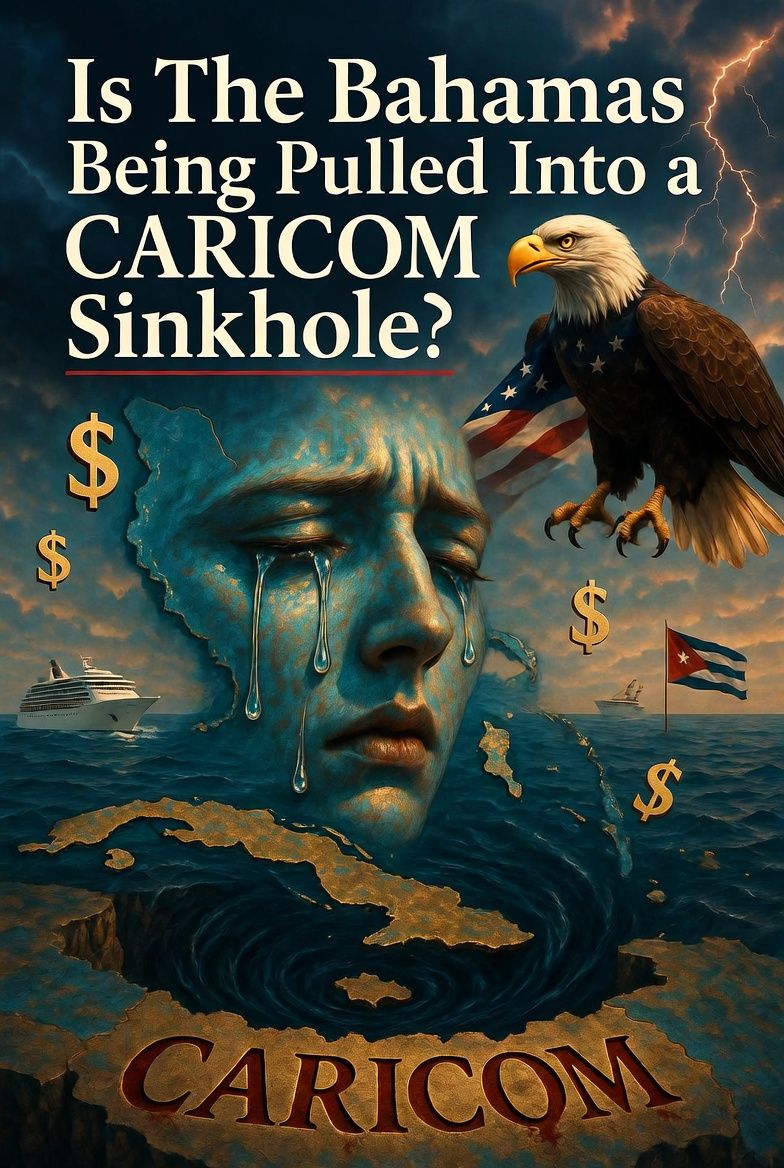
Is The Bahamas Being Pulled Into a CARICOM Sinkhole?
By: Michael Elijah Muhammad Clare
When the Hon. Philip Edward Davis announced that The Bahamas would provide aid to Cuba following a collective vote by the Caribbean Community (CARICOM), reactions across the region were immediate and divided.
Some praised Caribbean solidarity. Others saw something more strategic and potentially more dangerous.
Because this is not just about aid.
It is about alignment.
For decades, CARICOM has attempted to present itself as a unified regional bloc capable of speaking with one voice on international matters. From climate reparations demands directed at industrialized nations to diplomatic balancing acts involving Venezuela, Haiti, and Cuba, the organization has increasingly positioned itself as a moral force in global politics.
But moral force is not the same as geopolitical power.
A History of Tension
The relationship between CARICOM and Washington has not always been smooth. Disagreements have surfaced over sanctions on Venezuela, migration policy, trade leverage, and regional security cooperation. At times, Caribbean leaders have signaled independence from U.S. pressure, diplomatically worded, but unmistakable.
With Donald Trump once again shaping American foreign policy, the tone of Western Hemisphere diplomacy has sharpened. The United States remains the dominant economic and military power in the region. It controls major trade access, banking channels, tourism pipelines, cruise traffic, and security partnerships that Caribbean economies depend on daily.
The reality is simple: the Caribbean basin exists within America’s sphere of influence.
So when CARICOM collectively takes positions that appear to challenge Washington, even symbolically, the implications are not theoretical. They are economic.
Is CARICOM a Superpower?
Some Caribbean citizens are asking whether a united CARICOM could be considered a superpower in its own right.
The honest answer is no.
The combined population and GDP of CARICOM member states, while significant regionally, do not compare to the economic and military weight of the United States. There is no Caribbean aircraft carrier fleet. There is no trillion-dollar defense budget.
CARICOM’s strength lies elsewhere.
Its influence comes from diplomatic unity, strategic geography, voting blocs at international forums, and moral positioning on global issues. When united, it can amplify its voice. But unity alone does not shield individual nations from economic retaliation or policy consequences.
Solidarity has power.
But it also has limits.
The Venezuela Flashpoint
The last major test of regional alignment came amid tensions involving Nicolás Maduro. While Washington intensified pressure on Caracas, several Caribbean nations adopted more cautious tones, balancing sovereignty with economic realities such as energy supply arrangements.
To critics in the United States, that looked like defiance.
To supporters in the Caribbean, it looked like independence.
But independence without leverage is a delicate position.
Cuba and Symbolism
Aid to Cuba carries symbolic weight. Havana has long been central to U.S. foreign policy debates. When CARICOM collectively supports Cuba, it sends a signal: the Caribbean will not be dictated to.
Yet symbolism does not change economic math.
The Bahamas relies heavily on U.S. tourism, investment, banking relationships, and security cooperation. Any deterioration in that relationship would have immediate consequences. Cruise ships do not reroute based on regional speeches, but policies can shift quickly when geopolitical tensions rise.
Strategy or Theater?
The deeper concern for many citizens is whether CARICOM’s posturing is strategic leverage or political theater.
Is the region strengthening its negotiating position through unity?
Or is it overestimating its bargaining power against a global superpower?
Caribbean nations have every right to pursue independent foreign policy. Sovereignty is not optional; it is fundamental. But sovereignty must be paired with strategic realism.
In geopolitics, small states survive by balancing, not by charging headfirst into contests of raw power.
The question now facing The Bahamas is whether collective decisions are being made with full consideration of long-term consequences. Regional solidarity is admirable. But economic survival is non-negotiable.
The Caribbean does not need confrontation.
It needs calculated influence.
Because in global politics, sinkholes rarely appear suddenly. They form slowly, when emotion overrides strategy, and symbolism outpaces strength.
The real issue is not whether CARICOM can compete with the United States.
It is whether it fully understands the stakes when it tries.
Page Reply:
We’re praying for Cuba and that is all we can do right now…
Related stories

Biometric Voter Cards Go Local, PAC Digs Into $1.5m Vouchers, and Some PMH Wards Relocate
Late-afternoon Bahamas Islands Briefing for Wednesday, October 14, 2026: Exuma’s Business Outlook is tomorrow;…

PUBLIC MESSAGE TO ALL BAHAMA DRAMA FOLLOWERS
We are taking Bahama Drama to the next level, and we want you to…

Eleuthera Residents Threaten to Stop Paying BPL Bills, Treasure Cay’s $177m Sale Nears Closing, and a “Miracle Baby” Gets Her Wheels
Afternoon Bahamas Islands Briefing for Wednesday, October 14, 2026: Eleuthera residents threaten to withhold…
Join the conversation
No comments yet. Be the first.