
Escalating Global Persecution of Christians: Evidence from…
Escalating Global Persecution of Christians: Evidence from Established Sources
By: Michael Elijah Muhammad Clare
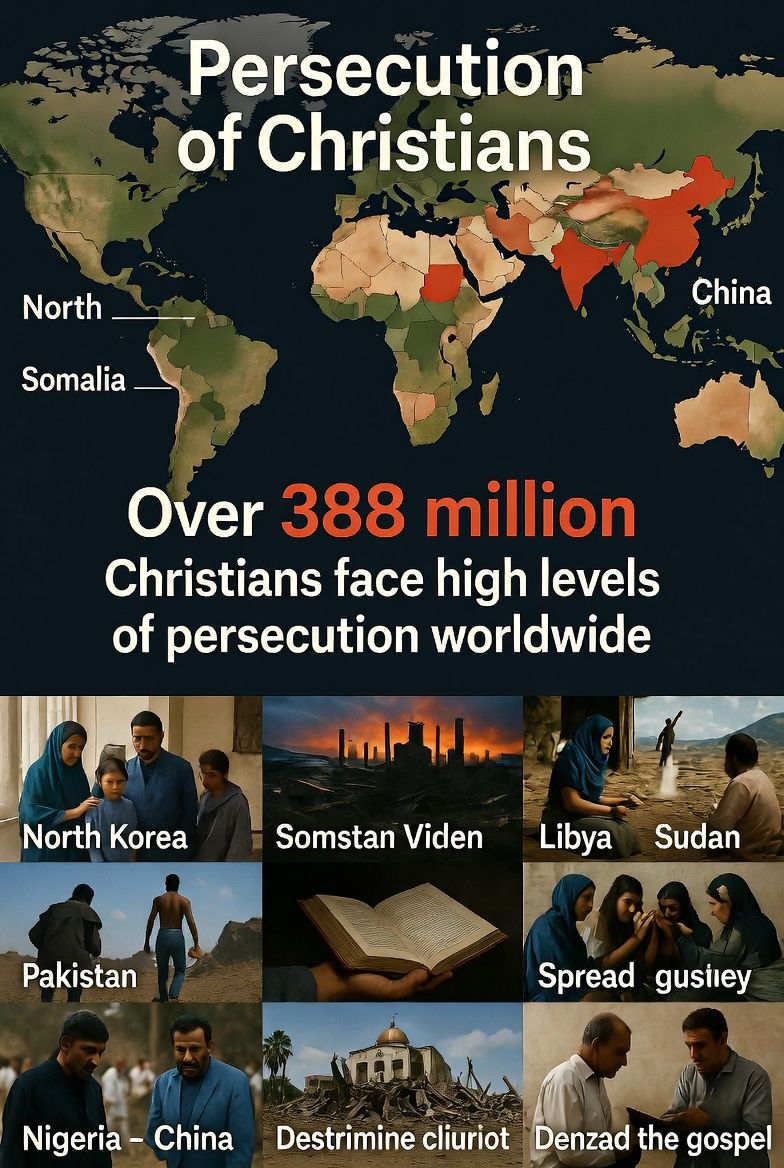
In the contemporary global landscape, religious persecution persists as a profound challenge to human rights and human dignity. Based on the 2026 World Watch List compiled by Open Doors, a recognized authority in monitoring faith-based discrimination, more than 388 million Christians worldwide are subjected to high or extreme levels of persecution. This figure represents nearly one in seven Christians facing targeted discrimination, physical violence, arbitrary detention, arbitrary arrests, or severe restrictions on religious practices because of their faith in Jesus Christ.
The epicenters of intensified persecution remain concentrated in nations such as North Korea, Somalia, Libya, Pakistan, Sudan, Nigeria, and China, extending across parts of the Middle East and Asia. In these regions, Christians face systematic hostility. Believers are harassed, threatened, imprisoned, or assaulted. Churches are monitored, demolished, or forced to close. Religious gatherings are restricted, and communities are pressured to abandon or dilute their beliefs. These conditions violate fundamental human rights and contribute to long-term social and humanitarian instability.
Open Doors’ research highlights how persecution is often driven by authoritarian governments, extremist ideologies, or hostile social systems. In North Korea, Christianity is viewed as a direct threat to state loyalty, resulting in labor camps and executions. In Somalia and Libya, militant groups enforce religious conformity through violence. In Pakistan and Nigeria, legal systems and mob activity expose Christians to false accusations, lynching, and displacement. In China, state control over religion has become increasingly strict, demanding loyalty to Communist ideology above spiritual authority.
State Control and Alteration of Christian Teachings in China
One of the most troubling developments in China is not only the restriction of worship, but also the manipulation of Christian doctrine itself. Under President Xi Jinping’s Sinicization of Religion policy, churches are required to align Christian teachings with socialist values and Communist Party ideology. This includes censorship, rewriting sermons, altering religious texts, and replacing biblical teachings with political messaging.
A widely reported example emerged in 2018 from a Chinese government-approved textbook titled Professional Ethics and Law. In this publication, a story based on John 8:7–11, the biblical account of Jesus and the woman caught in adultery, was radically altered.
In the authentic Bible, Jesus responds to those who want to stone the woman by saying
Let any one of you who is without sin be the first to throw a stone at her
John 8:7
He then forgives the woman and tells her to go and sin no more, demonstrating mercy, grace, and redemption.
However, in the Chinese state-approved version found in the textbook, the story was rewritten to say
When everyone left, Jesus stoned the woman himself and said, I am also a sinner. But if the law could only be carried out by sinless people, the law would be dead.
This version presents Jesus as participating in violence and justifying harsh punishment, completely contradicting the central Christian message of forgiveness and compassion. While this altered story did not appear in official church Bibles, it was published in government materials used for education and ideological training, reflecting how authorities are willing to reshape religious narratives to fit political agendas.
In addition, reports from house churches and independent Christian groups indicate that some state-approved churches have been pressured to replace biblical passages with quotations from Communist leaders, display national flags in sanctuaries, and reinterpret scripture to promote loyalty to the Party above loyalty to God.
Broader Implications for Religious Freedom
These actions demonstrate that persecution is not limited to physical violence or imprisonment. It also includes spiritual and intellectual control. By altering sacred texts and restricting authentic teaching, authorities seek to weaken the core of Christian belief and reshape faith into a tool of state ideology.
For many Chinese Christians, this represents a direct attack on their conscience. Refusing to accept distorted teachings can lead to harassment, loss of employment, surveillance, or detention. As a result, millions continue to worship in secret, risking severe consequences to remain faithful to their convictions.
Resilience of the Global Christian Community
Despite relentless pressure, persecuted Christians around the world continue to demonstrate extraordinary resilience. Underground churches, home fellowships, and informal prayer groups remain active even in the harshest environments. Believers share resources, encourage one another, and quietly spread their faith despite constant danger.
In China, North Korea, and other restrictive nations, many Christians choose obedience to God over safety, believing that spiritual integrity is worth personal sacrifice. Their courage stands as a powerful testimony to the enduring strength of faith under oppression.
A Call for Awareness and Solidarity
The manipulation of Christian scripture in China, combined with widespread persecution across multiple regions, highlights the urgent need for global attention and advocacy. Religious freedom is not merely about the right to worship publicly. It includes the right to believe, teach, and practice faith without political interference.
International organizations, governments, and civil society must continue to hold oppressive regimes accountable and support victims of religious discrimination. Silence enables injustice to spread.
In reflection, believers and supporters worldwide are encouraged to stand in solidarity with those suffering for their faith. Through prayer, awareness, and responsible advocacy, the global community can help preserve the fundamental right to religious freedom.
May those facing persecution find strength in divine grace. May the true message of the gospel, centered on love, forgiveness, and redemption, continue to reach hearts across borders and ideologies. And may truth prevail over distortion, even in the face of powerful opposition.
Related stories

Biometric Voter Cards Go Local, PAC Digs Into $1.5m Vouchers, and Some PMH Wards Relocate
Late-afternoon Bahamas Islands Briefing for Wednesday, October 14, 2026: Exuma’s Business Outlook is tomorrow;…

PUBLIC MESSAGE TO ALL BAHAMA DRAMA FOLLOWERS
We are taking Bahama Drama to the next level, and we want you to…

Eleuthera Residents Threaten to Stop Paying BPL Bills, Treasure Cay’s $177m Sale Nears Closing, and a “Miracle Baby” Gets Her Wheels
Afternoon Bahamas Islands Briefing for Wednesday, October 14, 2026: Eleuthera residents threaten to withhold…
Join the conversation
No comments yet. Be the first.