
CLUSTER FIRE: THE NEW SHAPE OF WAR IN THE MIDDLE EAST
CLUSTER FIRE: THE NEW SHAPE OF WAR IN THE MIDDLE EAST
By: Bahama Drama
This is not the war the world prepared for.
This is something faster, messier, and far more dangerous.
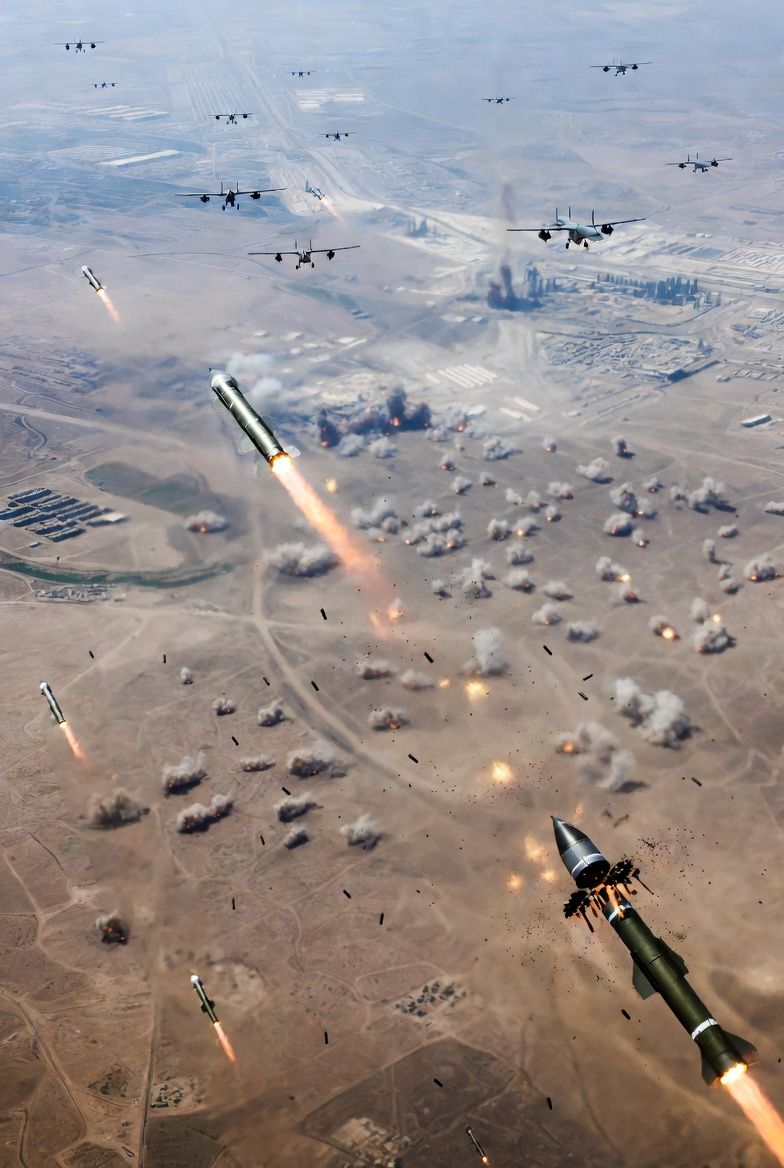
In the skies above Israel and across the Middle East, a new kind of weapon is rewriting the rules of modern conflict. Cluster-loaded missiles and coordinated drone attacks are now shaping how this war is being fought.
And what’s happening right now should concern not just the region, but the entire world.
Because this war is no longer clean, precise, or predictable.
It is becoming chaotic by design.
The latest battlefield developments show that many of the missiles being used now carry cluster-style payloads. Instead of striking a single target, these weapons break apart in the air and scatter multiple smaller explosives across a wide area.
Each launch no longer means one explosion.
It means many.
Some of those smaller explosives detonate on impact. Others do not, remaining on the ground as hidden dangers long after the initial strike. That turns entire areas into ongoing risk zones, especially for civilians.
This is where the danger multiplies.
Even when missile defense systems intercept an incoming threat, the timing becomes critical. If interception happens too late, the weapon can still disperse its contents, allowing damage to occur even after a successful defensive action.
That creates a serious challenge for countries like Israel, which rely heavily on advanced air defense systems.
Those systems were largely designed to stop single warheads.
Now they are being forced to deal with multiple threats from a single missile.
At the same time, drone warfare is being layered into the strategy. Smaller, harder-to-detect drones are being used alongside missiles, coming from different directions and at different altitudes.
The goal is not just destruction.
The goal is to overwhelm.
Missiles attack from above.
Drones approach from multiple angles.
Volume and timing are used together to stretch defenses to their limits.
This changes the entire equation of modern warfare.
It is no longer about precision strikes alone.
It is about pressure.
The conflict itself is also expanding in ways that are hard to ignore.
Strikes and counterstrikes are no longer confined to a single front. Key infrastructure, energy routes, and strategic locations across the region are being pulled into the situation.
That includes areas critical to global oil supply and international shipping.
As tensions rise, the risk of wider regional involvement increases.
And with that comes global economic consequences.
But there is another side to this story.
Despite the intensity of these attacks, there are signs that military infrastructure on multiple sides has taken heavy damage. This has reduced the number of launches in some cases.
Instead of relying purely on volume, the strategy appears to be shifting.
Fewer attacks.
More impact per strike.
More psychological effect.
Cluster-style weapons and coordinated drone tactics fit that shift perfectly.
So where is this all heading?
In the immediate future, the conflict is expected to remain heavily focused on air, missile, and drone operations. Strikes and counterstrikes will likely continue, with both sides testing each other’s limits.
Over the next few months, the situation could move in one of two directions.
There could be pressure toward de-escalation driven by global economic and political concerns.
Or the conflict could expand further, drawing in additional regional players and increasing the scale of confrontation.
Right now, it sits dangerously between both outcomes.
Looking further ahead, even if the intensity slows, something permanent has already changed.
The combination of drones, distributed explosives, and saturation tactics is redefining warfare.
And that change is not going away.
The hard truth is this.
Technology has not made war cleaner.
It has made it more unpredictable.
More fragmented.
More dangerous for ordinary people.
Weapons that scatter turn the sky into a hazard.
This is a technology the US and Israel never saw coming. A technology that caught both countries off guard.
Drones remove the safety of distance.
And together, they create a battlefield with no clear boundaries.
The question is no longer who has the strongest military.
The question is who can endure this new kind of pressure.
Because what we are witnessing is not just another conflict.
It is a preview of how wars will be fought in the future.
Page Reply:
Last days…
Related stories

Biometric Voter Cards Go Local, PAC Digs Into $1.5m Vouchers, and Some PMH Wards Relocate
Late-afternoon Bahamas Islands Briefing for Wednesday, October 14, 2026: Exuma’s Business Outlook is tomorrow;…

PUBLIC MESSAGE TO ALL BAHAMA DRAMA FOLLOWERS
We are taking Bahama Drama to the next level, and we want you to…

Eleuthera Residents Threaten to Stop Paying BPL Bills, Treasure Cay’s $177m Sale Nears Closing, and a “Miracle Baby” Gets Her Wheels
Afternoon Bahamas Islands Briefing for Wednesday, October 14, 2026: Eleuthera residents threaten to withhold…
Join the conversation
No comments yet. Be the first.