Arrogance is the fastest path to death…
China is on top of the world right now, in AI and robotics?
A NATION AT THE EDGE: AN ELECTIONS AROUND THE CORNER
A NATION AT THE EDGE: AN ELECTIONS AROUND THE CORNER
By: Michael Elijah Muhammad Clare
TRUST, TRANSPARENCY, IMMIGRATION, SPACE & THE SOUL OF 2026
NASSAU, BAHAMAS — The countdown to 2026 has begun, and this election cycle feels different.
Not louder.
Not flashier.
Heavier.
Every seat in the House of Assembly will soon be contested. The governing Progressive Liberal Party (PLP), under Prime Minister Philip Davis, is preparing to defend its leadership. The opposition Free National Movement (FNM), led by Michael Pintard, is positioning itself as the corrective alternative.
But this race is no longer just a two-party contest.
It is becoming a referendum on the entire political structure.
A CRISIS OF TRUST THAT WILL NOT DIE
Across New Providence, Grand Bahama, Abaco, Exuma, and the Family Islands, one conversation refuses to fade: distrust.
For years—even as recently as last month—citizens have openly expressed belief that politicians, past and present, hold financial stakes or indirect ownership in major business opportunities across the country. From large developments to government contracts, suspicion runs deep.
Many residents believe corruption is not occasional; they believe it is systemic.
They say politicians are crooked.
They say public money disappears.
They say insiders benefit while ordinary Bahamians struggle.
These accusations vary in proof and detail, but the persistence of the belief has created a national mood that cannot be dismissed. When overwhelming numbers of citizens in everyday conversation express the view that corruption stretches across both major parties, that sentiment becomes more than frustration.
It becomes disillusionment.
FOI: THE LINE BETWEEN FAITH & FATIGUE
Freedom of Information has become the emotional heartbeat of this election.
For many Bahamians, FOI is the test. Without full enforcement, real disclosure, accessibility, and oversight, the cycle of suspicion will never end.
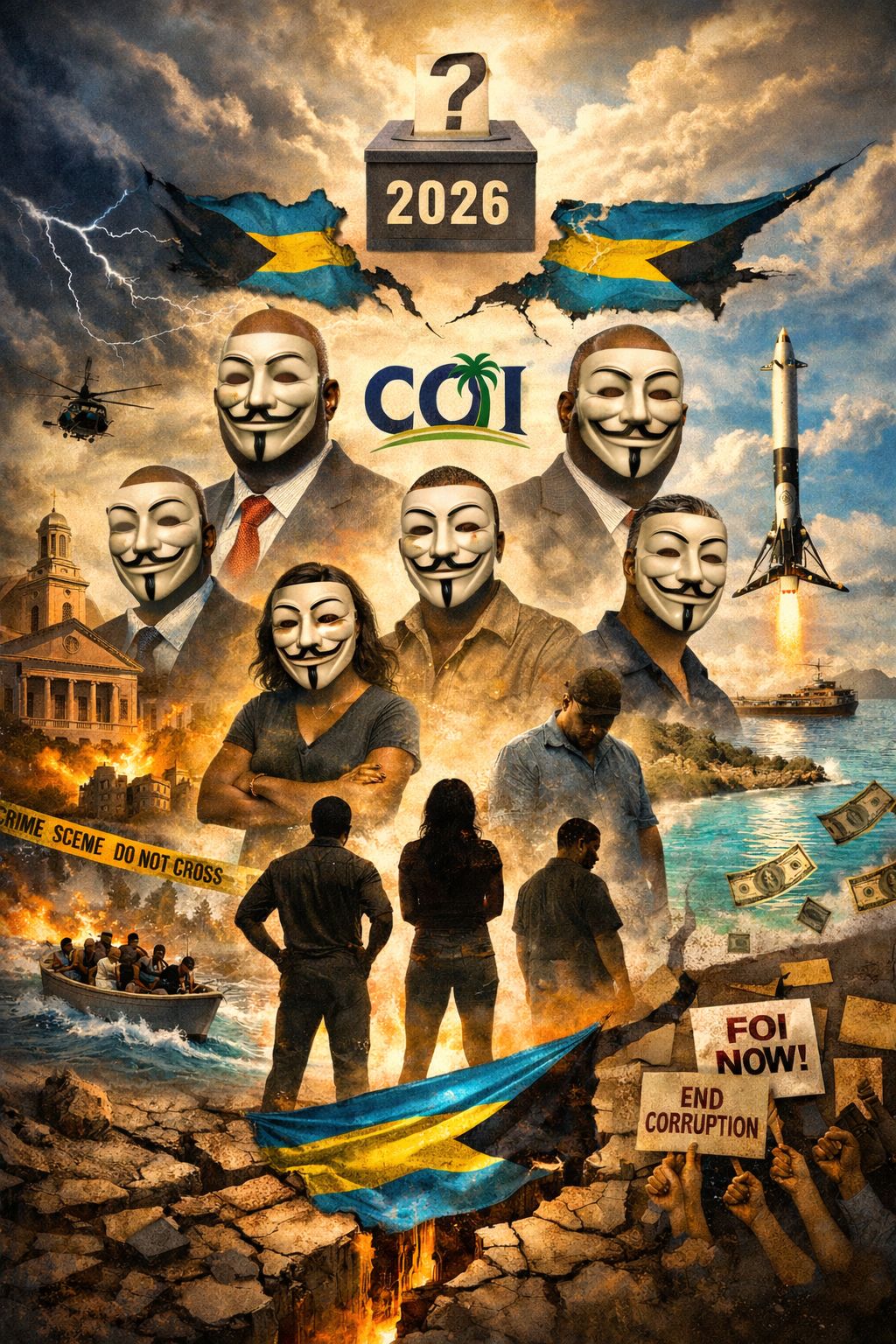
A new and dangerous shift is emerging: many citizens are openly saying they may not vote at all because both major parties have failed to deliver meaningful FOI implementation.
Not because they do not care.
Because they care too much—and feel unheard.
If turnout declines significantly in 2026, the story of the election may not be about victory margins. It may be about trust margins.
CRIME: A DAILY WEIGHT
Crime continues to press heavily on the national psyche. Families want security they can feel in their neighborhoods. Business owners want confidence to operate without fear. Young people want hope, not headlines.
The opposition demands stronger measures. The government defends its initiatives and partnerships. But communities want results, not rivalry.
Security is not abstract. It is lived reality.
IMMIGRATION: SOVEREIGNTY, HUMANITY & ECONOMIC REALITY
Immigration remains one of the most emotionally charged national debates.
The Bahamas’ proximity to Haiti and regional migration routes places the country at a sensitive crossroads. Some citizens demand stronger enforcement and tighter documentation controls. Others caution that aggressive policies could destabilize industries reliant on migrant labor—construction, hospitality, agriculture.
It is a tightrope between sovereignty and stability.
Handled poorly, immigration policy could deepen social division.
Handled weakly, it fuels resentment and political fire.
ECONOMIC SURVIVAL & GLOBAL REPUTATION
While domestic demand for government securities signals short-term financial confidence, long-term sustainability depends on governance credibility.
If corruption perceptions persist and FOI reforms stall, potential consequences include:
* Investor hesitation
* Higher borrowing costs
* Reduced foreign direct investment
* Brain drain of skilled Bahamians
* Rising living expenses without wage growth
In a small island economy dependent on tourism and financial services, perception is power.
Transparency is not optional.
It is protection.
SPACE OVER EXUMA: PRIDE & POLITICAL STATIC
Rocket landings by SpaceX are set to continue near the Exuma Cays, creating excitement throughout the islands. The sight of reusable boosters descending near Bahamian waters has captivated residents and drawn global attention.
For many Bahamians, it feels like history unfolding above turquoise seas.
Yet even this moment of technological wonder has entered political debate. Some opposition voices question environmental oversight and transparency surrounding agreements. Supporters argue it signals innovation, economic diversification, and global relevance.
Even progress now passes through the filter of trust.
THE RISE OF ALTERNATIVES
Frustration with the two major parties has created space for smaller political movements.
The Coalition of Independents (COI) has positioned itself as a reform-focused alternative, emphasizing transparency, national sovereignty, and systemic change.
Lincoln Bain and his political movement continue to campaign on themes of anti-corruption, immigration enforcement, and greater national control over economic assets.
Whether these emerging forces can convert frustration into electoral victories remains uncertain. But their presence signals something undeniable: a segment of the population is actively searching for something beyond PLP vs. FNM.
NEW FACES, OLD QUESTIONS
Former NBA champion Rick Fox has also entered the national conversation, symbolizing potential generational change. But many voters are asking whether any individual—celebrity or career politician—can alter a system they believe is structurally flawed.
The hunger is not just for new faces.
It is for new rules.
THE CROSSROADS
The 2026 election is shaping into more than a contest for seats.
It is a test of whether transparency will be enforced.
A test of whether crime can be reduced in measurable ways.
A test of whether immigration policy can balance order and humanity.
A test of whether economic survival can be secured in uncertain global waters.
A test of whether technological progress can unify instead of divide.
A test of whether voters still believe their participation matters.
The Bahamas stands at a fragile crossroads.
Between cynicism and courage.
Between apathy and accountability.
Between staying home and demanding change.
In 2026, the ballot will not simply measure party strength.
It will measure whether the nation still believes in itself.
Eternal game of oligarchs
Eternal game of oligarchs
Keep them poor and fighting each other over crumbs, so they never see the whole table…
The Green Machine
The Green Machine
Someone at my job today asked me’ “do you know how to drive a stick shift?”
And all I could think about is, how long ago Bahama Drama first learned to!
If you couldn’t go really fast and then hook slide in a sharp turn, you wasn’t a skilled man…



Bahama Drama — 20 February 2026
Part 1 Maria Daxon in Grand Bahama
Bahama Drama — 20 February 2026
Jeffrey Epstein File global links
Jeffrey Epstein File global links
The Illusion of Immunity Is Over
The name Jeffrey Epstein continues to echo through legal systems, media headlines, and private conversations across the globe. Documents released over time have fueled speculation, outrage, and deep public suspicion. But beyond the noise, one truth stands firm and unshakable:
The law does not recognize wealth as a shield.
Around the world, individuals whose names have appeared in records connected to Epstein may believe that distance, status, or influence offers protection. Some may assume that being outside the United States places them beyond reach. Others may believe that time dulls legal consequences.
That assumption is dangerous.
When alleged crimes involve U.S. territory, U.S. citizens, U.S. financial systems, or digital activity routed through American infrastructure, federal jurisdiction can apply. In today’s world, geography means far less than it once did. An action committed abroad but involving U.S. victims, online platforms, or financial transfers touching American banks can open the door to prosecution.
And once that door opens, it rarely closes quietly.
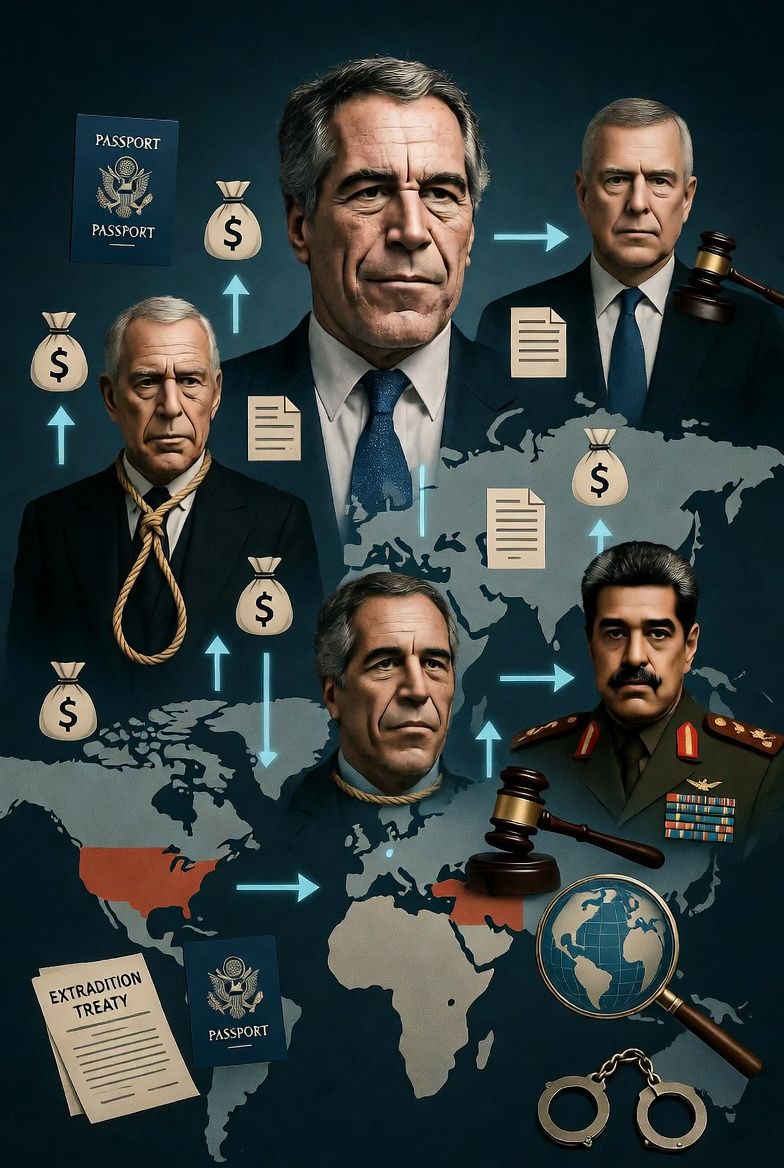
Extradition treaties bind the United States with nations across Europe, the Caribbean, Asia, Africa, and beyond. These agreements exist for one purpose: to ensure that serious criminal allegations cannot be escaped simply by crossing a border. If prosecutors file charges supported by sufficient evidence, formal requests can be made to bring defendants to U.S. courtrooms.
Money does not void treaties.
Political connections do not cancel indictments.
Luxury passports do not override federal law.
Even more sobering is the power of financial investigation. Modern enforcement agencies track digital transfers, shell companies, offshore trusts, and layered transactions with precision that was unimaginable decades ago. Asset freezes and forfeiture proceedings can follow when courts determine that funds are linked to criminal conduct. Properties, investments, accounts, and holdings can all become part of a legal battle.
None of this means that everyone named in public documents is guilty. The law requires proof. Evidence must be presented. Accusations must withstand scrutiny in court. Due process remains a cornerstone of justice.
But here is the reality that cannot be ignored:
If credible evidence exists tying any individual—no matter how wealthy or powerful—to crimes under U.S. jurisdiction, the legal system has both the tools and the authority to act.
The world has witnessed dramatic examples of how far U.S. enforcement can reach. Venezuelan President Nicolás Maduro has faced U.S. federal indictments alleging narcotics trafficking and related offenses, demonstrating that even a sitting or former head of state can become the subject of American criminal charges when U.S. interests and laws are involved.
At the same time, Prince Andrew, Duke of York, faced intense legal scrutiny and civil proceedings connected to his association with Jeffrey Epstein. The very fact that a royal prince could be drawn into international legal action and public accountability underscores a powerful message: titles and lineage do not automatically shield anyone from investigation.
The digital age has erased hiding places. Emails are archived. Flight records are logged. Financial systems record movements down to the cent. Online communications leave trails. Cooperation between nations has strengthened. Investigations that once stalled at borders now continue across them.
The message to the global elite is simple and unmistakable: the law applies equally. Titles, influence, and net worth do not grant exemption from prosecution. Accountability does not disappear because a person resides in another hemisphere.
For those who have done nothing wrong, transparency is protection. For those who have engaged in criminal conduct, silence and distance are not long-term solutions.
If evidence exists, authorities can and will pursue it. And if charges are filed, legal action may follow—no matter where you reside.
The world is smaller than it used to be. Jurisdiction travels farther than many realize. And when justice moves, it does not ask for permission from wealth.
Let the federal indictments of Nicolás Maduro and the legal consequences faced by Prince Andrew serve as sobering reminders to all: the American justice system takes alleged crimes seriously and has demonstrated its willingness to pursue accountability beyond its borders when jurisdiction permits.
If wrongdoing has occurred, beware: legal accountability can reach across borders, and they might be coming for you soon, no matter where your country is.