Who is paying the London silk in the Rosewood Exuma fight?
Who is paying the London silk in the Rosewood Exuma fight?
Preliminary court rulings are not a final verdict. The public still has not been told what the government’s King’s Counsel is costing.
By Darren Thompson, Exuma
1 October 2026
Good afternoon. A post now circulating on social media says the courts have already spoken on the Rosewood Exuma dispute, and that a government official is trying to reopen a settled matter. That is not what the published record shows.
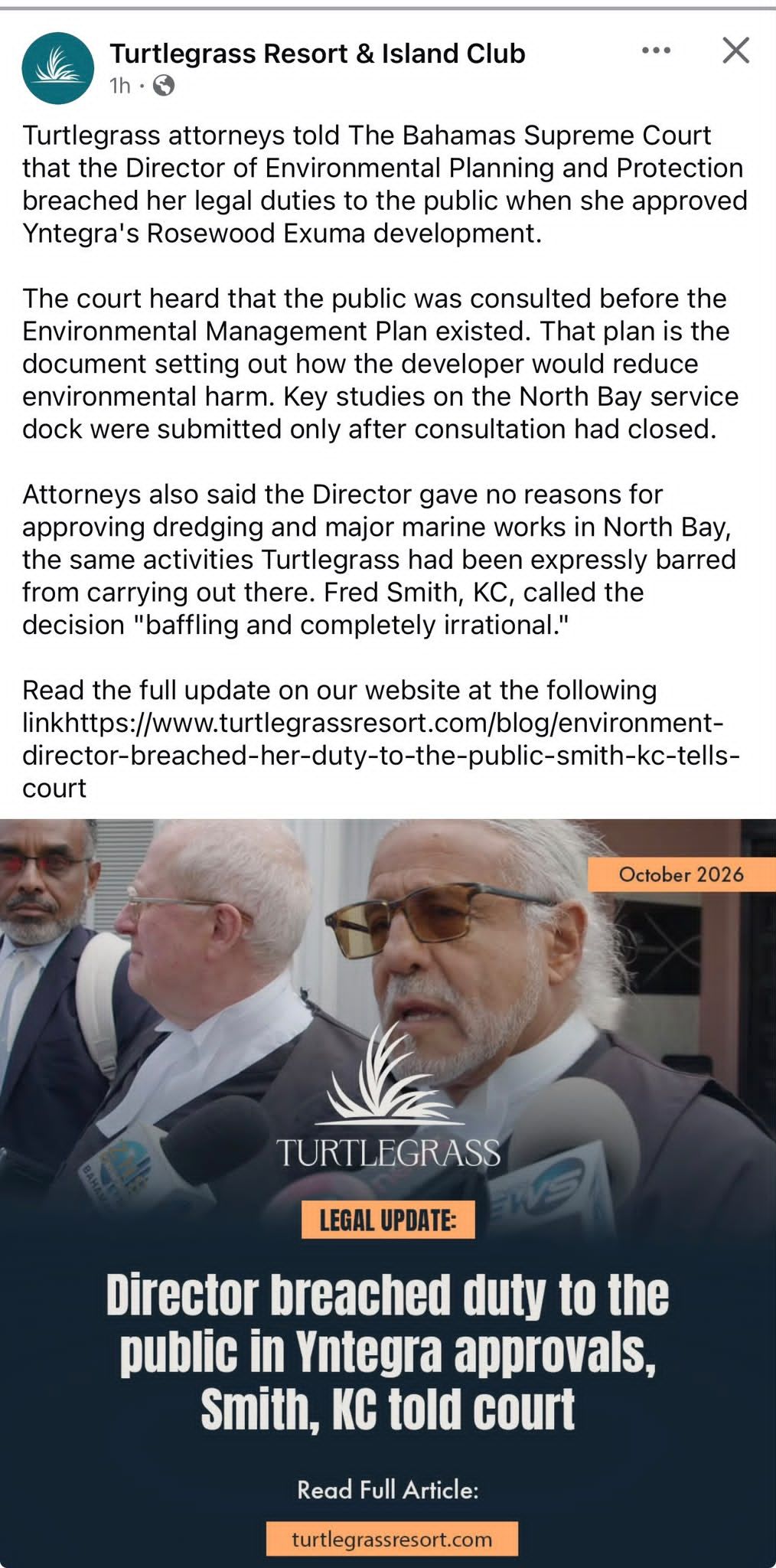
What is circulating underneath that claim is an update from Turtlegrass Resort & Island Club. It says Turtlegrass attorneys told the Supreme Court that the Director of Environmental Planning and Protection breached her legal duties when she approved Yntegra’s Rosewood Exuma development on East Sampson Cay. It says the public was consulted before the Environmental Management Plan existed. It says key studies on the North Bay service dock were filed only after consultation had closed. And it quotes Fred Smith, KC, calling the decision to approve dredging and major marine works in North Bay “baffling and completely irrational,” noting that Turtlegrass itself had been expressly barred from dredging there.
Those are arguments. They are not a judgment.
What the court has actually decided
The fight is a judicial review. Turtlegrass, whose principal is US investor and Exuma resident Bob Coughlin, and Over Yonder Cay are challenging environmental approvals granted to Miami-based Yntegra Group for a project of about $200 million, planned as a Rosewood resort on Sampson Cay. The government is in the case because its own regulators made the decisions under attack.
Justice Leif Farquharson has ruled on the shape of the case, not on whether those approvals were lawful. In early September 2026 he refused to admit six specialist reports Turtlegrass wanted to put in evidence, calling the application exceedingly late. On 10 September he refused a further demand for documents on the planned solar farm, a forestry permit, an enabling-works method statement, and the environmental bonds. On 23 September the court rejected a late bid for permission to appeal those rulings and to halt the substantive hearing. The Court of Appeal, before Justice Gregory Smith, likewise refused to stop the trial.
The substantive hearing was underway at the end of September. On 30 September the Nassau Guardian reported that the claims remained allegations and that the court had not yet issued its ruling. Former environment minister Romauld Ferreira, appearing for Over Yonder Cay, told the court that the case is the first serious test of the Environmental Planning and Protection Act and the environmental-impact rules he tabled. A win for the approvals, he warned, could set the standard every later developer is held to. A loss could force the project back through consultation and assessment.
Until that ruling is published, anyone who says “the courts have spoken” is talking about the preliminary skirmishes. Yntegra has treated those skirmishes as victories and has asked its opponents to stop delaying and argue the main case. Turtlegrass has said the preliminary losses are not the end of the matter. Both of those statements can be true at once. Neither of them is a final verdict on the North Bay.
Why the government looks like it is fighting for the developer
In a judicial review the decision-maker and the permit-holder usually stand on the same side. Both want the approval upheld. That is ordinary procedure. It is also, here, more than procedure. The government signed a Heads of Agreement with the developers on 19 December 2023, amended on 21 May 2024, covering development on East Sampson Cay and acreage on Big Sampson Cay. Officials, including the Prime Minister and the Deputy Prime Minister, attended a groundbreaking for the Rosewood project. Deputy Prime Minister Chester Cooper has said the government will not be bullied by any investor in the dispute between Turtlegrass and Rosewood.
The alignment is therefore real. It is not, by itself, proof that the Cabinet has hired lawyers for Yntegra.
Who the King’s Counsel actually act for
Three silks are in this fight, and they are not on one brief.
Edward Fitzgerald KC, a London barrister, was hired by the government to represent its regulatory agencies. Tribune Business has described him as the UK attorney retained for the Director of Physical Planning and the other public respondents. It was his submission — that a judicial review of an environmental impact assessment should not become a “descent into the minutia,” and that the decision-maker is entitled to a margin of appreciation — that Justice Farquharson accepted when the late expert reports were kept out.
Robert Adams KC of Delaney Partners appears for Yntegra, not for the government. He is the lawyer who described a separate Appeal Board hearing as an “ambush of the worst kind.”
Fred Smith KC of Callenders & Co leads for Turtlegrass. The “baffling and completely irrational” line in the post now being shared is his characterisation of the Director’s decision, made in argument.
So the English King’s Counsel is on the government’s side of the courtroom. Yntegra has its own Bahamian King’s Counsel. The public question is not whether Yntegra has a KC. It is whether taxpayers are paying for a second one.
Is the government paying the bill?
On the face of the reporting, yes for Fitzgerald, because the government hired him to defend its own agencies. No published judgment or ministerial statement has said that the government is paying Yntegra’s lawyers.
Turtlegrass has already put the cost point in public. After the 10 September disclosure ruling it asked why the government had “thrown its full weight behind Yntegra — retaining a roster of international attorneys, including senior King’s Counsel from London, at considerable cost to Bahamian taxpayers — to fight this hard on behalf of a private developer.” That is a party allegation. It is a fair one to test. It is not an invoice.
Foreign silks in Bahamian public litigation are not cheap. Years ago, while in opposition, Philip Davis pressed a previous administration to say what it was paying foreign Queen’s Counsel and put the market, from his own experience, at roughly £15,000 to £25,000 a day. That figure is not a bill for this case. It is a reason the number matters. A four-day trial, plus preparation, advice, and any appeal, is real money if the Treasury is carrying it.
What has not been published is the brief fee, the daily rate, the instructing solicitor’s costs, whether any of it is recoverable from Yntegra under the Heads of Agreement, and whether the Attorney General approved the retainer in the ordinary way. Those are questions for the Attorney General and the Ministry of Finance, not questions the Supreme Court is there to answer.
The question that should be on the record
Why is so much latitude being given by the government, which appears in court on the same side as the developer? Is the government paying their legal fees? They have a King’s Counsel from England in the government team. Is the government paying that legal bill, and will it publish the figure?
Latitude in the legal sense has already been explained by the judge: on a review of an environmental study, the court does not retry the science, and the Director gets room to judge. Latitude in the political sense — a Heads of Agreement, a groundbreaking, and a London silk instructed to resist the neighbours — is a choice. Choices made with public money ought to come with a number attached.
None of this decides the North Bay. Dredging for a service dock, a seawall, and barge access in shallow water beside another resort’s beach is the substance of the case, and it is still before the court. Moving the industrial dock south, which Turtlegrass has proposed because deeper water already exists there, is a planning argument, not a ruling. Until Justice Farquharson’s decision on the approvals is handed down, the honest sentence is the shorter one: the preliminary fights have mostly gone against Turtlegrass, and the main case has not been decided in public.
Publish the ruling when it exists. Publish the fee now.
This is a commentary draft based on published reporting and a party statement. It is not a court judgment, and it is not legal advice.