
BREAKING INTERNATIONAL ALERT
BREAKING INTERNATIONAL ALERT
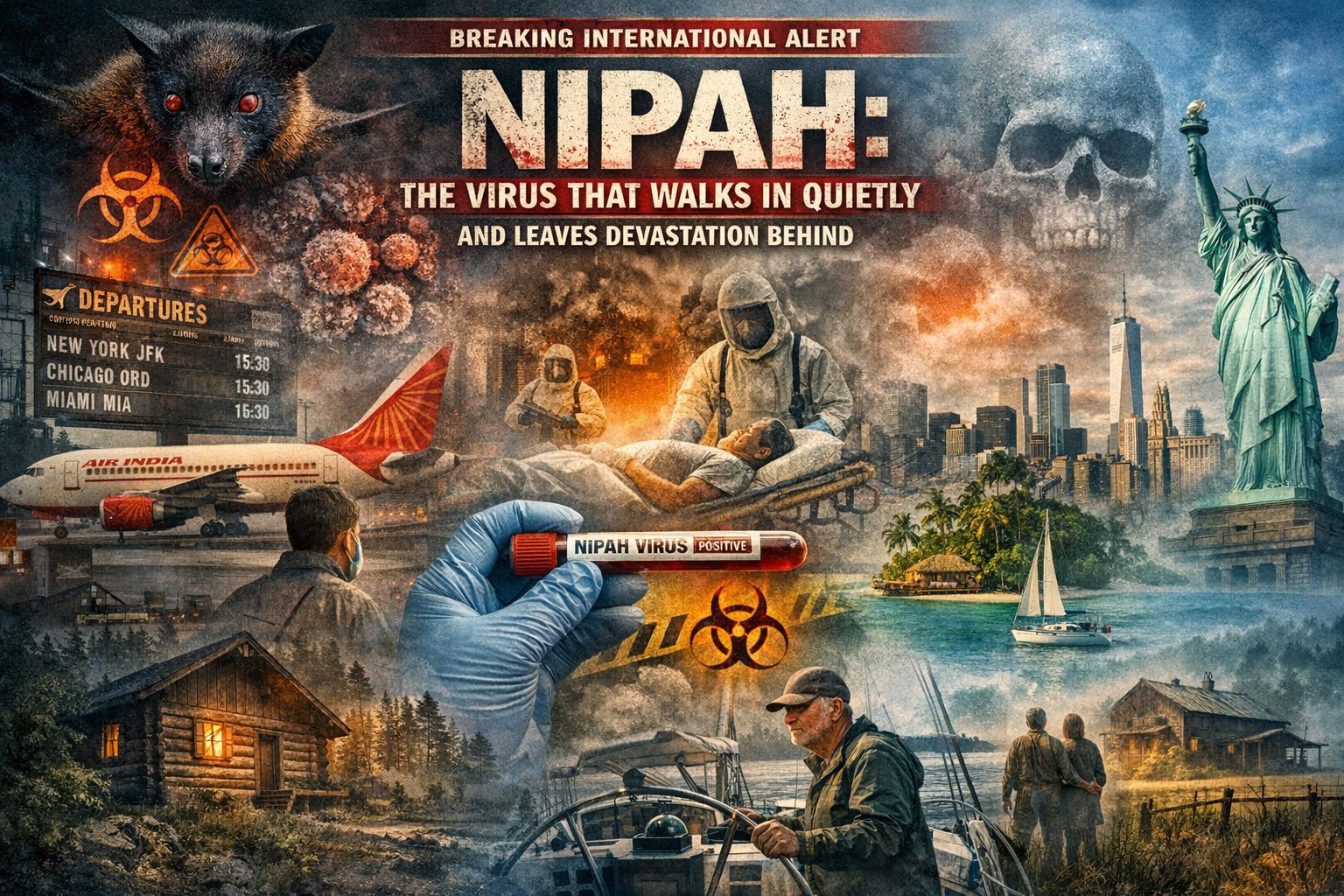
NIPAH: THE VIRUS THAT WALKS IN QUIETLY
AND LEAVES DEVASTATION BEHIND
UPDATED FLIGHT WATCH • GLOBAL MOVEMENT • SURVIVAL PATTERNS
By: Michael Elijah Muhammad Clare
It always begins the same way.
A fever.
A headache.
A sore throat.
Fatigue that feels ordinary, almost boring.
And then, suddenly, it isn’t.
India has confirmed new cases of the Nipah virus, activating emergency containment protocols, contact tracing, and heightened surveillance. Global health authorities are watching closely, not because the numbers are large, but because the virus itself is one of the most lethal known to science.
This is not seasonal flu.
This is not COVID.
This is Nipah.
And unlike louder outbreaks, Nipah moves quietly, through proximity, travel corridors, and human contact patterns that rarely make headlines until it is too late.
WHAT IS HAPPENING IN INDIA RIGHT NOW
Health authorities in India have confirmed a localized cluster of Nipah infections and immediately initiated isolation procedures and regional containment. Officials state the outbreak is currently limited. History shows Nipah outbreaks always begin this way.
Small.
Localized.
Underestimated.
Because of this, international monitoring has intensified around air travel routes departing India, especially long-haul routes connecting India to major global hubs.
This is not panic.
This is pattern recognition.
CURRENT FLIGHT WATCH: INDIA TO THE UNITED STATES
India currently maintains active scheduled passenger flights to the United States, primarily through major international gateways. These routes matter because they connect dense populations across continents within hours.
Key U.S. cities receiving regular scheduled connections from India include:
New York (JFK and Newark)
Chicago
Dallas / Fort Worth
Washington D.C. (seasonal and variable)
Miami (often via connecting hubs)
These flights typically depart from Indian hubs such as Delhi and Mumbai, either nonstop or with limited international connections.
Viruses do not need passports.
FROM THE UNITED STATES INTO THE CARIBBEAN AND THE BAHAMAS
There are no direct flights from India to the Bahamas.
However, the Bahamas is tightly connected to major U.S. cities that receive international traffic from India and elsewhere.
Primary U.S. gateways with frequent flights into the Bahamas include:
Miami
New York
Atlanta
Fort Lauderdale
Orlando
Charlotte
Public-health risk does not depend on direct travel alone. It depends on chains of movement. A virus only needs connection points, not a straight line.
WHY NIPAH IS SO DANGEROUS
Nipah’s most dangerous trait is deception.
Early symptoms often resemble common flu:
Fever
Headache
Muscle pain
Sore throat
Fatigue
In many cases, the disease escalates rapidly.
As it progresses, patients may develop severe respiratory distress, encephalitis (inflammation of the brain), confusion, seizures, and coma. Fatality rates in past outbreaks have ranged from approximately forty percent to as high as seventy-five percent.
There is no guaranteed survival window.
IS THERE A CURE OR VACCINE?
There is currently no approved vaccine for Nipah virus and no proven antiviral cure.
Treatment is supportive only, focusing on oxygen, ventilation, seizure control, and management of brain swelling and complications.
Several vaccines and antibody therapies are in development, but none are available for widespread use. This reality explains why health authorities act swiftly and quietly when Nipah appears.
THE LARGER PATTERN PEOPLE AVOID DISCUSSING
A pattern is emerging across decades of outbreaks.
The most vulnerable populations are often the most connected.
Dense cities.
Constant travel.
High-frequency human contact.
History shows that secluded populations repeatedly survive collapse events at higher rates.
People living:
On boats
On farms
In forests
On remote islands
In off-grid or semi-off-grid communities
These groups unintentionally practice natural isolation buffers. They are not immune. They are simply less exposed.
When transmission relies on proximity, distance becomes protection.
A SOBERING POSSIBILITY
If outbreaks like Nipah become more frequent, not global pandemics, but recurring lethal clusters, civilization does not collapse instantly.
It thins.
Cities feel it first.
Transit corridors follow.
Supply chains fracture.
Those who remain are often not the most advanced, but the most distant.
History supports this.
After plagues and collapses, it is often farmers, hill communities, island dwellers, forest populations, and maritime nomads who endure long enough to rebuild.
Not by design.
By geography.
In that future, survival is not about technology alone.
It is about separation, behavior, and location.
HOW PEOPLE CAN PROTECT THEMSELVES
There is no cause for panic.
There is reason for awareness.
Public-health guidance remains clear:
Avoid close contact with sick individuals.
Avoid raw foods potentially exposed to bats.
Practice hand hygiene.
Use masks in healthcare or outbreak settings.
Seek medical care immediately after possible exposure.
Immune resilience matters:
Vitamin D for immune regulation.
Vitamin C for cellular defense.
Zinc for immune function.
Adequate rest, hydration, and nutrition.
None are cures.
All are defenses.
FINAL WORD
Nipah is not spreading globally at this time.
There is no confirmed outbreak in the Bahamas.
There is no reason for fear.
But there is reason for respect.
The most dangerous viruses are not the loud ones.
They are the ones that arrive quietly, adapt patiently, and exploit connection.
This is not fear.
This is awareness.
Bahama Drama
Research • Awareness • Protection
Related stories

Biometric Voter Cards Go Local, PAC Digs Into $1.5m Vouchers, and Some PMH Wards Relocate
Late-afternoon Bahamas Islands Briefing for Wednesday, October 14, 2026: Exuma’s Business Outlook is tomorrow;…

PUBLIC MESSAGE TO ALL BAHAMA DRAMA FOLLOWERS
We are taking Bahama Drama to the next level, and we want you to…

Eleuthera Residents Threaten to Stop Paying BPL Bills, Treasure Cay’s $177m Sale Nears Closing, and a “Miracle Baby” Gets Her Wheels
Afternoon Bahamas Islands Briefing for Wednesday, October 14, 2026: Eleuthera residents threaten to withhold…
Join the conversation
No comments yet. Be the first.