
American Boaters Tell Bahama Drama How They Feel, and So Do a Few…
American Boaters Tell Bahama Drama How They Feel, and So Do a Few Bahamian Fishermen
So the Debate Continues
What Is Our Solution to This Quagmire
By: Michael Elijah Muhammad Clare
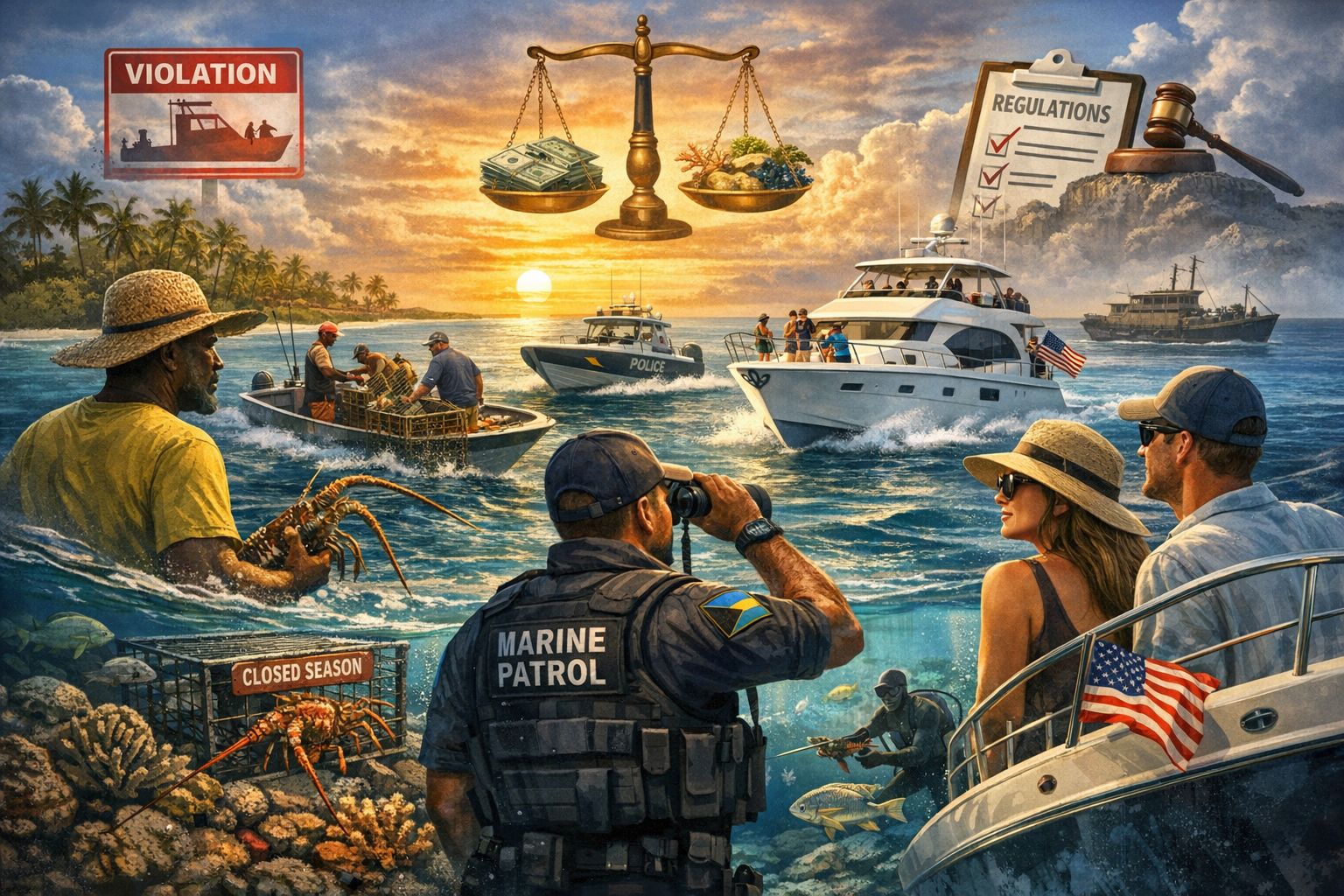
The national conversation around the Bahamas’ new boating and fishing fees has become loud, emotional, and increasingly divided. Foreign boaters feel targeted. Bahamian’s feel ignored. Accusations are flying in all directions, and somewhere in the middle, the truth is being drowned out.
This debate is no longer about fees alone.
It is about trust, enforcement, survival, and respect.
After reviewing hundreds of public comments, captain testimonies, fisherman accounts, and on-the-water experiences, one reality is clear: no single group owns the full truth, but every group holds part of it.
What Foreign Boaters Are Right About
Recreational foreign vessels are not the primary drivers of marine depletion in Bahamian waters. Many long-term cruisers, sportfishing captains, and yacht owners spend significant money locally over decades, follow seasons and size limits, do not fish or lobster at all, and actively support conservation, research, and disaster relief.
There is also a legitimate concern that higher fees alone do not equal stronger enforcement. Without patrols, monitoring, and prosecutions, fees become taxation rather than protection.
On this point, the critics are correct.
What Bahamian’s Are Right About
Bahamian fishermen are watching their fishing grounds change: fewer lobsters, smaller conch, longer trips, higher fuel costs, and shrinking margins. To them, the pressure feels constant and visible.
They live with thin enforcement in remote areas, foreign vessels anchoring freely for long periods, and a system where the ocean absorbs the damage while communities absorb the loss. Once a resource collapses, it does not return easily.
For Bahamian’s, this is not an abstract debate.
It is about food security, income, and inheritance.
On this point, they are also correct.
The Hard Truth No One Wants to Face
The greatest damage to Bahamian marine life does not come from one group alone.
It comes from weak enforcement, local overfishing, illegal regional poaching, poor data, political avoidance, and some irresponsible foreign activity as well.
Fees did not create this problem.
Fees alone will not fix it.
A Real Solution That Protects Everyone
A balanced path forward exists, one that protects marine life without killing tourism or dividing communities.
That solution must include tiered, usage-based permits that clearly distinguish between short-term transit, fuel-only stops, non-fishing visits, and extended fishing stays. It must include a dedicated marine enforcement fund where boating and fishing fees are legally locked to patrols, data collection, and prosecutions, supported by public audits. Laws must be enforced equally for Bahamian and foreign vessels alike. Serious abuse must carry serious penalties, including confiscation, license revocation, and lifetime bans for repeat offenders. Finally, local economic incentives should encourage spending through marina credits, fuel rebates, and settlement partnerships tied directly to compliance.
This Is Bigger Than Fees
The ocean does not care about passports.
Fish do not recognize borders.
And once a reef or fishery collapses, no argument will bring it back.
The Bahamas does not need to choose between protection and prosperity.
But it does need honesty, enforcement, and balance.
If this debate leads to smarter policy instead of louder outrage, then something good can still come from it.
Because in the end, everyone claiming to love the Bahamas must prove it the same way: by leaving enough behind for the next generation.
Bahama Drama is recommending that the government of the Bahamas reduce these fees back to their previous levels and then reduce them further, approximately 30 percent below their June 2025 rates. This is especially important given that the country was already positioning itself to rely on carbon credit revenue as a major financial pillar.
Whatever happened to that discussion?
Instead of squeezing boaters, the Bahamas should seriously develop and protect its blue carbon assets. Conservative estimates already place the nation’s mangroves, seagrass beds, and marine ecosystems at roughly three to four billion dollars in potential carbon credit value per year if properly certified, protected, and marketed on the global carbon market.
That revenue stream, still understated in public discourse, could easily outperform new boating fees without harming tourism, straining diplomatic relations, or deepening internal divisions.
Leave the boaters alone, enforce the laws properly, protect the ocean, and get paid for the carbon the Bahamas is already storing for the world.
At the same time, there is an uncomfortable but unavoidable reality that must be acknowledged. A country without a fully implemented and enforced Freedom of Information Act cannot function as a true democracy. In practical terms, the Bahamas operates under a system where citizens are ruled over rather than meaningfully consulted on government actions, policies, or laws. Transparency is limited, access to records is restricted, and accountability remains optional rather than mandatory.
As a result, the Bahamian public finds itself locked in constant confrontation across social media and public platforms, often facing government-aligned social media agents posing as concerned citizens. These voices are frequently louder, better organized, and more protected than ordinary Bahamian’s who have grown exhausted, frustrated, and disillusioned.
Many citizens have effectively thrown their hands up. Years of attempting to push the Freedom of Information Act forward, to have it properly administered across government ministries and agencies, have led nowhere. Promises were made. Deadlines passed. Enforcement never arrived.
In that vacuum, public trust has eroded.
This matters directly to the boating, fishing, and environmental debate because without transparency, no one can verify how fees are spent, how enforcement decisions are made, or whose interests are truly being served. Policy without public access to information breeds suspicion, division, and resistance, even when the stated goals are valid.
Bahama Drama therefore calls on the American people and the government of the United States to recognize this democratic deficit and to assist the citizens of the Bahamas in advocating for this crucial legislation to be fully passed, implemented, and adhered to within Parliament and across the Bahamian government.
Transparency is not a luxury.
Access to information is not a threat.
And democracy cannot survive in the dark.
Or and we cannot have the Bahamas carbon credit payments going into a politicians personal bank account as it is set up right now, that’s wild as hell.
WTH… 😳
Related stories

Biometric Voter Cards Go Local, PAC Digs Into $1.5m Vouchers, and Some PMH Wards Relocate
Late-afternoon Bahamas Islands Briefing for Wednesday, October 14, 2026: Exuma’s Business Outlook is tomorrow;…

PUBLIC MESSAGE TO ALL BAHAMA DRAMA FOLLOWERS
We are taking Bahama Drama to the next level, and we want you to…

Eleuthera Residents Threaten to Stop Paying BPL Bills, Treasure Cay’s $177m Sale Nears Closing, and a “Miracle Baby” Gets Her Wheels
Afternoon Bahamas Islands Briefing for Wednesday, October 14, 2026: Eleuthera residents threaten to withhold…
Join the conversation
No comments yet. Be the first.