
146 PEOPLE AT SEA — THEN THE INTERCEPTION BEGAN
146 PEOPLE AT SEA — THEN THE INTERCEPTION BEGAN
BAHAMA DRAMA EXCLUSIVE
Researcher ✔️
Michael Elijah Muhammad Clare
THE SOUTHERN BAHAMAS JUST BECAME THE CENTER OF ANOTHER MAJOR MARITIME INTERCEPTION.
It was Wednesday evening, September 2.
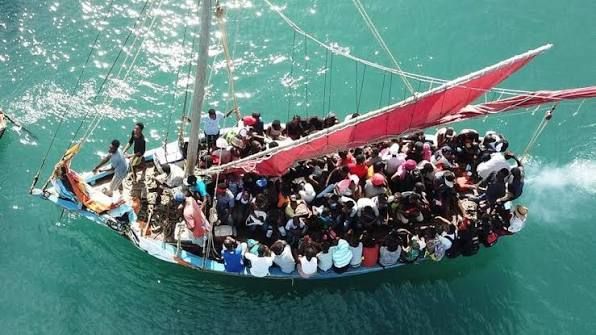
Somewhere south of Great Inagua, a migrant vessel was moving through Bahamian waters carrying a staggering 146 people.
But they were not moving unnoticed.
High above the water, U.S. Coast Guard aircrews were watching.
On the surface, Royal Bahamas Defence Force assets were operating in the same maritime environment.
Then came the move.
The vessel was intercepted.
According to information released by the U.S. Embassy in Nassau, the operation involved U.S. Coast Guard aircrews and the Royal Bahamas Defence Force, with 146 people found aboard the migrant vessel.
For those on the water, what may have started as another dangerous journey suddenly became a confrontation with the reality of modern maritime enforcement.
Aircraft overhead.
Defence Force assets on the water.
A vessel carrying 146 people.
And the southern Bahamas stretching out in every direction.
This is the part of border security that most people never see.
There are no highways.
No checkpoints.
No border fence.
Just hundreds of miles of open ocean separating islands, countries and people.
That makes surveillance and cooperation absolutely critical.
And Great Inagua is not just another dot on the map.
Its location places it near some of the most important maritime routes in the region, making the waters around the island a critical area for monitoring migration, smuggling and other maritime activity.
The U.S. Embassy says the latest operation demonstrates the continuing cooperation between Washington and Nassau on maritime security, border protection and safe, lawful migration.
And this latest interception comes against a much larger backdrop.
The Bahamas and the United States have repeatedly worked together to detect and intercept vessels moving through the region. In July, for example, the U.S. Coast Guard and RBDF worked together in an operation near Great Inagua that resulted in the seizure of approximately 2,380 pounds of suspected marijuana.
That tells us something important.
The waters around our southern islands are not quiet.
They are part of an enormous maritime crossroads.
And when a vessel carrying 146 people is detected and intercepted, it is not simply a story about one boat.
It is a reminder of the enormous challenge facing a country made up of hundreds of islands and cays.
Every night, vessels can disappear into darkness.
Every storm can reduce visibility.
Every mile of ocean creates another challenge for those responsible for protecting Bahamian waters.
That is why aircraft, patrol vessels, intelligence sharing and international cooperation matter.
The RBDF cannot be everywhere at once.
Neither can the U.S. Coast Guard.
But working together, their ability to detect and respond becomes considerably stronger.
The question now is what happens next for the 146 people intercepted south of Great Inagua.
Their journey has ended at sea.
But the larger issue has not.
Migration pressure continues to place enormous demands on Caribbean nations, while dangerous sea voyages continue to put human lives at risk.
For The Bahamas, this is also about protecting our territorial waters and maintaining control of our borders.
Because out here, the border is not a line on a map.
THE BORDER IS THE OCEAN.
And on September 2, somewhere south of Great Inagua, that ocean became the scene of another major interception.
146 people.
One migrant vessel.
U.S. Coast Guard aircrews.
Royal Bahamas Defence Force personnel.
And a southern Bahamian sea route once again placed under the spotlight.
Page Reply:
If anyone of these 146 Haitian migrants grew up in America and are from the bunch that was deported by the Trump administration. I really don’t blame them for getting the hell out of Haiti fast and trying to make it into the Bahamas or Turks and Caicos islands. I want my readers to ask themselves honestly and on the real, What would you have done if you were in their shoes?
He who feels it knows it best. I’m not giving anyone the greenlight to enter any one of these countries illegally. I’m just saying I feel their pain and struggle to the bone. But for dem Haitian’s who grew up in Haiti, please stay y’all asses right there, y’all is the ones that got Haiti like it is today!
Related stories

Biometric Voter Cards Go Local, PAC Digs Into $1.5m Vouchers, and Some PMH Wards Relocate
Late-afternoon Bahamas Islands Briefing for Wednesday, October 14, 2026: Exuma’s Business Outlook is tomorrow;…

PUBLIC MESSAGE TO ALL BAHAMA DRAMA FOLLOWERS
We are taking Bahama Drama to the next level, and we want you to…

Eleuthera Residents Threaten to Stop Paying BPL Bills, Treasure Cay’s $177m Sale Nears Closing, and a “Miracle Baby” Gets Her Wheels
Afternoon Bahamas Islands Briefing for Wednesday, October 14, 2026: Eleuthera residents threaten to withhold…
Join the conversation
No comments yet. Be the first.