You might have money & influence in abundance compared to me.
You might have money & influence in abundance compared to me. But you ain’t got God’s listening ears in abundance like me…

Bahamian news, stories and drama
You might have money & influence in abundance compared to me. But you ain’t got God’s listening ears in abundance like me…
Histories Forgotten White Slaves
Researcher ✔️
By: Michael Elijah Muhammad Clare
The brutal, often-overlooked story of European Christians enslaved on the Barbary Coast
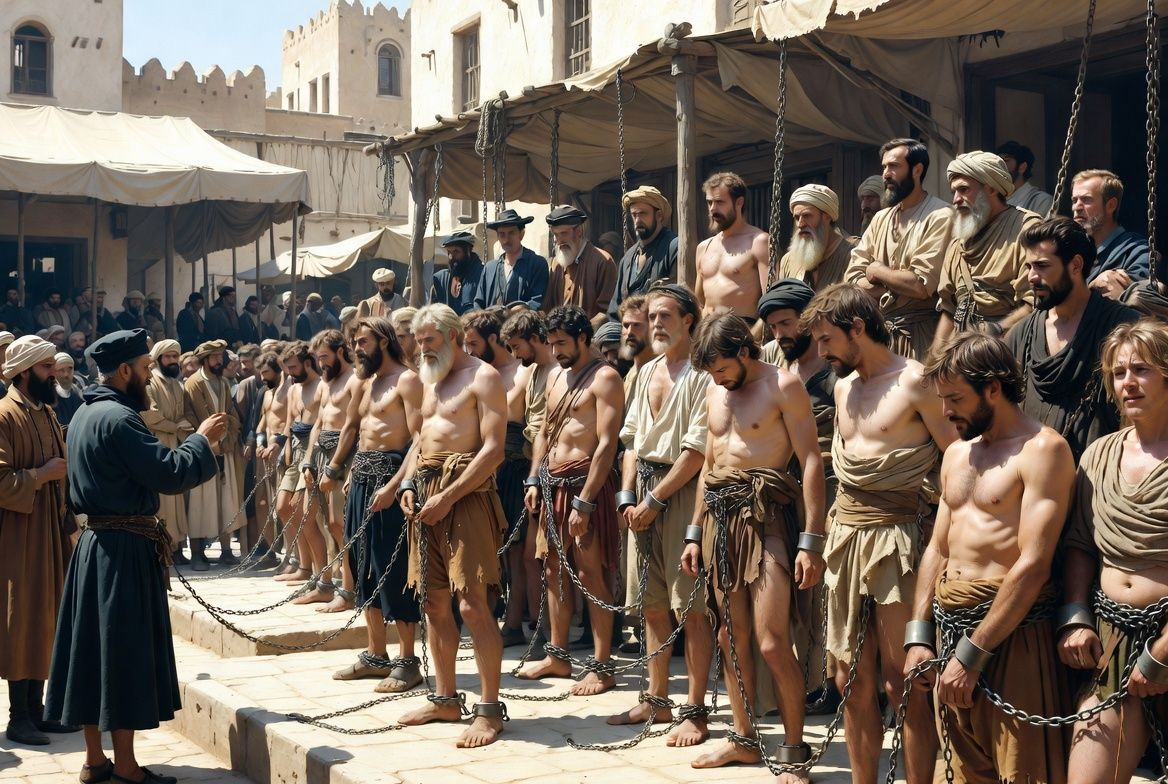
Most people know the history of the transatlantic slave trade and the deep, lasting harm it did to African people and their descendants in America. That history is real, documented, and still shapes lives today. What fewer people hear about is that for centuries, European Christians—white people from Italy, Spain, France, England, Ireland, and even Iceland—were also seized, sold, and worked under brutal conditions by corsairs operating out of North African ports like Algiers, Tunis, and Tripoli.
Between roughly the early 1500s and the early 1800s (about 250 to 300 years), historians estimate that around 1 million to 1.25 million Europeans were captured and enslaved in this system. Raiders hit coastal towns and ships. Entire villages in places like Cornwall, Sicily, or southern Spain could lose people in a single attack. In 1627 corsairs even reached Iceland and carried off hundreds. Men, women, and children were taken.
What happened to them
Captives were marched into slave markets, inspected like livestock, and sold. Some men were chained to the benches of galleys for months at a stretch, rowing under the whip in all weather with little food. Others did heavy labor in quarries, construction, or fields. Women often ended up in domestic work or concubinage. Conditions in the prison compounds (bagnios) were filthy, overcrowded, and disease-ridden. Beatings and flogging were routine. Escape attempts or resistance could bring public executions meant to terrify everyone else—impalement, burning, or beheading.
This was not a gentle system. People were treated as property to be used up. Many died from exhaustion, injury, or sickness. A ransom economy existed—families, churches, or governments sometimes bought people back—but most of the poor stayed enslaved for life. Some converted to Islam to improve their chances of survival or better treatment; others never saw home again.
The trade largely ended after European and American military pressure in the early 1800s, including the Barbary Wars, and the French conquest of Algiers in 1830.
Surnames and descendants
Unlike the hereditary chattel slavery that developed in the Americas, this Barbary system did not systematically pass enslavement down through generations in the same way, and the enslavers were North African Muslim rulers and corsairs, not European “white masters.” Captives generally kept their own family names. Survivors who were ransomed or escaped brought those names home. People who stayed and converted often took new names.
There is no large documented list of “slave surnames” created the way many African Americans received or chose surnames connected to the American plantation system after emancipation. What we do know is that the people taken came from ordinary European families along the coasts and shipping routes. Their surnames were the everyday names of those regions. Many white Americans today descend from populations in the British Isles, Ireland, Italy, Spain, France, and other places that suffered these raids for centuries. Some family lines almost certainly include people who were held in North Africa and later returned, or relatives of those who never came back. European migration to America later mixed those bloodlines widely.
Here are 53 common surnames from the European regions most heavily hit by the raids (English, Irish, Scottish, Italian, Spanish, French, and related). These are ordinary family names that appear among the populations who lived under the threat of capture for generations:
Smith, Gates, Jones, Williams, Brown, Taylor, Davies, Evans, Thomas, Roberts, Johnson, Wilson, Wright, Robinson, Thompson, White, Walker, Hall, Green, Lewis, Harris, Clark, Jackson, Wood, Turner, Hill, Moore, Cooper, King, Baker, Adams, Murphy, Musk, Kelly, Sullivan, Byrne, Ryan, O’Brien, Walsh, Doyle, McCarthy, Rossi, Russo, Ferrari, Esposito, Bianchi, Romano, Conti, Garcia, Fernandez, Lopez, Martinez, Gonzalez, Rodriguez, Sanchez, Perez, Martin, Bernard, Dubois, Lefebvre, Moreau, Laurent.
These names are not proof that a specific modern person is a direct descendant of a Barbary captive. They simply reflect the same coastal European communities that lost people to the trade for nearly three centuries.
Why this history matters
Slavery and forced labor have appeared in many forms across human history. The transatlantic system that enslaved Africans was unique in its scale, its racial codification, its hereditary nature in the Americas, and its long aftermath in the United States. The Barbary trade was different in structure and ended earlier, yet the day-to-day reality for the people inside it was still extreme violence, loss of freedom, and being treated as less than human.
Knowing both histories does not erase or diminish either one. It simply shows that cruelty on this scale has been practiced by many societies against many groups. The records of the Barbary captives—letters, ransom lists, traveler accounts, and the eventual military campaigns that shut the system down—make clear that European Christians suffered real, documented brutality for hundreds of years. Many ordinary white American families today carry ancestry from the same European populations that lived through it.