One island. Two countries. And a political movement that says the line between them is a lie.
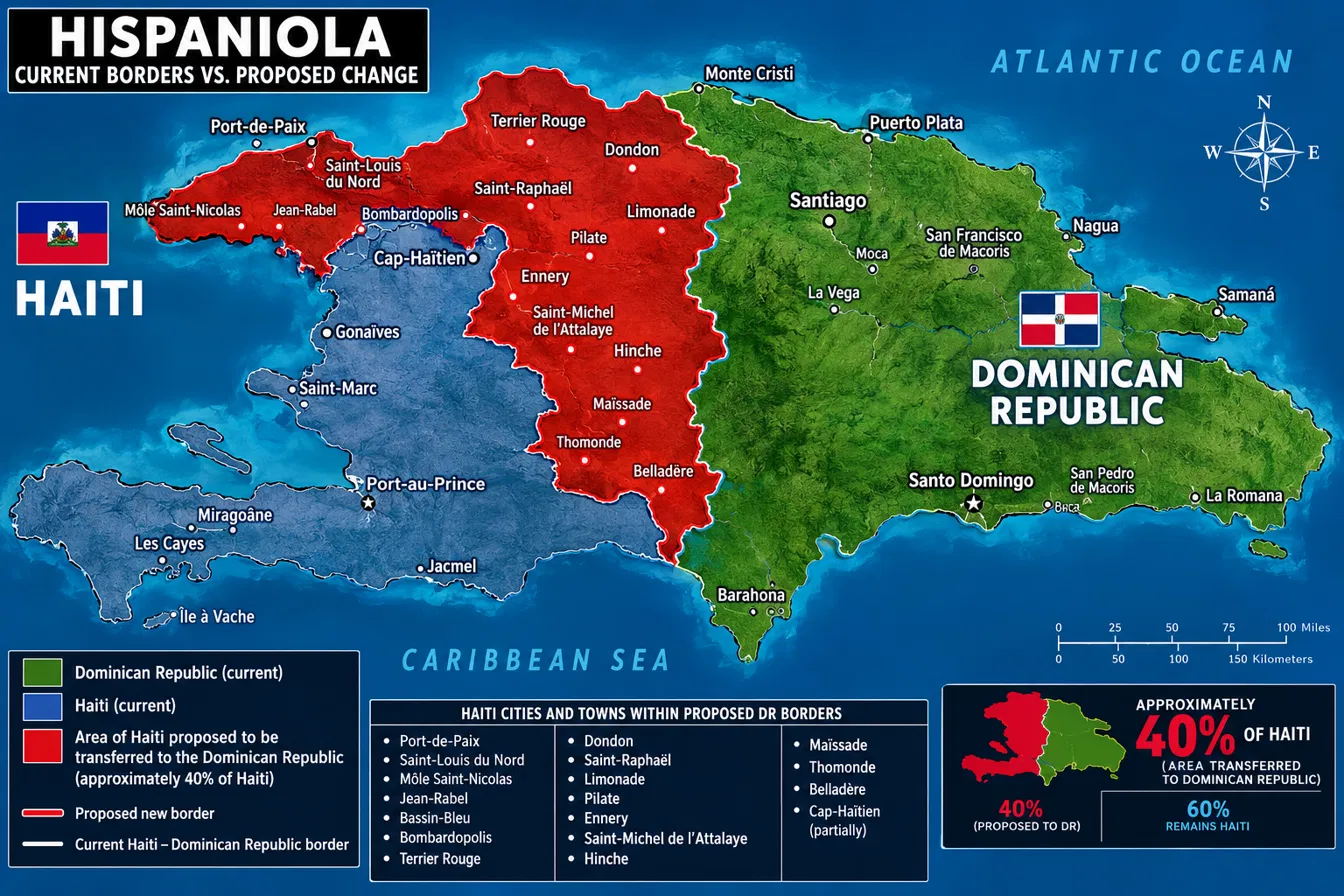
Look at the map below and find the red. That is not a war zone. That is not empty land. That is Cap-Haïtien, Port-de-Paix, Hinche, Môle Saint-Nicolas — towns where people are cooking dinner right now, walking children home, arguing about football, burying their dead.
A Dominican political movement says that land is not Haiti.
The thing that is no longer whispered
For generations, the idea that the Dominican Republic should take back land from Haiti lived where dangerous ideas usually live. In bars. In comment sections. In the mouths of men nobody had to take seriously.
It does not live there anymore.
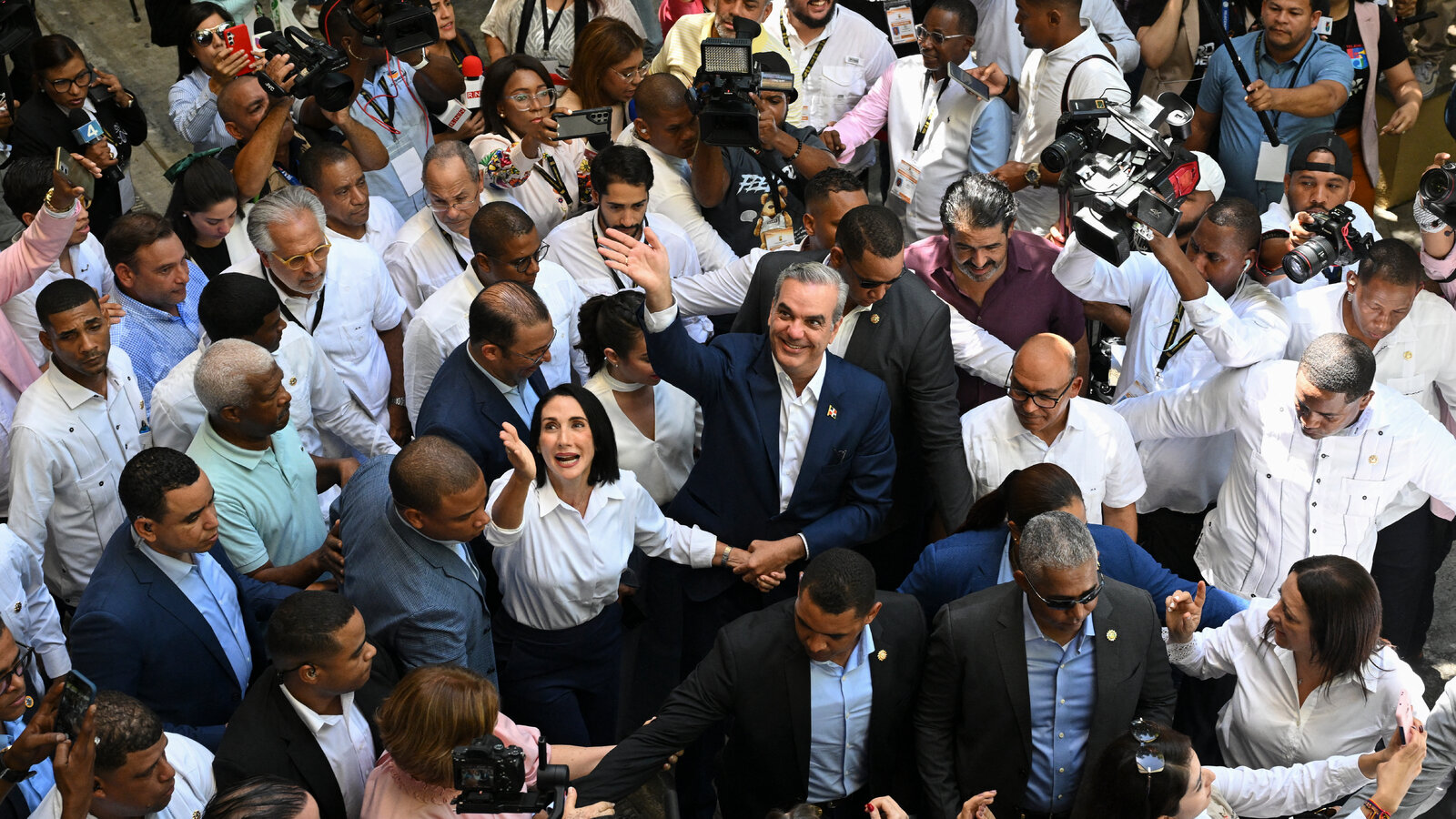
Carlos Peña, leader of Generación de Servidores, has pledged that if his party takes power it will reclaim land that is internationally recognized as Haitian. He has put the figure at nearly 40 percent of present-day Haiti, and later at least 30 percent. He says the land would be absorbed into the Dominican Republic and carved into four new provinces, named for Dominican founding figures: Francisco del Rosario Sánchez, Matías Ramón Mella, Gregorio Luperón, and Pedro Santana.
Four provinces. Names already chosen. That is not a grievance. That is a filing cabinet.
He does not treat this as folklore. He treats the 1777 Treaty of Aranjuez as the only valid line, and rejects the later settlements that built the modern border — those tied to 1795, 1929, and 1936. Asked how his party would pursue the claim, he said it would do so by all means.
by all meansThree words. On an island with this history, three words are enough to keep people awake.
The border, treaty by treaty
- 1777The Treaty of Aranjuez draws a colonial line between Spanish and French territory. Peña treats this, and only this, as valid.
- 1795Basel hands Spanish Santo Domingo to France, unsettling everything the earlier treaty assumed.
- 1929A Dominican–Haitian treaty fixes the modern frontier.
- 1936A revision adjusts and confirms it. This is the line the world recognizes today, and the one the Dominican government still recognizes.
What the government actually says
Here is where honesty matters more than heat.
This is not, today, a war plan issued by the Dominican state. President Luis Abinader's government still recognizes the existing frontier, marked by hundreds of official boundary posts running from the Dajabón River in the north to the Pedernales River in the south.
In early September 2026, Dominican and Haitian officials sat down together in Dajabón and talked about migration, security, trade and the border. Both sides restated respect for each other's sovereignty. Diplomacy is still the official language of this island.

But a border that is respected on paper can still be a hard place to stand next to.
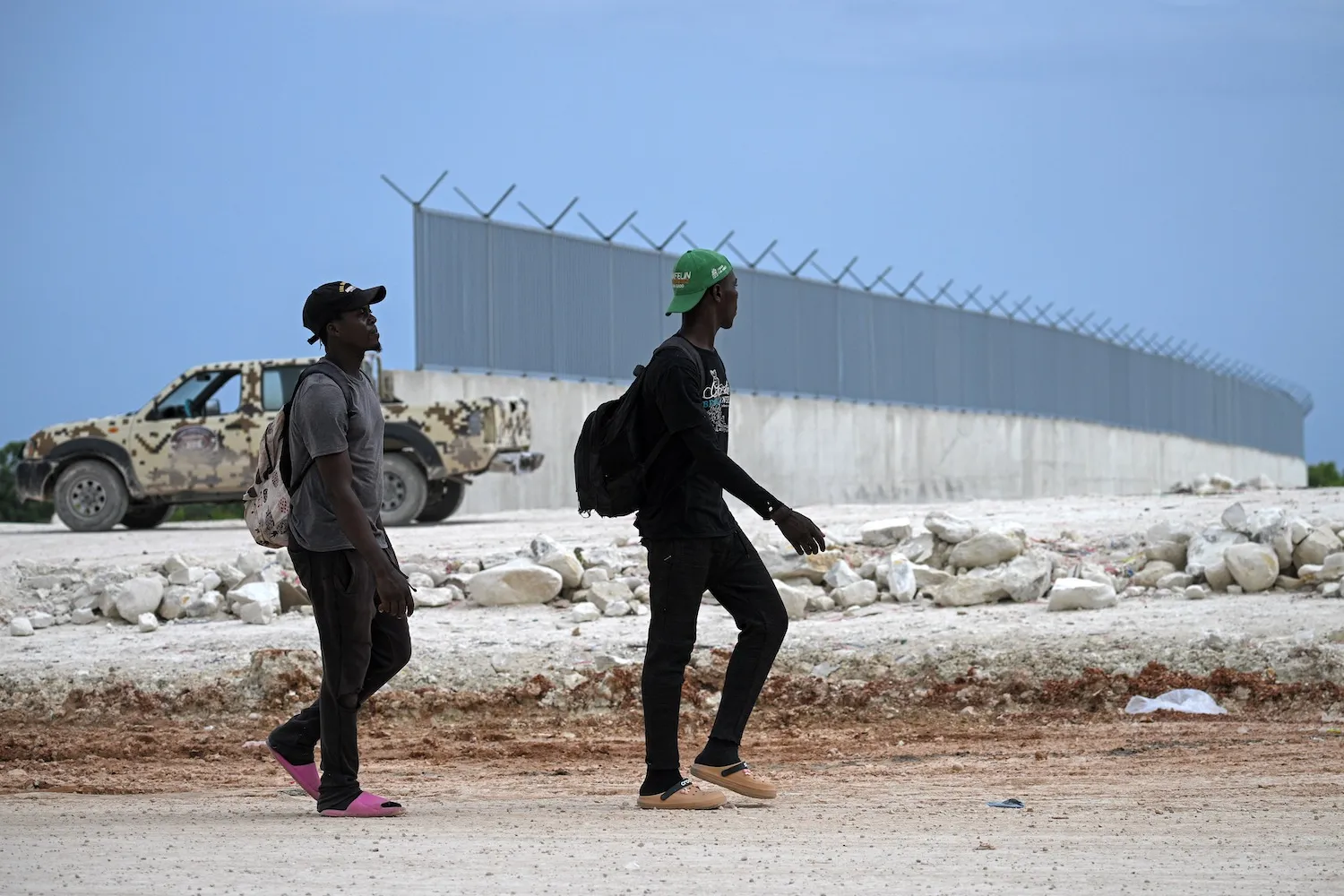
Santo Domingo is building a fence. It is deporting undocumented migrants. It has flooded the frontier with troops. That is harsh policy, and harsh policy is legal. It is not annexation.
The trouble is that harsh policy and a territorial claim are not enemies. They are neighbours. One makes the other easier to imagine.
What it already costs, before anybody invades
You do not need an army crossing a border to produce suffering on a border. That work is already being done, quietly, day after day, by paperwork and buses.
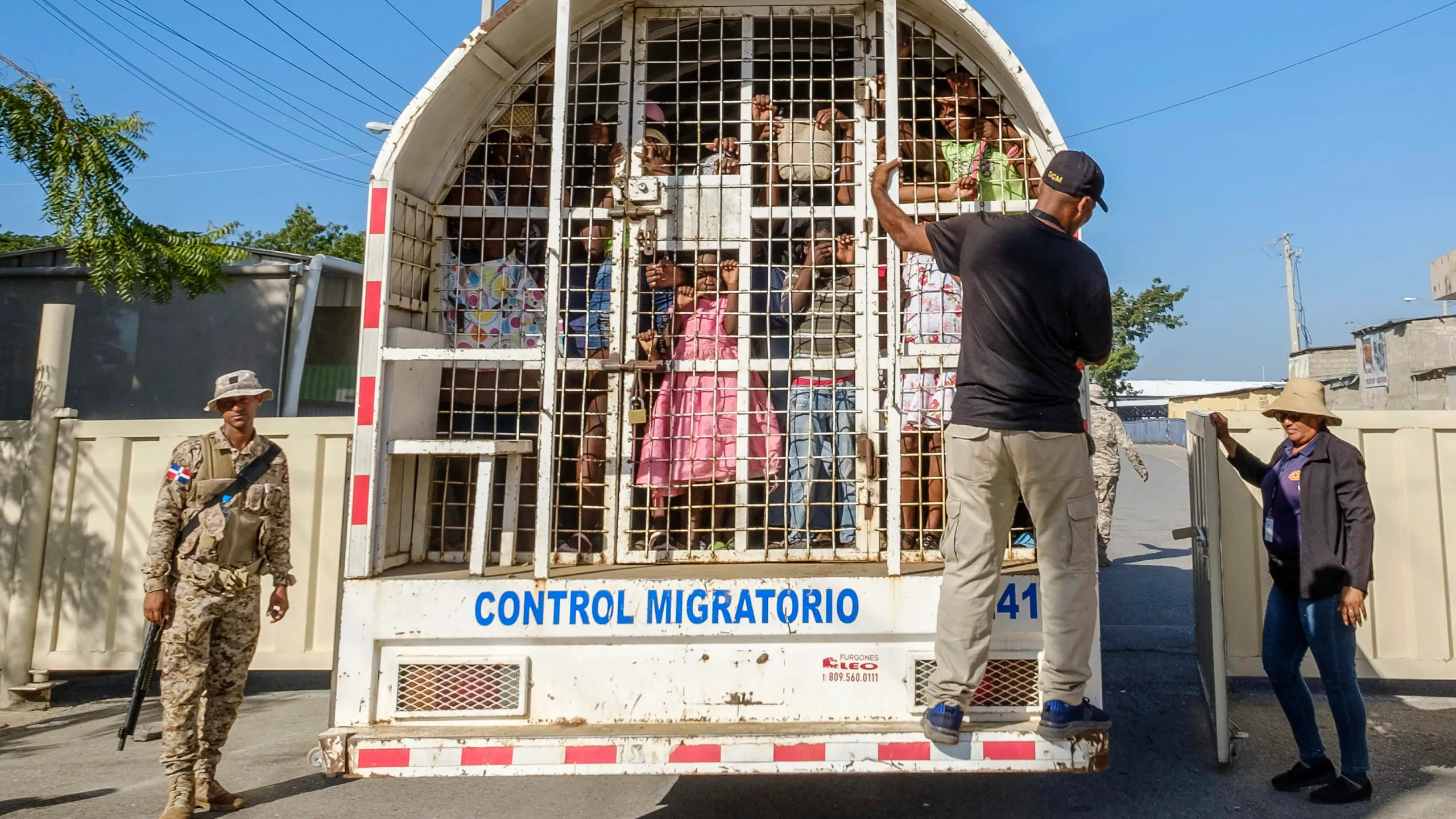
Thousands have been sent back across the line. Some had lived in the Dominican Republic for years. Some were born there. Many crossed for work in cane, in construction, in kitchens, doing the jobs every economy needs and no economy wants to discuss.
They arrive in Haiti carrying what they could hold.
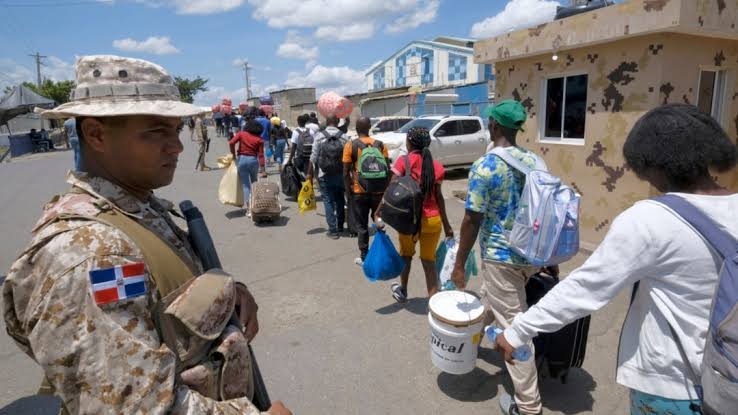
And when the crossings close, the panic is immediate — because a border is not an abstraction to the people who live off it. It is groceries. It is medicine. It is Tuesday's market.
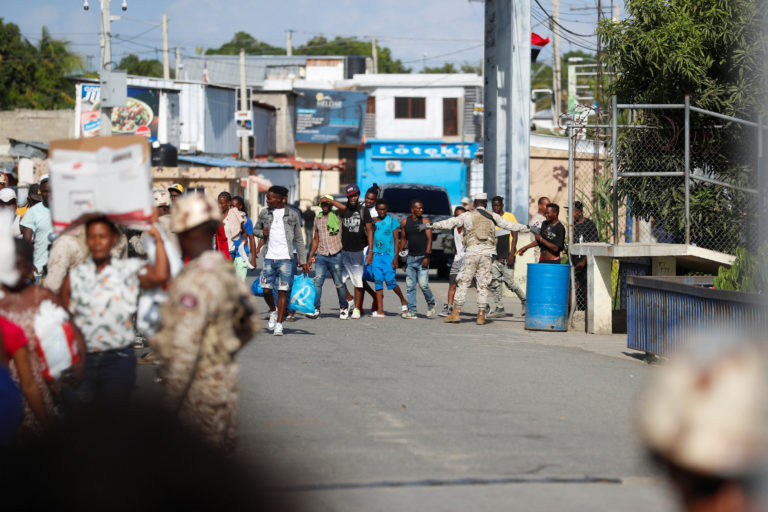
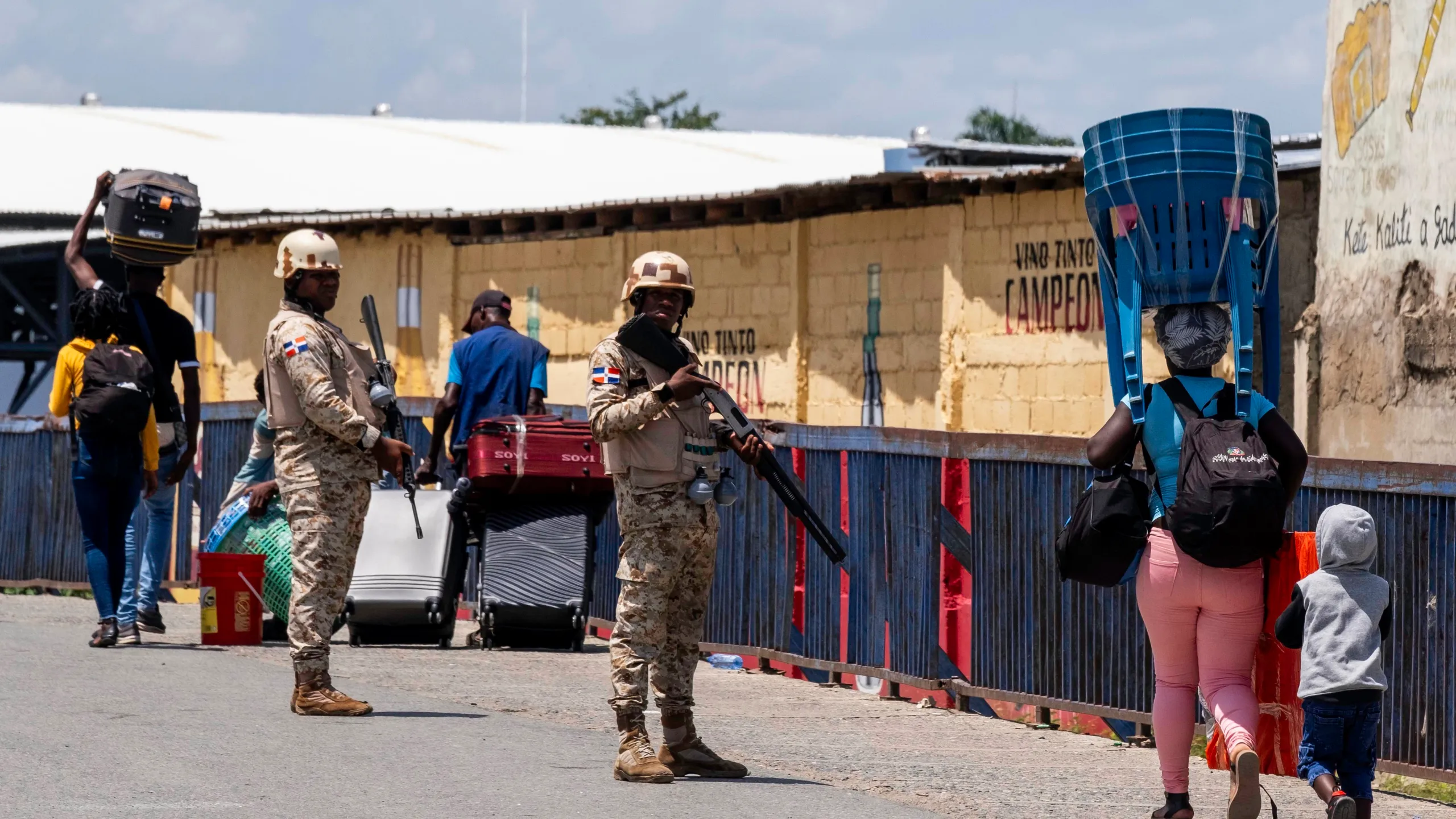
That canal fight is worth remembering, because it is this whole story in miniature. It began as irrigation. It became pride, sovereignty, history and blood. On this island, nothing stays small.
Two countries that are nothing alike
If any government ever tried to seize a third or more of Haiti, the island would not face a polite legal seminar. It would face the raw question of force. And that question already has an answer.
The balance of force
Haiti has rebuilt a small armed force after years with no standing army. Gangs choke much of the capital. The state is fragile. Its security depends on a thin international mission that arrived late, arrived understrength, and was never designed to fight a neighbouring army.
The Dominican Republic has a far larger and better funded military, tens of thousands of active troops, a defence budget many times Haiti's, and a frontier already held by thousands of soldiers, drones and a growing wall. Washington and other partners treat it as a functioning ally and security partner.
That imbalance is the danger. A border war here would not be two equals colliding. It would be a strong state pressing a weak one that cannot easily call a great power to its side.
The scar this island already carries
In 1937, on this same frontier, Dominican forces killed thousands of Haitians. It is remembered as the Parsley Massacre, named for the word people were made to say, because how you pronounced it decided whether you lived.
A river ran through it. People still call it the Massacre River.
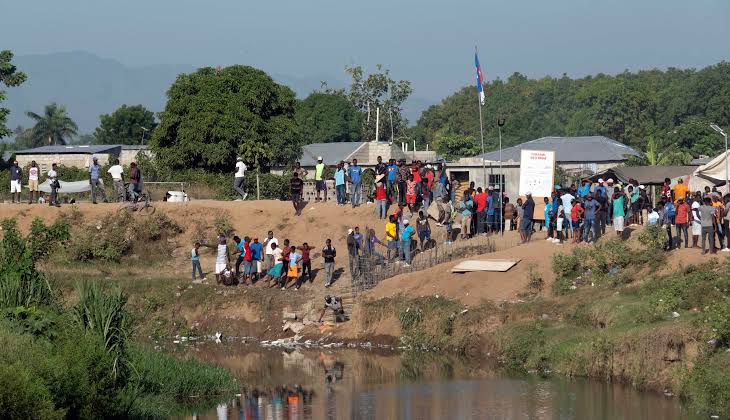
This is not a prediction of 2026. Nobody serious is saying 1937 is about to repeat itself next month. But it grew out of this exact soil, and it explains why Haitians hear a phrase like by all means differently than a foreigner does.
History is not background on this island. History is the argument.
Three ways this can go
Nobody knows which of these happens. All three are possible from where the island stands today.
It stays talk
Generación de Servidores never wins power. The claim stays a campaign slogan, quoted at rallies and ignored in ministries. The Dajabón talks continue. Trade keeps moving, because both economies need it to. In twenty years this article reads like a false alarm — which is the best thing an article like this can ever become.
It hardens without a shot
The party never governs, but the idea does. Its language migrates into mainstream politics. Deportations widen. The wall grows. Haitians born in the Dominican Republic find their papers questioned. Nobody invades anything, and yet a generation grows up stateless on one side and resentful on the other. This is the quiet outcome. It is also the one that history says is most likely.
It moves
A crisis arrives — a collapse in Port-au-Prince, a killing on the frontier, an election won on anger — and a government decides the moment has come. Then this stops being a territorial adjustment. It becomes mass displacement, people driven from their homes for who they are, and a catastrophe the region would spend a century explaining. This remains a possibility, not a fact. But once armies move, civilians do not get a second chance to debate treaties.
For now, there is no invasion. No Haitian province has been renamed. No new line has been drawn in blood.
The claim, though, is real. A Dominican party has promised to take a vast slice of Haiti if it wins. Haiti is weaker. The Dominican Republic is stronger and better connected. And the Caribbean cannot pretend that words like by all means are harmless when they are aimed at another people's land.
A word about where I am standing
I do not take a side between the Dominican Republic and Haiti in this piece, and I am not going to pretend to be a blank page either.
I grew up in Miami from the age of four until I was twenty-nine, in classrooms and neighbourhoods where half the Caribbean and Latin America sat at the same lunch table. Haitian, Cuban, Jamaican, Mexican, and a dozen more flags on one block. Some of those people are still my closest friends today, decades later.
So when I read a proposal to redraw a border by all means, I am not reading about strangers. I am reading about the families of people who fed me at their kitchen tables.
That is not a political position. It is just where I am standing when I tell you this. The facts above are the facts. What you do with them is yours.
The Haiti 1804 Fund
Reading about this is one thing. Doing something about it is another, and it does not have to be large.
Bahama Drama runs a private fund that sends help directly to Haitian families — people living through the crisis at home, and Haitians recently deported from the United States who arrive with nothing but what they carried. It goes to the practical things that buy a person time: food, transport, documents, rent, a first step back.
No government receives any of it. It goes to people.
The money is carried the last mile by people I know and trust on the ground in Haiti. Their names and their locations are not published here, and they will not be. In Haiti today, being known to have money or access to it makes you a target for kidnapping and ransom. Their anonymity is not evasion. It is what keeps them alive to do the work.
This is not a new arrangement being invented for a fundraiser. It is a network that already moves, already knows who is in need, and already knows how to reach them. Anyone who knows how Haiti actually works will understand why it is run this way.
Give to the Haiti 1804 Fund Payments are processed securely by Stripe, which deducts a standard processing fee. This is a privately run fund operated by Bahama Drama, not a registered charity, so contributions are not tax-deductible.Now I want to hear you
This comment section is open, and it is not decoration. Bahama Drama readers include Haitians, Dominicans, Bahamians and people who have lived on both sides of this line. You know things no reporter does.
- Have you or your family crossed this border, worked across it, or been sent back over it? Tell it.
- If you are Dominican, what do people in your community actually say about this claim?
- What would a real solution look like — on migration, on citizenship, on trade, on the wall?
- What should CARICOM and the wider Caribbean be doing now, before anyone has to react instead of act?
Argue the claim, not the people making it. Then scroll down and write.
Join the discussion